
Most of us have had a dream in which years went by. We moved house, grew older, lost someone, and woke to find the clock had moved twenty minutes. We shrug and get on with the day. The Yoga Vasishtha does not shrug. It asks why we are so sure the day we woke into is any longer, or any more solid, than the dream.
In the previous episode, Death went looking for a brahmin born of the sky and could not lay a hand on him, because he had no past karma and had never taken himself to be a body. The world, Vasishtha said, is made of mind in the same way. He could tell the point had not settled for Rama, so he promised a story that would settle it: the tale of the mandapa, the inner hall. Rama asked him to keep it brief. It runs to forty-six sargas.
This is the Leela Upakhyana, Sargas 15 to 60 of the Utpatti Prakarana, the book on creation, told by Vasishtha to Rama. Long stretches describe a war and a burning city, and I pass over those in a few lines. Otherwise I keep the sequence and the events as the text gives them; only the telling is mine.
The Story at a Glance
| Text | Yogavasishtha (Maharamayana), also known as Yoga Vasistha, Utpatti Prakarana, Sargas 15–60 |
|---|---|
| Narrator | Vasishtha, to Rama |
| Main characters | Queen Leela (also written Lila), King Padma (who becomes Viduratha), the goddess Saraswati; in the story within the story, the brahmin Vasishtha and his wife Arundhati |
| The wish | Leela won a boon from Saraswati: when her husband died, his soul would not leave the inner hall of their palace |
| The discovery | Three lives nested in one small space: a hill-village brahmin dead eight days, King Padma's reign inside his house, Viduratha's seventy years inside Padma's palace |
| Outcome | Viduratha dies in battle and his soul returns into Padma's body; Padma rules with two Leelas, free while living, and finally attains liberation |
| Key teaching | The story was told to cure "the fault of the seen": let go of the world's solidity, since its space and time are imaginings of the mind (Utpatti Prakarana, Sarga 60, Verse 1) |
A Queen Who Wanted Her King to Last
"Long ago," Vasishtha began, "there was a king on this earth named Padma." His queen was Leela. The text spends verse after verse on her beauty, but one detail says more. She was like his reflection, sad when he was sad, glad when he was glad. Only when he was angry did the likeness fail: then she was simply afraid.
Years of happiness went by. Then one day a thought came to her. This husband is dearer to me than my life. How can he be free of age and death? She called learned brahmins and asked them again and again. Austerity and discipline can win every power, they told her, but deathlessness is never won. So she made a plan of her own. If I die first, she thought, I will be free of all sorrow. But:
अथ वर्षसहस्रेण भर्तादौ चेन्मरिष्यति ।
तत्करिष्ये तथा येन जीवो गेहान्न यास्यति ॥atha varṣasahasreṇa bhartādau cen mariṣyati |
Yogavasishtha (Maharamayana) — Utpatti Prakarana, Sarga 16, Verse 27
tat kariṣye tathā yena jīvo gehān na yāsyati ||
Meaning: And if my husband should die before me, even a thousand years from now, I will see to it that his soul does not leave this house.
Without telling him, she began to worship Saraswati, whom the text also calls Jnapti, the goddess as pure knowing. She ate only after every third night, a hundred times over, and all the while served her husband exactly as before so that he never guessed. At the end the goddess appeared and offered a boon. Leela asked for two: that when her husband died his soul would not leave this inner hall, and that the goddess would come whenever she called. "So be it."
The wheel of time turned, and Padma, his body cut in battle, died in that very hall. Leela withered like a lotus without water, wept, fell silent, wept again, and was ready to die herself.
Flowers That Would Not Wilt
A voice came from the sky, like the first rain on a fish in a drying pond. "Child, cover his body with flowers and keep it here. The flowers will not wilt and the body will not decay. Soon he will be your husband again, and his soul will not leave this hall."
Leela sat beside him, the text says, like a poor woman sitting on a buried treasure she cannot use. At midnight she called the goddess. "Where is my husband? What is he doing? Take me to him. I cannot live alone." Saraswati spoke of three kinds of space: the space of the mind, the pure space of consciousness, and ordinary space. When awareness jumps in a blink from one place to another, what lies in between is the space of consciousness. Rest there, free of every thought, and by my boon you will reach him quickly.
Leela sank into samadhi, left her body as a bird leaves its nest, and found her husband in the very space of that room. He sat on a throne in a crowded court, a youth of sixteen, his old age gone. Around him sat the same ministers, scholars and servants she knew, each in his usual place, as if the whole court had moved to another city with its king. No one saw her, just as no one can see a city another person is imagining. Had everyone in their city died too, she wondered.
She came back, woke her maids and had the court called in the middle of the night. Lamps were lit, the ministers hurried in, and from a golden seat beside the empty throne she saw all of them, alive, exactly as before. Back beside the flowers, the real question took shape. Our people are here, and they are there. A mountain appears both inside a mirror and outside it, and so does creation in the mirror of the mind. Which one is the illusion, and which one is real?
A Brahmin Named Vasishtha
Saraswati came in the form of a young girl. Leela told her: this world where we sit is real; the one where my husband is now is made up. The goddess took that apart gently. Where did the earth of that world come from? From my husband's memory, said Leela. "Memory is as empty as the sky," said Saraswati, "so what grows from it is sky too." Then this world is the same, Leela said. "Yes. I see it so."
Then came the story inside the story. Somewhere in the space of consciousness stands the old hall of samsara, with the sky for its dome, Meru for its pillar and the sun for its lamp. In one corner, under a clod that is a mountain range, lies a hill village. A brahmin lived there with his wife and sons, his sacred fire and his cows, welcoming every guest. He was like the sage Vasishtha in learning and conduct, the goddess added, though he had nothing to do with teaching Rama. His name was in fact Vasishtha, and his wife was Arundhati.
One day, sitting on the slope, he saw a king below riding out to hunt with banners and a roaring army. How lovely it is to be a king, he thought. When will I fill the ten directions with my elephants and banners? The wish stayed with him all his life. When his death drew near, his wife worshipped Saraswati as Leela had, and asked that her husband's soul should not leave their house. The goddess granted it.
He died. His soul stayed in the space of that house, and the force of his old wish made it a mighty king. Arundhati, her heart split by grief like a dried bean pod, left her body and followed him. "Today is the eighth day since he died," said Saraswati. "That brahmin is your husband, who became a king. And Arundhati is you."
How could a kingdom with mountains and ten directions sit inside a house? It sounded like an elephant tied inside a mustard seed. And there was a second problem:
अष्टमे दिवसे विप्रः स मृतः परमेश्वरि ।
गतो वर्षगणोऽस्माकं मातः कथमिदं भवेत् ॥aṣṭame divase vipraḥ sa mṛtaḥ parameśvari |
Yogavasishtha (Maharamayana) — Utpatti Prakarana, Sarga 20, Verse 27
gato varṣagaṇo 'smākaṃ mātaḥ katham idaṃ bhavet ||
Meaning: Supreme goddess, that brahmin died eight days ago, yet whole years of our lives have gone by. Mother, how can this be?
Time Has No Length of Its Own
"Just as distance has no real length," said Saraswati, "time has no real length either." Then she described death:
अनुभूय क्षणं जीवो मिथ्यामरणमूर्च्छनम् ।
विस्मृत्य प्राक्तनं भावमन्यं पश्यति सुव्रते ॥anubhūya kṣaṇaṃ jīvo mithyāmaraṇamūrcchanam |
Yogavasishtha (Maharamayana) — Utpatti Prakarana, Sarga 20, Verse 31
vismṛtya prāktanaṃ bhāvam anyaṃ paśyati suvrate ||
Meaning: After passing through the false swoon of death for a moment, the soul forgets its former state and sees another.
In that blink it feels "I am here." It sees a body with hands and feet. Then the memories arrive, as fruit follows the flower: I am this man's son, I am so many years old, this is my home, I was a child and grew up. It feels that an age has passed in an instant. King Harishchandra lived twelve years in a single night, she reminded Leela, and to someone parted from the one they love, a day feels like a year.
As for space: the brahmin's soul is inside his house, and inside that soul-space lies this whole earth, like a bee shut in a lotus, with this city in one corner of it. The house itself still stands, untouched. Within every atom of consciousness there are worlds within worlds. Leela asked to be taken to that hill village. Not in this body, said the goddess; first she would need practice, until the sense of being this body thinned the way a dream body vanishes once you know you are dreaming.
The House Where She Had Died
That night the two sat beside the flower-covered king and went into samadhi, still as figures carved on a jewelled pillar. They rose hand in hand through immense skies. Vasishtha later says it outright: they never left the room. The whole journey happened within a hand-span of its space.
In the hill village the house was sunk in grief. Leela's will had by now become true will, and the household saw two radiant women, like two moons in the house. The eldest son, Jyeshtasharma, scattered flowers at their feet and begged these "forest goddesses" to end his sorrow: his loving parents had gone to heaven and the world felt empty. Leela laid her hand on his head and his misery lifted. (Why not appear to him as his mother, Rama later asked. For one who has seen through the body, Vasishtha replied, whose son is anyone?)
Leela put it together. In the space of this very room my husband was a brahmin, died and became Padma; inside Padma's palace he died again and became a king again. Of her three husbands, the goddess agreed, the brahmin had been burned to ashes, Padma lay under the flowers, and the third was a king now asleep in "I am king, I am strong, I am happy."
Walking through the village, Leela remembered her old self, a thin, white-haired brahmin woman with hands roughened by kusha grass, and some eight hundred births before that. "This is my calf Karnika, who has stopped eating since I went. This is my water-carrier, who has been crying for eight full days." Then, quietly: "He wished hard to be a king soon. That is why in eight days he gained a kingdom that feels to him like ages."
Seventy Years Since Yesterday
The two flew out past the shell of the universe into boundless consciousness, where Leela saw countless universes like specks of dust in a sunbeam. Then, from Padma's hall, she dropped into that same space and broke through the shell of the world her husband's mind had made.
A war was raging there. The text describes it over many sargas, even pausing for Rama to ask who counts as a true hero; the two women watched it from a sky-chariot conjured by the mind. At night they entered the king's palace. Everyone but the king fell asleep. He woke, took flowers from the basket by his pillow, sat cross-legged on the floor and offered them at their feet. His minister, woken by the goddess, told his story: a king of the Ikshvaku line named Viduratha, son of Nabhoratha, crowned at ten when his father left for the forest, ruling by dharma ever since.
Saraswati touched his head. "King, remember your former birth." The darkness cleared. He remembered being Padma, and was swept away with wonder. "Goddesses, what is this? For me, who died, only a single day..."
गतमद्येह जातानि वयो वर्षाणि सप्ततिः ।
स्मराम्यनेककार्याणि स्मरामि प्रपितामहम् ॥gatam adyeha jātāni vayo varṣāṇi saptatiḥ |
Yogavasishtha (Maharamayana) — Utpatti Prakarana, Sarga 41, Verse 30
smarāmy anekakāryāṇi smarāmi prapitāmaham ||
Meaning: "...has gone by, and yet here seventy years of my life have passed. I remember a great many deeds. I remember my great-grandfather."
Right after the swoon of death, Saraswati told him, in that same moment, in that same house and that same space, this world rose up in his mind, as a river leaves one whirlpool and forms another, as a dream of a moment holds a hundred years. "In truth you were never born and have never died."
Vasishtha paused the story here for Rama. To one who has not woken, he said, the world is as hard as diamond, like the ghost a child sees in the dark. Rama pressed him on dreams and waking, and he answered:
एतदास्तामिदं तावद्यज्जाग्रदिव मन्यसे ।
विद्धि तत्स्वप्नमेवान्तर्देशकालाद्यपूरकम् ॥etad āstām idaṃ tāvad yaj jāgrad iva manyase |
Yogavasishtha (Maharamayana) — Utpatti Prakarana, Sarga 42, Verse 23
viddhi tat svapnam evāntar deśakālādyapūrakam ||
Meaning: Let that rest for now. What you take to be waking, know that it too is only a dream, seen from the inside, one that does not fill the space and time of any other.
The commentary spells out the argument. We call a dream unreal because it never spills into waking space and time. But waking never spills into the dream either. On that test the two stand level.
Two Leelas, Two Wishes
Viduratha begged to go with them, and to take his minister and his young daughter. "You will die in this battle," said Saraswati, "and regain your former kingdom. They will come too." Just then a man rushed in: the enemy was at the gates and the city was on fire. The queen ran in with her maids, her garlands torn, and the king left her in the goddesses' care and went out to fight.
Leela stared at the queen as if into a mirror. Same face, same body, and her name, too, was Leela. How could she be me? What is inside appears outside in a moment, said Saraswati; Padma had died holding that longing, and here it had taken form.
The second Leela asked a boon: wherever her husband went after death, she wanted to be his wife there, in this very body. It was granted. The first Leela felt a pang. Why could she go with her body when I could not? "I do nothing for anyone," said the goddess. "Each being's own power of knowing brings what it has long reached for. While you worshipped me, the wish that kept rising in you was 'If only I could be free.' That is what you were given."
Then why, the two Leelas asked, was their husband losing? The same law, said Saraswati. The enemy, King Sindhu, had long worshipped her for victory. Viduratha had worshipped her thinking "May I be free." So Sindhu would win, and Viduratha would be freed.
Back Under the Flowers
Viduratha fell, and Sindhu entered the capital as king. Before her husband breathed his last, the second Leela fainted and died; she had once asked never to be a widow. Small as a bird she flew, guided by her daughter, across the universe into Padma's hall, and sat fanning the flower-covered body. My lord fought hard, she thought; let him sleep a while.
Then Viduratha died. His soul was led to Yama, who found no wrong in his deeds and sent him back to the body lying under flowers. Saraswati held the soul back for a moment. How long had it been here? "A month," she told Leela. The ministers had found Leela's own body lifeless, burned it with sandalwood and ghee, and mourned her. "Today is the thirty-first day."
The goddess let the second Leela see them, then released the soul. It entered Padma's nostril as wind enters a hollow bamboo, and his face bloomed like a lotus after rain. "Who is there?" he called. "Command us," said both Leelas, and the first explained: I am your wife from before, this is your second wife whom I brought for you, and this is Saraswati, who brought us back from the other world. Padma fell at the goddess's feet and asked for wisdom, long life and wealth. She blessed him and vanished, and at dawn the palace woke to music. People in many lands sang of how Leela brought the king and queen back from the other world. Padma, knowing the truth of the Self, ruled with both Leelas for eighty thousand years, free while living, and then attained the final freedom.
Why Vasishtha Told It
Vasishtha then told Rama what all of this had been for:
एतत्ते कथितं राम दृश्यदोषनिवृत्तये ।
लीलोपाख्यानमनघं घनतां जगतस्त्यज ॥etat te kathitaṃ rāma dṛśyadoṣanivṛttaye |
Yogavasishtha (Maharamayana) — Utpatti Prakarana, Sarga 60, Verse 1
līlopākhyānam anaghaṃ ghanatāṃ jagatas tyaja ||
Meaning: Rama, I have told you this spotless story of Leela to cure the fault of the seen. Let go of the world's solidity.
Rama still asked what any listener would. Eight days in the village, a month in Padma's palace, seventy years for Viduratha: different universes, or one time that only looks different? Whatever a person perceives at a time, Vasishtha answered, is what that person lives. A moment can be an aeon and an aeon a moment. A night is endless to the grieving and gone in a flash for the happy. To people dizzy on a boat the land is turning; to people on the shore it is not. "The world," he said, "is as it is perceived."
The Core Message
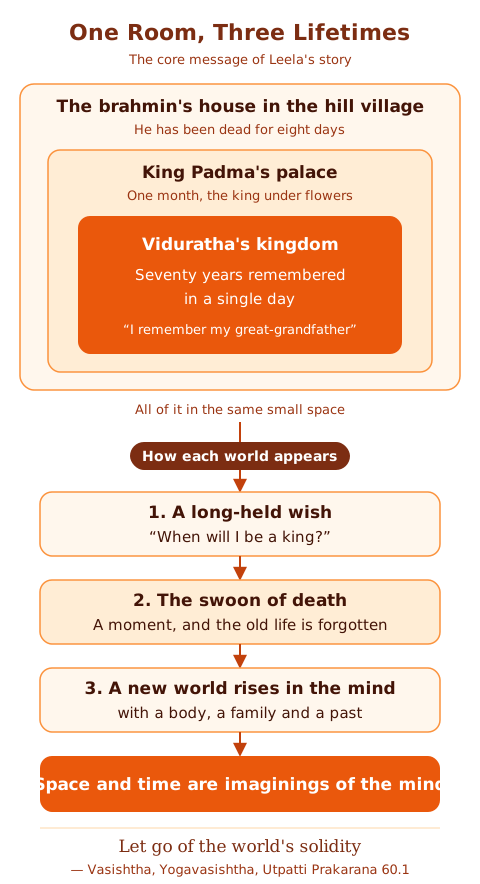
The Leela story starts from the most ordinary fear there is, the fear of losing someone, and uses it to open the strangest teaching in the Yoga Vasishtha. Leela wanted her husband to stay in one room. He did. Inside that room she found a kingdom, and inside that kingdom another life with seventy years of memories. Eight days, one month and seventy years turned out to be the same stretch of time seen from three places.
The reason the text gives is simple. Length in space and in time is not in things; it is in the mind that lives them. At death the soul passes through a moment's swoon, forgets, and wakes into a world that already comes with a past. Waking life is no different, and we never step outside it to measure it.
The second thread is just as striking. Every world in the story grows out of a long-held wish. The brahmin wanted to be a king and became one. Arundhati and Leela wanted the soul to stay in the house, and it stayed. The second Leela wanted to remain his wife, Sindhu wanted victory, Leela and Viduratha wanted freedom, and each got exactly that. Saraswati grants nothing from outside. Whatever a mind keeps reaching for, it eventually lives inside.
In Everyday Life
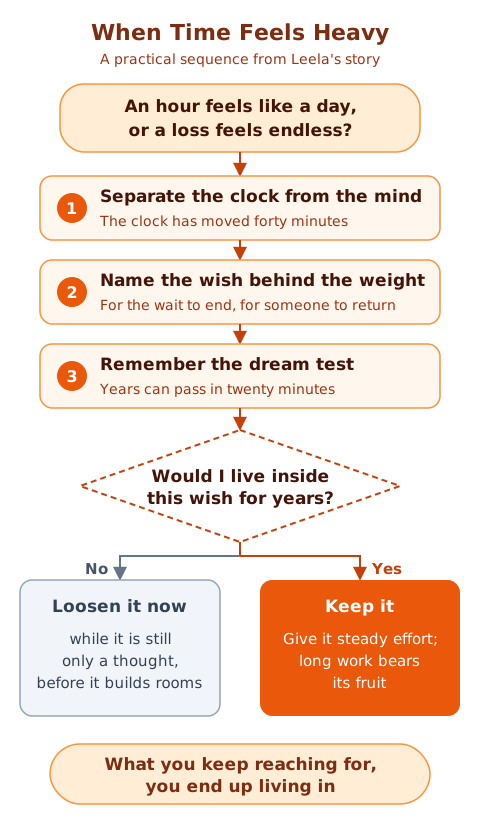
None of us will cross into another universe, but time stretching and shrinking with the state of the mind happens every week. An hour in a hospital corridor lasts all afternoon; a good holiday is gone in a blink. Apart from the one you love, as Saraswati said, a day feels like a year.
So when a stretch of time feels unbearable, separate the clock from the mind. The clock has moved forty minutes. The heaviness usually belongs to a wish: for the waiting to end, for someone to come back, for things to have gone differently. Name that wish honestly.
Then ask the question this story keeps putting to us. Is this a wish I would be glad to live inside for years? If yes, give it steady effort; the text insists that what a person works at for long bears fruit. If no, loosen your grip now, while it is still only a thought, before it builds its rooms around you. And when something feels utterly solid, remember the dream in which years passed in twenty minutes. The problem does not vanish, but you get a little room inside it.
Author's Note
Key Terms
| Term | Meaning |
|---|---|
| Mandapa (मण्डप) | The inner hall of a house or palace; in this story, the small space that holds whole worlds |
| Chidakasha (चिदाकाश) | The space of consciousness, in which every world appears |
| Chittakasha (चित्ताकाश) | The space of the mind, filled with its own impressions |
| Jnapti (ज्ञप्ति) | Pure knowing; a name for the goddess Saraswati in this story |
| Ativahika deha (आतिवाहिक देह) | The subtle body of thought, in which one travels after death or in deep meditation |
| Vasana (वासना) | A deep-rooted wish or latent tendency that shapes the world one experiences |
| Satyasankalpa (सत्यसंकल्प) | One whose will comes true; Leela gains this as her identification with the body fades |
| Drishya-dosha (दृश्यदोष) | "The fault of the seen": taking the visible world to be solid and real in itself |
Sources
- Yogavasishtha (Maharamayana) — Utpatti Prakarana, Sargas 15–17 (Padma and Leela, the boon, Padma's death and Leela's first vision)
- Yogavasishtha (Maharamayana) — Utpatti Prakarana, Sargas 18–22 (the brahmin of the hill village, and Saraswati's teaching on death, space and time)
- Yogavasishtha (Maharamayana) — Utpatti Prakarana, Sargas 23–30 (the journey to the hill village, Leela's memory of past births, the countless universes)
- Yogavasishtha (Maharamayana) — Utpatti Prakarana, Sargas 31–40 (the war in Viduratha's kingdom)
- Yogavasishtha (Maharamayana) — Utpatti Prakarana, Sargas 41–45 (Viduratha remembers, Vasishtha on dream and waking, the second Leela's boon)
- Yogavasishtha (Maharamayana) — Utpatti Prakarana, Sargas 46–51 (the war with Sindhu, why Viduratha loses, the fall of his city)
- Yogavasishtha (Maharamayana) — Utpatti Prakarana, Sargas 52–57 (the deaths of the second Leela and Viduratha, the teaching on death, Yama sends the soul back)
- Yogavasishtha (Maharamayana) — Utpatti Prakarana, Sargas 58–60 (Padma revived, his reign and liberation, and the purpose of the story)