
Most of us have said it at some point: if I can just get this one thing, I will be fine. A job, a house, a figure in the bank. Sometimes we even get it. And a little later the same restlessness is back, attached to something else.
In the previous episode, the goddess Sarasvati led Queen Leela through worlds that existed only in consciousness. A few sargas later Rama asked a pointed question: what exactly is this jiva, the self that takes itself to be the mind, and how does it stand to the Supreme Self? Vasishtha answered with one of the strangest stories in the book, about a demoness who did fierce austerity to become a needle.
The story of Karkati, also called the Suchika story, runs from Sarga 68 to Sarga 83 of the Utpatti Prakarana, the book on creation. Vasishtha tells it to Rama in Dasharatha's assembly, over more than one day. The sequence and the events are the original's; only the way of telling is mine.
The Story at a Glance
| Text | Yogavasishtha (Maharamayana), also known as Yoga Vasistha, Utpatti Prakarana, Sargas 68–83 |
|---|---|
| Narrator | Vasishtha, to Rama in Dasharatha's assembly |
| Main characters | Karkati the rakshasi, Brahma, the king of the Kiratas and his minister (also Indra, Narada and Vayu) |
| The hunger | A body vast as a cloud and a hunger nothing could fill; by austerity she won the boon of becoming a living needle that could enter every heart |
| The turn | As a needle she could hold only a drop and was more miserable than ever; a second austerity turned inward, and knowledge dawned through her own reflection |
| Outcome | She tested the king and his minister with riddles, found inner coolness in their answers, vowed to take no life, and became their friend and the protector of their land |
| Key teaching | Peace comes from understanding, not from getting what you want: "she came to an inner coolness, to rest" (Utpatti Prakarana, Sarga 82, Verse 2) |
A Hunger the Size of a Mountain
On the northern flank of the Himalaya, Vasishtha said, lived a rakshasi named Karkati, also called Vishuchika and Anyayabadhika, "she who harms without cause". She was black as lamp-black and so huge that she filled half the space between earth and sky, yet dried out and wasted like the Vindhya forest. Food fit for such a body was hard to find, and the fire in her belly was never satisfied.
One day she worked it out. If she could swallow every person in Jambudvipa, steadily, with every breath, her hunger would vanish as a mirage vanishes in the rain. But people are protected by mantras, medicines, austerity, charity and worship. Who could get past all that at once? "I will do the highest austerity with a mind that never tires," she decided. "What is hard to get is got by fierce austerity." She climbed a peak no other creature could reach and stood on one foot, eyes unblinking, through days, months and seasons of cold and heat.
Everything about her effort is admirable except its aim. Her patience and single-mindedness are exactly what the scriptures praise in a seeker. She aimed them at swallowing the world.
"Make Me a Living Needle"
After a thousand years Brahma came. Fierce austerity always bears fruit, Vasishtha remarks; through it even a poisoned fire turns cool. Karkati bowed to him in her mind and wondered which boon would end her hunger. Then it came to her: she would become a needle, a living one, and a double one, one of iron and one not of iron. As the second she would slip unseen into every heart, the way a scent enters with the breath, and eat the world at leisure. "There is no happiness greater than the end of hunger." Brahma said, "Daughter Karkati, rise. I am pleased. Ask for the boon you want." And she asked:
भगवन्भूतभव्येश स्यामहं जीवसूचिका ।
अनायसी चायसी च विधेऽर्पयसि चेद्वरम् ॥bhagavan bhūtabhavyeśa syām ahaṃ jīvasūcikā |
Yogavasishtha (Maharamayana) — Utpatti Prakarana, Sarga 69, Verse 8
anāyasī cāyasī ca vidhe 'rpayasi ced varam ||
Meaning: Lord of all that has been and will be, Creator, if you will grant me a boon, let me become a living needle, one not of iron and one of iron.
"So be it," said Brahma, and added terms of his own. She would be a vishuchika, a needle-sickness travelling in on the breath to pierce the heart. Her prey would be those who eat badly, live badly and act wickedly. She would reach the virtuous too, and for their cure Brahma gave a mantra on the spot. (The text records it; I have left it out.) So even the granted wish carried a limit she had not asked for.
A Needle With No Stomach
The huge rakshasi began to shrink: to the size of a cloud, a tree branch, a man, a cubit, a span, a finger, a bean, and finally a fine needle for sewing silk, slender as a lotus filament. Beside it, unseen, went the living needle, made of nothing but breath and the old intention. Her abandoned body was scattered by the winds like an autumn cloud.
Vasishtha does not hide his amusement. She had become a needle in order to eat, and a needle has no stomach. "She never thought of that. Such is the reach of foolishness." A mind fixed on one thing loses sight of everything else; she had thrown away her body like a blade of grass, and even that death felt pleasant because it served her want.
For years she roamed, piercing people as the sickness, and as the iron needle being dropped in the dust, sunk in mud and trodden underfoot. The telling runs so long that the assembly breaks for the evening and resumes at sunrise. And she was never satisfied:
पूर्वेणैव किलाह्ना सा तृप्ता रुधिरबिन्दुना ।
सूच्याः किमिव मात्यन्तस्तृष्णासूची सुदुर्भरा ॥pūrveṇaiva kilāhnā sā tṛptā rudhirabindunā |
Yogavasishtha (Maharamayana) — Utpatti Prakarana, Sarga 71, Verse 2
sūcyāḥ kim iva māty antas tṛṣṇāsūcī sudurbharā ||
Meaning: On the very first day, a single drop of blood had filled her, for how much can fit inside a needle? But the needle of craving is very hard to fill.
Then comes one of the most human laments in the book. "Why did I become a needle? Not one mouthful fits in me. Where are my great limbs, huge as rain clouds? I sink in mud, I am trampled by people's feet. I have no friend, no mother, no father, no body, no home. I long to die, and even that does not come. I threw away my own body like a fool who drops a wish-fulfilling gem thinking it is glass. I staged this whole drama myself, for my own ruin."
To me this is the honest centre of the story. No trickster god twisted her words; Brahma gave exactly what she asked. The result was more hunger, not less, because the hunger had never been in her stomach.
The Second Austerity
When her grief had run its course, the needle decided to do austerity again, to get her body back. She put away her intention of killing people and returned to the same peak; Narada later tells Indra that she rode there in the heart of a young vulture, which set her down and flew home as light as a man cured of an illness.
There she stood on her point, face turned upward. The trees filled her mouth with pollen and Indra sent bits of meat on the wind; she swallowed neither. Mud buried her, floods, storms, forest fires and hail beat on her for thousands of years, and she did not tremble. Then something happened that she had not planned. Withdrawn from all outer activity, she began to reflect on her own self, real and aware, and in time the light of knowledge rose in her. "She came to know what is to be known, by herself, with her own understanding."
Her tapas was scorching the worlds. Narada told Indra it was a needle, for seven thousand years; the Wind, sent to find her, was too awed to ask what she wanted; and the gods went to Brahma. Vasishtha turns to Rama: she had realised the supreme cause by examining her own awareness. One's own reflection is the true guru here, Raghava, and no other.
"What Would I Do With a Boon?"
Brahma arrived and called from the sky: "Daughter, take a boon." A needle has no mouth to speak with, so she only thought: "I am full. My doubts are gone. What would I do with a boon? I am at peace. For so long I was yoked to unwisdom, like a little girl to a ghost she imagined herself. Now it has calmed through my own inquiry. What are things wanted or unwanted to me?"
Brahma spoke again. "Take it anyway. Live a while on earth, and then you will reach the highest state; destiny has fixed it. Be a rakshasi of the Himalayan forest again. Since you know what is to be known, you will not torment the world. When you need food, you will take it lawfully and harm only the unjust." Her old name, "she who harms without cause", is quietly turned around.
"Why should I oppose what he has said?" Karkati thought, and in a blink the body grew back, limbs sprouting like shoots from a seed of thought. But the rakshasa nature, the text says, she shed through understanding, as a snake sheds its skin. She sat in lotus posture and went into meditation. Six months later she came out of it hungry, for as long as there is a body its nature does not go. What had changed was her answer to the hunger: "I must not eat another being except by right. Better to die than eat what is not justly come by. I was only mind wearing the illusion of a body. What are living and dying to me?"
A voice came from the sky. It was the Wind, pleased that she had dropped her rakshasa nature: "Go, Karkati, and wake the ignorant with knowledge. Whoever will not wake even when you teach him will be your rightful food." She came down the mountain into the land of the Kiratas. It was night.
The King Who Was Not Afraid
It was a darkness you could almost hold in your hand. On that night the Kirata king, a steady man named Vikrama, slipped out of his sleeping city with his minister on a hero's night round through the forest, armed with nothing but courage. Karkati saw them. Her first thought was the old one: food, two fools who do not know the Self. The second was new: "Perhaps they are men of real quality. I would rather perish with this body than eat a person of virtue. I will test them with questions."
She roared like a thundercloud: "Who are you, great minds or fools, walking into my mouth?" The king answered without a tremor. "Hey, spirit, where are you? Show yourself. Who is afraid of a voice like a bee's hum? What do you want? Tell me and I will give it." She liked that, and laughed, and in the flash they saw her: a black mass reaching to the sky, hair on end, tawny eyes. Both men stood exactly as before. "Nothing can confuse a mind that discerns," Vasishtha says.
The minister spoke calmly. "Why all this fury? The wise get what they need with a clear, even mind. Tell us what you want." Karkati thought: only someone who knows the Self is this fearless before death, and whoever meets the wise and does not ask is the lowest of people. "Knowledge of the Self is the highest of all qualities," she told them. "If you two have it, well and good. If not, I will eat you, as my nature is. Answer my questions."
A Net of Questions
The questions come in a long cascade, almost all riddles about one "atom". What single thing, counted as many, holds millions of universes like bubbles in the sea? What is space and not space, nothing and yet something? What goes and does not go? What fire does not burn? What light shines without sun, moon or stars? And:
कोऽणुस्तमःप्रकाशः स्यात्कोऽणुरस्ति च नास्ति च ।
कोऽणुर्दूरेऽप्यदूरे च कोऽणुरेव महागिरिः ॥ko 'ṇus tamaḥprakāśaḥ syāt ko 'ṇur asti ca nāsti ca |
Yogavasishtha (Maharamayana) — Utpatti Prakarana, Sarga 79, Verse 9
ko 'ṇur dūre 'py adūre ca ko 'ṇur eva mahāgiriḥ ||
Meaning: Which atom is both darkness and light? Which atom both is and is not? Which atom is far away and yet not far? Which atom is itself a great mountain?
Which instant is an aeon? What is won with a hundred efforts, and when won, nothing has been gained? Fail to answer, she warned, and both of you will be fuel for my belly, and then your whole country. Then she fell silent, terrible outside but clear inside, the text says, like an autumn cloud with no rain in it. Every riddle has the same answer, and she knows it. She is finding out whether they know.
The Minister Answers, Then the King
The minister went first. "I will break your questions as a lion breaks a maddened elephant. In this riddling speech you have been describing the Supreme Self." And he named the atom:
अनाख्यत्वादगम्यत्वान्मनः षष्ठेन्द्रियस्थितेः ।
चिन्मात्रमेवमात्माणुराकाशादपि सूक्ष्मकः ॥anākhyatvād agamyatvān manaḥ ṣaṣṭhendriyasthiteḥ |
Yogavasishtha (Maharamayana) — Utpatti Prakarana, Sarga 80, Verse 4
cinmātram evam ātmāṇur ākāśād api sūkṣmakaḥ ||
Meaning: Because it cannot be named, and cannot be reached by the senses with the mind as the sixth, the Self, which is consciousness alone, is called the atom. It is subtler even than space.
Then he went through the riddles. The worlds appear in that atom of consciousness as a tree exists in its seed. It is darkness because it is so hard to know, light because it is pure knowing. It is far because no sense can reach it, and not far at all because it is what we are. It travels a thousand leagues and does not move, for the leagues are inside it: does a mother look elsewhere for the child asleep in her lap? Instant and aeon are only how time appears to the mind; for Harishchandra one night of sorrow lasted twelve years.
"Pure and purifying," said Karkati. "Now let the king speak." The king took the same questions from his side. What you point at with all these names, he said, is pure Being, the eternal Brahman, where all the Vedanta texts come to rest, beyond words. The Self is gained by a hundred efforts, and when it is gained, nothing new is gained at all. Whoever sees the world inside that atom of consciousness, like a tree folded in its seed, truly sees.
Cool Inside
Hearing the king, Karkati let go of the restless envy of her kind.
अन्तःशीतलतामेत्य विश्रान्तिमपतापताम् ।
प्राप्ता प्रावृण्मयूरीव सज्योत्स्नेव कुमुद्वती ॥antaḥśītalatām etya viśrāntim apatāpatām |
Yogavasishtha (Maharamayana) — Utpatti Prakarana, Sarga 82, Verse 2
prāptā prāvṛṇmayūrīva sajyotsneva kumudvatī ||
Meaning: She came to an inner coolness, to rest and freedom from all burning, like a peahen when the rains come, like a pond of night-lotuses in the moonlight.
"In good company I have opened as the night-lotus opens to the moon," she said. "Who carries a lamp and is still overcome by darkness? Tell me what good I can do for you." The king explained why he was out that night. A heart-pain, this very piercing sickness, was tormenting his people and medicines were not curing it; he had come looking for a mantra from a being such as she, and to restrain those who prey on the innocent. "Only accept this one word from me: from now on, take no one's life." She replied:
बाढमेवं करोम्यद्यप्रभृत्यवितथं प्रभो ।
सत्यमेव न किंचिद्धि हिंसनीयं मयाधुना ॥bāḍham evaṃ karomy adyaprabhṛty avitathaṃ prabho |
Yogavasishtha (Maharamayana) — Utpatti Prakarana, Sarga 82, Verse 15
satyam eva na kiṃcid dhi hiṃsanīyaṃ mayādhunā ||
Meaning: Very well, my lord. From today I will do exactly so, without fail. Truly, from now on there is nothing that I will harm.
"Then how will you live?" asked the king. She would go back to her peak, she said, sit in meditation like a living statue as long as she wished, and then let the body go; until then she would take no life. She told them who she was, did not soften what she had done, and at the riverbank, where they sat as her students, gave them Brahma's mantra to quiet the heart-pains of the land.
The king would not let her simply leave. "You are our guru and our friend. Live in our house in a gentle form." She was frank: ordinary food would not satisfy a rakshasi's body, and that nature would not leave while the body lasted. The king's answer belongs to the law of his age. He would gather criminals already condemned to death; she could take them to her mountain, eat, and return to samadhi. To execute such people by law, he said, was dharma, not violence. She agreed, lived six days in the palace as a gracious lady, then took three thousand condemned prisoners to the Himalaya, ate, slept three days and went back into samadhi. After that, every four or five years she would wake, visit the king, talk with him for a while, and go back with the condemned he had gathered for her.
Vasishtha ends by saying she is there still, free while living, mostly absorbed in meditation. She kept the friendship with every Kirata king after him, wards off disaster and disease in that land, and the people set up an image of her in the city as the goddess Kandara, also called Mangala.
A modern reader will stop at the arrangement with the condemned, and should. The text belongs to a world in which executing criminals was a king's duty, and does not pretend otherwise. What it insists on is narrower. The hunger stayed as long as the body did, but it no longer decided anything. The one who once wanted to swallow Jambudvipa now takes only what the law has already given up, once in several years, and spends the rest of her life in samadhi.
The Core Message
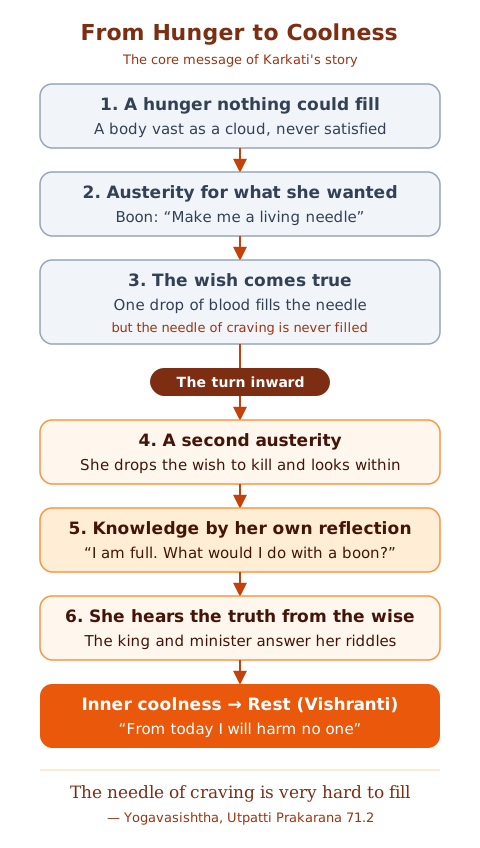
Karkati's story is a story of two austerities. The first was aimed at a want, and it succeeded completely. Brahma gave her exactly the boon she asked for, and it left her smaller and hungrier than before. A drop of blood filled the needle; nothing filled the craving.
The second austerity began with the same motive, to get her body back. But she had given up the wish to kill, and in those thousands of years of stillness her attention turned from what she lacked to the one who was lacking. Knowledge came through her own reflection. When Brahma offered a boon this time, she had nothing to ask for, and the body she had thrown away came back only when she no longer needed it.
Self-knowledge did not abolish her hunger. It changed who was in charge. Her riddles were all about the "atom" of consciousness in which every world rests like a tree in its seed, and the final coolness came when she heard that truth from people who lived it, not from anything she was given.
In Everyday Life
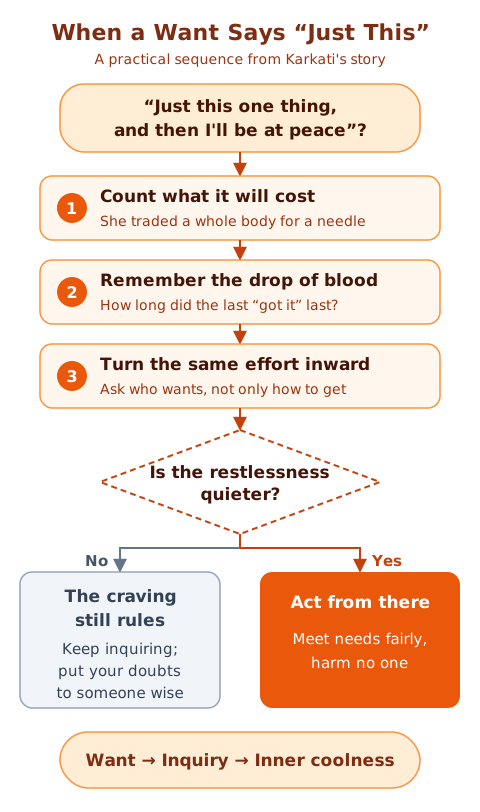
Most of us know Karkati's bargain: just this one thing, and then I will be at peace. The story does not say wanting is evil. It says the thing we want is usually small, and the wanting is not.
So before you make the bargain, count what it will cost. Karkati traded her whole body for a needle and later saw she had dropped a gem thinking it was glass. Health, sleep and family are often what we hand over without noticing.
Then remember the drop of blood. Think of the last time you got what you badly wanted. How long did the satisfaction last before the restlessness found a new object? If the honest answer is "not long", the object was never the problem.
Next, use the same discipline on yourself. Karkati did not need new qualities; she already had patience and resolve. What changed was their direction. A few quiet minutes asking who it is that wants, instead of how to get, is the same tapas turned the other way. And ask the wise, as she did.
One caution: this does not mean denying every need. Karkati still got hungry after she knew the truth. The difference was that she would rather die than take what was not rightfully hers. Needs met fairly are not the problem. Being ruled by them is.
Author's Note
Key Terms
| Term | Meaning |
|---|---|
| Tapas (तपस्) | Austerity; sustained, disciplined effort that bears fruit whatever its aim |
| Trishna (तृष्णा) | Craving; in this story, the "needle" that no amount of food can fill |
| Suchika (सूचिका) | Needle; the form Karkati asked for, one of iron and one living and unseen |
| Vishuchika (विषूचिका) | The piercing sickness Karkati became, entering through the breath to strike the heart |
| Chidanu (चिदणु) | The "atom" of consciousness; the Self, subtler than space, in which all worlds appear |
| Vichara (विचार) | Self-inquiry; the reflection by which knowledge dawned in Karkati |
| Vishranti (विश्रान्ति) | Rest; the inner coolness of a mind that no longer burns with wanting |
| Jivanmukta (जीवन्मुक्त) | One who is free while still living in the body |
Sources
- Yogavasishtha (Maharamayana) — Utpatti Prakarana, Sargas 68–69 (Karkati's hunger, her austerity and Brahma's boon)
- Yogavasishtha (Maharamayana) — Utpatti Prakarana, Sargas 70–71 (she becomes a needle; her life as the sickness and her lament)
- Yogavasishtha (Maharamayana) — Utpatti Prakarana, Sargas 72–75 (the second austerity, her awakening, Indra, Narada and Vayu, and Brahma's second boon)
- Yogavasishtha (Maharamayana) — Utpatti Prakarana, Sargas 76–79 (her body restored, the descent to the Kirata land, the meeting with the king and minister, and her questions)
- Yogavasishtha (Maharamayana) — Utpatti Prakarana, Sargas 80–81 (the minister's answers, then the king's)
- Yogavasishtha (Maharamayana) — Utpatti Prakarana, Sargas 82–83 (her inner peace, her vow, the mantra, and her friendship with the Kirata kings)