
Every hospital form starts the same way. Name, date of birth, weight, blood group. We fill it in without a pause, because we know who we are: this body, born on that day, getting a little older each year. It rarely occurs to us that the form might be asking the wrong question.
In the last part of this series, Vishvamitra told the story of Shuka and King Janaka, and Vasishtha agreed to teach Rama. The rest of that book, the Mumukshu Vyavahara Prakarana, is Vasishtha's groundwork: self-effort, and the calm and self-control that make a mind ready to listen. It is teaching rather than story, so this series skips ahead to the next book, where the next story is. Vasishtha opens it with a strange little tale. Death goes to collect a man and cannot get a grip on him.
The tale fills the second sarga of the Utpatti Prakarana, the third book of the Yoga Vasishtha, the book on how the world arises. Vasishtha tells it to Rama as a doorway into that book: the first sarga sets out the theme, and the third takes up the question Rama asks about the story. The sequence and the events are the original's; the wording is mine.
The Story at a Glance
| Text | Yogavasishtha (Maharamayana), also known as Yoga Vasistha, Utpatti Prakarana, Sargas 1–3 (the story itself is Sarga 2) |
|---|---|
| Narrator | Vasishtha, to Rama |
| Main characters | Akashaja, the sky-born brahmin; Mrityu (Death); Yama, the king of dharma |
| The puzzle | Death, who devours every creature in turn, cannot seize one brahmin even with a hundred hands |
| The search | On Yama's advice Death searches the whole earth for the brahmin's karmas, and finds none |
| The answer | Born of pure space, with no past karma and no sense of "I am this body," he cannot be grasped. Death goes home amazed, and Rama sees that the brahmin is Brahma himself |
| Key teaching | One who is convinced "I am this, made of earth" soon becomes earthly, and can be seized (Utpatti Prakarana, Sarga 2, Verse 32) |
Where the Bondage Lies
Vasishtha begins the new book plainly. "After the book on the conduct of seekers, I will now tell you the book of origination. This bondage exists because the seen exists. Where there is nothing seen, there can be no bondage. So listen, in order, to how this seen world comes about."
He sketches the whole of it first. At the end of an age, everything vanishes the way a dream vanishes in deep sleep, and what remains is still and deep, without a name. The wise call it Atman, Brahman, Truth, only so that there is something to say. That same Self, as if becoming something other, takes on the life of a jiva and becomes mind, and the mind keeps imagining until this whole magic show of a world spreads out. It is no more separate from Brahman than a bracelet is from its gold.
Then he says what bondage is. It is the reality the seen has for the seer. The seer is bound by the seen, and set free when the seen is gone. And he closes the easy exits. Saying "not this, not this" does not end it. Arguments, pilgrimages and vows do not end it. Even samadhi does not. You can sit as still as a stone, but when you rise the whole world of sorrow is back, exactly as it was, the way it returns after deep sleep. The seen lives inside the seer like the lotus plant folded inside its seed.
So what does dissolve it? That is what the whole Utpatti Prakarana sets out to show. And Vasishtha begins, not with an argument, but with a story: "Listen, Raghava, to the tale of the sky-born, an ornament for the ears. Through it you will understand this book."
The Brahmin Death Could Not Eat
There was once a brahmin named Akashaja, the sky-born. He was supremely righteous, devoted to meditation and nothing else, and always intent on the good of all creatures. And he lived for a very, very long time.
Long enough for Death to notice. Death thought it over. "I am the one who does not wear out. I eat every creature, one after another, in its turn. So why can't I eat this one?"
एनमाकाशजं विप्रं न कस्माद्भक्षयाम्यहम् ।
अत्र मे कुण्ठिता शक्तिः खङ्गधारा इवोपले ॥enam ākāśajaṃ vipraṃ na kasmād bhakṣayāmy aham |
Yogavasishtha (Maharamayana) — Utpatti Prakarana, Sarga 2, Verse 4
atra me kuṇṭhitā śaktiḥ khaṅgadhārā ivopale ||
Meaning: Why is it that I cannot devour this sky-born brahmin? Here my power is blunted, like the edge of a sword striking stone.
It is an honest complaint. Death is not described as wicked. He is simply someone whose job has always worked, and here, for the first time, it doesn't.
Through the Fire
So Death set out for the brahmin's city to kill him. The text adds a dry little remark: those who are capable never give up the effort their own work demands.
The moment Death stepped into the brahmin's house, a fire like the blaze at the end of an age began to burn him. The commentary explains it as a fire that guarded the brahmin's meditation against disturbance. Death tore through the great garland of flames and got inside. There was the brahmin, right in front of him. Death reached out with his hand, with real effort, to take hold of him.
He could not. Not with one hand, and not with a hundred. Death was strong, and the brahmin was right there in plain sight, but he could no more grip him than a strong man can grip a person who exists only in someone else's imagination.
"Find His Karmas"
Puzzled, Death went to Yama, the one who cuts through doubts. "Lord, why can't I eat the sky-born brahmin?"
Yama's answer turns the whole picture of death around.
मृत्यो न किंचिच्छक्तस्त्वमेको मारयितुं बलात् ।
मारणीयस्य कर्माणि तत्कर्तृणीति नेतरत् ॥mṛtyo na kiṃcic chaktas tvam eko mārayituṃ balāt |
Yogavasishtha (Maharamayana) — Utpatti Prakarana, Sarga 2, Verse 10
māraṇīyasya karmāṇi tatkartṛṇīti netarat ||
Meaning: Death, on your own you cannot kill anyone by force. It is the karmas of the one who is to die that do the killing, and nothing else.
"So if you want this brahmin," Yama went on, "search carefully for his karmas. With their help you will eat him."
Death took the advice seriously. He went everywhere: lakes and rivers, forests and mountains, seashores and distant islands, cities, villages and whole kingdoms. The commentary notes that he was not sightseeing. Finding out what someone did, and where, takes legwork.
He found nothing. Not one karma of the sky-born brahmin, anywhere on earth. The text compares it to a wise man looking for the son of a barren woman. So Death went back to Yama, because, as the text says, when servants are in doubt their master is their refuge. "Lord, tell me. Where are the sky-born brahmin's karmas?"
Yama, the king of dharma, thought about it for a long time before he answered.
Born of Space Alone
आकाशजस्य कर्माणि मृत्यो सन्ति न कानिचित् ।
एष आकाशजो विप्रो जातः खादेव केवलात् ॥ākāśajasya karmāṇi mṛtyo santi na kānicit |
Yogavasishtha (Maharamayana) — Utpatti Prakarana, Sarga 2, Verse 18
eṣa ākāśajo vipro jātaḥ khād eva kevalāt ||
Meaning: Death, the sky-born one has no karmas at all. This brahmin was born from space alone, from nothing else.
Then Yama explained. Whatever is born of space alone is itself stainless space. There are no karmas that could help Death against him, because he has not the slightest connection with any past action, any more than the son of a barren woman does, or a shape that was never formed. With no causes behind him, he is simply space. Past karma cannot exist in him, just as a great tree cannot grow in the sky.
He went further. The brahmin's mind is not driven by anything, since there is no past karma to drive it, and to this day he has stored up no new karma either. "The breathing and moving that we see in him, we are the ones who see it as action," Yama said. "In him there is no thought of 'my action' at all." He rests in the supreme state the way fluidity rests in water, emptiness in the sky, movement in the wind.
"He did nothing before, and he does nothing now. So tell me, how could he be overpowered? Only when he himself, with his own intellect, forms the idea called death. Then, and not before."
The One Who Can Be Seized
Then Yama said the thing that makes this story about all of us, not only about one unusual brahmin.
पृथ्व्यादिमानयमहमिति यस्य च निश्चयः ।
स पार्थिवो भवत्याशु ग्रहीतुं स च शक्यते ॥pṛthvyādimān ayam aham iti yasya ca niścayaḥ |
Yogavasishtha (Maharamayana) — Utpatti Prakarana, Sarga 2, Verse 32
sa pārthivo bhavaty āśu grahītuṃ sa ca śakyate ||
Meaning: One who holds the firm conviction "I am this, made of earth and the other elements" soon becomes earthly himself, and he can be seized.
"This brahmin has no such notion of earth and the rest," Yama said, "so he has no form. Trying to grab him is like trying to tie up the sky with a strong rope."
I find this verse quietly startling. It does not say the body is what Death seizes. It says the conviction comes first, and the earthiness follows from it. Death needs something to hold, and the "I am this" is what gives him the handle.
Death was not satisfied. To him it sounded impossible. "Lord, how can anyone be born from emptiness? And how do earth and the elements exist, or if they do not, how is it that they do not?"
Never Born, Never Gone
Yama answered patiently. "He was never born, and there is no time when he is not. This brahmin is only the light of pure knowing, and he stays exactly as he is."
He took Death back to the very beginning. At the great dissolution nothing at all is left. Only Brahman remains: at peace, ageless, endless, subtle, without any limiting form, always shining. Then, because its very nature is awareness, it becomes aware of itself as "I am a body," and sees a form. That form is an error of seeing, appearing as much by chance as the palm fruit that falls just when a crow lands on the tree.
"That is this brahmin," Yama said. "At the beginning of creation, in the hollow of space, he stands as he is, without a single thought dividing him, in the form of the sky of consciousness."
नास्य देहो न कर्माणि न कर्तृत्वं न वासना ।
एष शुद्धचिदाकाशो विज्ञानघन आततः ॥nāsya deho na karmāṇi na kartṛtvaṃ na vāsanā |
Yogavasishtha (Maharamayana) — Utpatti Prakarana, Sarga 2, Verse 40
eṣa śuddhacidākāśo vijñānaghana ātataḥ ||
Meaning: He has no body, no karmas, no sense of being the doer, no vasana. He is the pure sky of consciousness, dense with knowing, spread everywhere.
Not a trace of the old web of vasanas is in him. He is like pure space, or like light that is nothing but shining. "So where could earth and the rest come from in him, and how? Death, do not waste your effort trying to seize him. No one, at any time, can take hold of the sky."
Hearing this, Death was amazed, and he went home.
I like that ending. There is no defeat, no battle. Death simply understands that there was never anything there for him to take.
Rama Sees Who It Is
Rama had been listening closely. "The one you have described to me is Brahma," he said, "the god, the great grandsire, the self-born, the unborn, the one Self whose nature is knowing. That is how I understand it."
Vasishtha confirmed it. "That is exactly so, Rama. Under that name I have been describing Brahma to you. Long ago, Death really did argue with Yama over him."
He told Rama how it happened. In one of the manvantaras, Death, who eats everything, had grown powerful carrying off creatures, and he set out on his own to attack the lotus-born Brahma. Yama, the king of dharma, set him straight at once. Why would Death even try something so hopeless? Vasishtha's answer is very human: whatever one does all the time, one comes to love doing.
"How could Brahma be attacked?" Vasishtha said. "His body is the supreme space. He is mind alone, pure intention, a form without earth or any element." Like a person imagined in the mind, like a city seen in a dream, he appears without being made of anything solid. In the Supreme Self alone there is neither seen nor seer. Still, by its own mind, the sky of consciousness appears as the self-born one. Vasishtha ends the sarga with this verse: the sky of consciousness, endless, without beginning or middle, appears as Brahma, the self-born, through the force of its own mind. It looks as if it had a form, as if it were a person. In truth, like the son of a barren woman, it has no body at all.
Rama's Next Question
Rama, being Rama, pushed further. "You say Brahma's mind is pure and free of earth and the elements. Then why is memory from a past life not the cause of his body, the way it is for me, for you, for everyone else and for the animals?"
Vasishtha answered: "Memory that keeps worldly life going arises only in someone who had an earlier body, carrying earlier karma. Brahma has no past karma at all. Where would such a memory come from?" So Brahma shines without any cause, or with his own mind as his only cause. His body is only the subtle one, the ativahika. A body of the gross elements, the adhibhautika, is not possible for the unborn.
"But every creature has two bodies, the subtle and the gross," Rama said. "Why does Brahma have only one?"
"Every creature that has a cause has two," Vasishtha said. "The unborn has no cause, so he has only the subtle one." From this first Prajapati, whose body is the sky, all creatures spread out, and they too are of the nature of the sky of consciousness, because whatever comes from something is that very thing.
So what went wrong with the rest of us? Vasishtha says it plainly. The subtle body, through a deep and firm forgetting, appears as a gross physical one, falsely, the way a ghost seems to have a body. In Brahma, who is pure awareness, that forgetting never arises. And since Brahma is mind alone and not made of earth, the whole world that comes from him is mind alone too.
The detailed account of how this mind-made world unfolds is where the Utpatti Prakarana goes next.
The Core Message
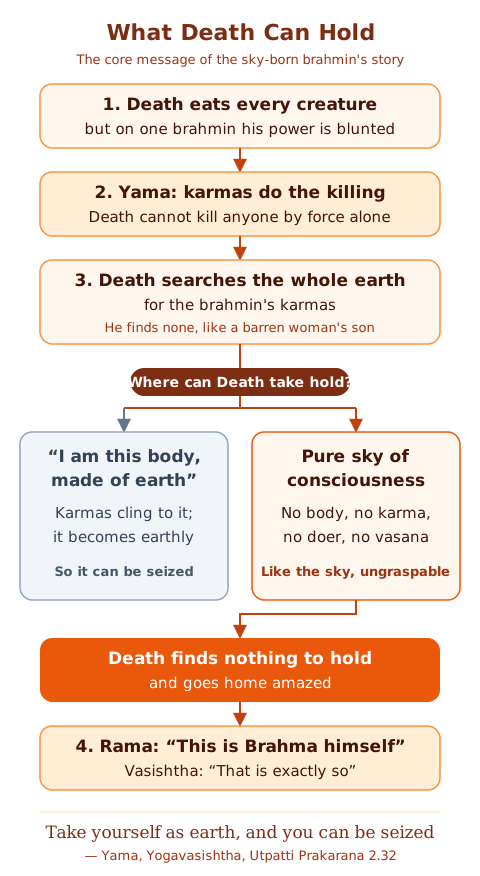
The sky-born brahmin story turns death into a question of grip. Death on its own has no strength. It needs a hold, and Yama names that hold: the karmas of the one who is to die. Those karmas, in turn, belong only to someone who believes "I am this, made of earth." Where there is no such conviction, no body taken as self, no sense of being the doer and no vasana, Death has nothing to take hold of. Trying to seize such a one is like trying to tie up the sky.
The reveal at the end gives the story its weight. The sky-born brahmin is Brahma, the first being, the mind from which all creatures come. Vasishtha then says, in the next sarga, that those creatures are of the same nature as their source. The difference between Brahma and us is not what we are made of. It is a firm forgetting, by which a subtle, mind-made body comes to look like a lump of earth. Brahma never forgets; we do.
Bondage, Vasishtha said in the first sarga, is the reality we give to the seen. The story shows the same thing from Death's side. What is taken to be solid can be seized. What knows itself as the sky of consciousness cannot.
In Everyday Life
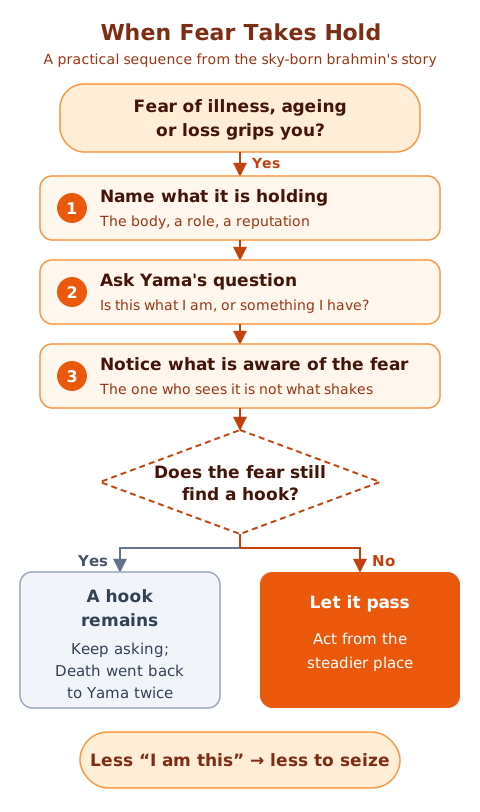
Most of us are not going to stop taking ourselves to be the body because we read a story. But the story offers a useful way to watch what happens when fear takes hold. Fear, like Death in the story, rarely acts on its own. It needs a hook in us. A diagnosis, a birthday with a zero in it, a mirror on a bad morning: each one grips only as much as we hold "I am this."
So when fear of illness, ageing or loss grips you, first name what exactly it has hold of. The body, yes, but often also a role, a reputation, a picture of who you are supposed to be.
Then ask Yama's question: is this what I am, or something I have, or something I do? The verse is careful about the order. The conviction "I am this" comes first, and only then does a person become earthly and graspable.
Then notice what is aware of the fear. The fear can be seen, and whatever is seeing it is not the thing that is shaking. You do not have to argue with it.
If the fear still finds a hook, that is information, not failure. Death had to go back to Yama twice. Keep asking, keep looking. If it finds nothing to hold, let it pass, and act from that steadier place.
One honest caution. This is not a promise that the body will not die. The sky-born brahmin is Brahma, and the rest of us will grow old. What the story offers is not a way to escape death but a way to see what death can and cannot touch.
Author's Note
Key Terms
| Term | Meaning |
|---|---|
| Akashaja (आकाशज) | "Sky-born"; the brahmin born of space alone, revealed to be Brahma |
| Mrityu (मृत्यु) | Death, here a figure who devours creatures but can act only through their karmas |
| Praktana karma (प्राक्तन कर्म) | Karma from the past; what gives Death his hold on a creature |
| Chidakasha (चिदाकाश) | The sky of consciousness; pure awareness, boundless and formless like space |
| Kartritva (कर्तृत्व) | The sense of being the doer of actions |
| Vasana (वासना) | Deep-rooted desire or latent tendency that pulls the mind towards objects |
| Ativahika deha (आतिवाहिक देह) | The subtle, mind-made body; Brahma has only this one |
| Adhibhautika deha (आधिभौतिक देह) | The gross body of the physical elements, which the subtle body seems to become through forgetting |
Sources
- Yogavasishtha (Maharamayana) — Utpatti Prakarana, Sarga 1 (Vasishtha introduces the book: bondage is the reality given to the seen)
- Yogavasishtha (Maharamayana) — Utpatti Prakarana, Sarga 2 (the story of the sky-born brahmin, Death and Yama, and the reveal that the brahmin is Brahma)
- Yogavasishtha (Maharamayana) — Utpatti Prakarana, Sarga 3 (Rama asks why Brahma has no past memory; Vasishtha on the subtle and the gross body)