
There is a particular kind of restlessness that has nothing to do with not knowing. You have read the books. You have thought it through. You could explain the answer to someone else. And still something in you keeps asking, "But is that really it?"
The last part of this series ended with Rama's long question and the silence that followed it in Dasharatha's court. Everyone expected Vasishtha to answer. But before he could, Vishvamitra spoke first, and he did not begin with philosophy. He began with a story about a young man who already knew the truth and could not rest in it: Shuka, the son of Vyasa.
The story takes up the first sarga of the Mumukshu Vyavahara Prakarana, the book on the conduct of one who longs for liberation. In the second sarga Vishvamitra turns it back on Rama. As before, I keep to the order and incidents of the original; only the telling is mine.
The Story at a Glance
| Text | Yogavasishtha (Maharamayana), Mumukshu Vyavahara Prakarana, Sargas 1–2 |
|---|---|
| Narrator | Vishvamitra, to Rama in the court of Ayodhya |
| Main characters | Shuka (son of Vyasa), King Janaka of Videha, Vyasa |
| The problem | Shuka had found the truth through his own reflection, but could not settle in the conviction "this is it" |
| Janaka's tests | Seven days at the gate, seven in the courtyard, seven amid the pleasures of the inner palace |
| Outcome | Janaka repeated the same teaching and confirmed Shuka's conviction; Shuka found peace and merged into samadhi on Mount Meru |
| Key teaching | The thinning of vasanas is liberation; their hardening is bondage (Mumukshu Vyavahara Prakarana, Sarga 2, Verse 5) |
Shuka Knew, and Still Had No Rest
Vishvamitra looked at Rama with obvious affection and said something surprising: "Rama, there is nothing left for you to know. With your own subtle intellect you have understood it all. The mirror of your mind is spotless by nature; it needs only the slightest wiping. Your mind is like Shuka's. It has known what is to be known. All it needs now is rest."
Rama asked the natural question. How could Shuka know the truth and not be at rest in it, and how did he come to rest later?
Vishvamitra did not have to look far for his example. "You see Vyasa sitting there beside your father on the golden seat," he said, "dark as a mountain of collyrium, bright as the sun? This is the story of his son. Listen. It is very much like your own."
Shuka was moon-faced, deeply wise, so composed that he seemed a sacrifice in bodily form. Like Rama, he kept turning over in his heart the whole business of worldly life. Discernment woke in him, and by his own long and careful reflection he arrived at what is true. No one had to teach him. And yet:
स्वयं प्राप्ते परे वस्तुन्यविश्रान्तमनाः स्थितः ।
इदं वस्त्विति विश्वासं नासावात्मन्युपाययौ ॥svayaṃ prāpte pare vastuny aviśrāntamanāḥ sthitaḥ |
Yogavasishtha (Maharamayana) — Mumukshu Vyavahara Prakarana, Sarga 1, Verse 11
idaṃ vastv iti viśvāsaṃ nāsāv ātmany upāyayau ||
Meaning: Though he had himself reached the supreme reality, his mind did not come to rest. The conviction "this is it" never settled within him.
I find this verse unusually honest. Shuka's problem was not ignorance. It was trust. His mind had already stopped chasing pleasures; it turned away from them the way the chataka bird turns away from the ordinary streams of rain. But a mind that has let go of the world and has not yet settled in the truth is in an odd place. It has nowhere to stand.
"I Knew That Already"
One day, on Mount Meru, Shuka found his father sitting alone and asked him with real devotion: "Sage, how did this whole pageant of samsara rise up? How does it come to rest? How large is it, whose is it, and how long will it last?"
Vyasa answered him fully, from beginning to end, exactly as it is. He was, after all, one who knew the Self. And Shuka listened and thought: I knew this before.
आज्ञासिषं पूर्वमेतदहमित्यथ तत्पितुः ।
स शुकः शुभया बुद्ध्या न वाक्यं बह्वमन्यत ॥ājñāsiṣaṃ pūrvam etad aham ity atha tat pituḥ |
Yogavasishtha (Maharamayana) — Mumukshu Vyavahara Prakarana, Sarga 1, Verse 16
sa śukaḥ śubhayā buddhyā na vākyaṃ bahv amanyata ||
Meaning: Thinking "I already knew this," Shuka, with his pure intellect, did not give his father's words much weight.
Notice that the text does not scold him. It says he did this with a good, clear intellect. Nothing new had been said, so nothing had moved.
Vyasa understood exactly what was going on in his son's mind. And he said something few teachers, and fewer fathers, would say: "I do not know this in truth. There is a king on earth named Janaka. He knows what is to be known, just as it is. From him you will get everything."
Seven Days at the Gate
So Shuka came down from Meru to the earth and reached Videha, the city that Janaka protected. The gatekeepers went in to the king: "Your Majesty, Shuka, the son of Vyasa, is standing at the gate."
Janaka had already heard about this young man. The commentary explains his thinking: Shuka had brushed aside his own father's teaching, and if Janaka simply started teaching him, the same thing would happen again. So before saying a word about the Self, he decided to test the boy's dispassion and the steadiness of his faith.
"Oh, he's here? Let him stay, then," the king said, as if it hardly mattered. And then he said nothing at all for seven days.
The son of Vyasa, who had sat with his father on the peak of Meru, stood at a palace gate like any petitioner, and nobody came for him.
Seven Days in the Courtyard, Seven in the Palace
After seven days Janaka let him into the courtyard. There too Shuka stayed for seven full days, exactly as before. The text calls him unmanāḥ: his mind was elsewhere, so absorbed in the longing for truth that the slight simply did not register.
Then the king had him brought into the inner palace, with a polite excuse: "The king cannot be seen until you have been properly honoured with food." For the next seven days Janaka had the moon-faced young sage looked after by women intoxicated with youth, with every kind of food and every luxury the palace held.
ते भोगास्तानि दुःखानि व्यासपुत्रस्य तन्मनः ।
नाजह्रुर्मन्दपवना बद्धपीठमिवाचलम् ॥te bhogās tāni duḥkhāni vyāsaputrasya tan manaḥ |
Yogavasishtha (Maharamayana) — Mumukshu Vyavahara Prakarana, Sarga 1, Verse 25
nājahrur mandapavanā baddhapīṭham ivācalam ||
Meaning: Those pleasures, and those slights, could not move the mind of Vyasa's son, just as soft breezes cannot move a mountain set firm on its base.
He remained the same throughout: even, at ease, silent, quietly glad, like the full moon. The order of the tests is worth noticing. Neglect first, then waiting, and only then comfort. Most of us would probably survive being ignored for a week. Being pampered for a week is another matter.
Only after twenty-one days, once he knew Shuka's nature for certain, did Janaka have him brought in. He looked at the contented young man in front of him, and the king bowed to him. Then he welcomed him quickly and asked, "You have finished everything there is to do in this world, and every wish of the heart is fulfilled. What is it that you want?"
"Is This Really It?"
Shuka asked him the same question he had asked his father: "Teacher, how did this pageant of samsara arise, and how does it come to rest? Tell me exactly."
And Janaka told him. Vishvamitra is careful to point out that it was the very same thing Vyasa had said earlier. Not a word was new.
This time Shuka did not shrug. He said: "I knew this myself, through my own discernment. When I asked my father, he said exactly this. You, best of speakers, have said the same. And this is the meaning the scriptures show too: that this burnt-out samsara rises from one's own mental constructs and fades when they fade, and has no substance in it. So, mighty one, is this the truth? Tell me firmly. My mind keeps wandering the whole world. From you I will find rest."
This is the moment in the story that moves me most. Shuka is not asking for more information. He has already heard the answer in three voices: his own, his father's and the king's. What he is asking for is one person who can look at him and say, without wavering, "Yes. This is it."
One Self, Bound by Its Own Wanting
Janaka did not add anything. "There is no conclusion beyond this one, sage," he said. "You knew it yourself, and you have heard it again from a teacher." Then, so that it would settle once and for all, he said it again:
अविच्छिन्नचिदात्मैकः पुमानस्तीह नेतरत् ।
स्वसंकल्पवशाद्बद्धो निःसंकल्पश्च मुच्यते ॥avicchinnacidātmaikaḥ pumān astīha netarat |
Yogavasishtha (Maharamayana) — Mumukshu Vyavahara Prakarana, Sarga 1, Verse 36
svasaṃkalpavaśād baddho niḥsaṃkalpaś ca mucyate ||
Meaning: Here there is only one unbroken conscious Self, and nothing else. Bound by the power of its own sankalpa, its own willing and imagining, it is freed when it becomes free of sankalpa.
Then he gave Shuka his reasons. "That is how I know you have truly understood: you turned away from all pleasures before you had even tasted them. Child, great hero, your mind has turned from pleasures that are like long illnesses. What else is left for you to hear? Your father is an ocean of all knowledge, standing in vast austerity, and yet he has not reached the fullness you have. You, Vyasa's son and student, have become my student, so in that sense I am more than Vyasa. But in how thin your desire for pleasure is, you are far more than me."
And finally: "You have gained all there is to gain. Your mind is full. You no longer fall into the seen. You are free, brahmin. Let go of this delusion."
The commentary notes that all this praise has one purpose: to make the conviction firm. I would add one thing. Janaka could say "you are free" with authority because he had watched for twenty-one days. His certainty was not flattery. It was evidence.
The Drop and the Ocean
Taught like this by Janaka, Shuka fell silent and remained in the clear, supreme reality. Grief, fear and strain fell away. Wanting had gone, no one could say where. Every doubt was cut.
He went to the peak of Meru for samadhi. There he stayed for ten thousand years in nirvikalpa samadhi, and then he went out in the Self, like a lamp whose oil is gone.
In the first part of this series, Rama had said that if no one answered his question, he would sit still until his body went out like a lamp with no oil left. Here the same image comes back, but turned completely around. For Rama it was a threat born of despair. For Shuka it is peace.
The last verse of the sarga is gentle. Washed clean of the stain of restless thinking, his vasanas dissolved, the great soul became one with that pure state, the way a drop of water becomes one with the ocean.
What Vishvamitra Wanted Rama to Hear
Then Vishvamitra brought the story home. "Rama, just as Vyasa's son needed only a little wiping away of the stain, that is all you need too."
He turned to the sages in the assembly. "Rama has fully known what is to be known. Pleasures do not taste good to him; to him they are like diseases. That is the sure mark of a mind that knows: pleasures no longer appeal to it." And then he gave the verse that the whole book seems to rest on:
वासनातानवं राम मोक्ष इत्युच्यते बुधैः ।
पदार्थवासनादार्ढ्यं बन्ध इत्यभिधीयते ॥vāsanātānavaṃ rāma mokṣa ity ucyate budhaiḥ |
Yogavasishtha (Maharamayana) — Mumukshu Vyavahara Prakarana, Sarga 2, Verse 5
padārthavāsanādārḍhyaṃ bandha ity abhidhīyate ||
Meaning: Rama, the wise call the thinning of vasanas liberation. The firm hold of vasanas on things is what is called bondage.
He went on: some general glimpse of the Self comes to most people without much trouble, but real distaste for sense objects is won only with difficulty. The one to whom pleasures do not appeal, and not because of some motive like fame or honour, is called a jivanmukta, free while living. And just as no creeper grows in a desert, that distaste does not grow until what is to be known is known.
So why teach Rama at all? Vishvamitra's answer is exactly Shuka's story: "When Rama hears from the right mouth that what he knows within is the truth, his mind will surely come to rest."
Then he turned to Vasishtha. He reminded him of the knowledge Brahma had once taught on the slopes of Mount Nishadha, for the sake of the sages and to put an end to the old enmity between the two of them, knowledge that dispels the vasanas of worldly life the way sunrise ends the night. "Teach that to Rama now," he said. "It will be no labour. Rama is free of stain, and a face appears in a clean mirror without any effort."
Vyasa, Narada and the other sages in the assembly all said, "Well said, well said." And Vasishtha agreed: "Who can set aside the words of the good? I will dispel the darkness in the minds of these princes with knowledge, as a lamp dispels the night."
Vasishtha's teaching begins in the next part of this series.
The Core Message
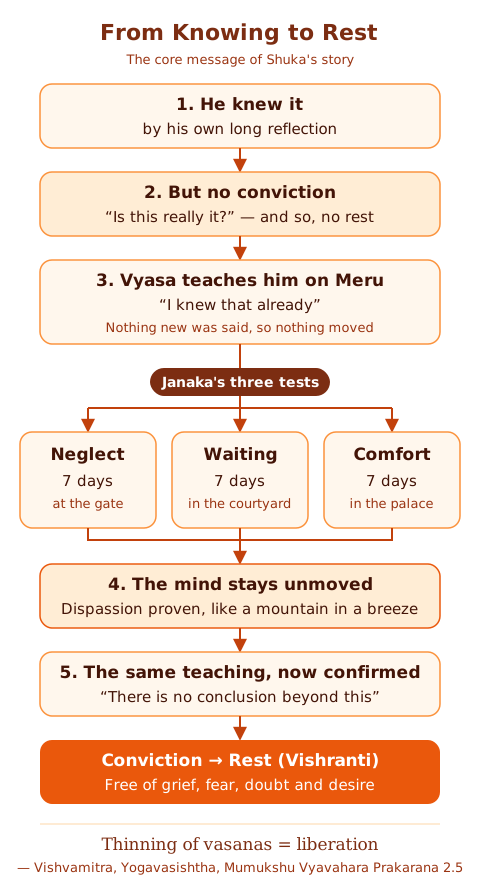
Shuka's story separates two things we usually treat as one: knowing the truth and resting in it. His understanding was correct from the start. Vyasa added nothing to it, and neither did Janaka. What was missing was vishvasa, the settled conviction that "this is it," and without that conviction there was no rest.
That conviction did not come from a cleverer explanation. It came from someone who had lived the teaching, who tested Shuka before saying a word, and who could therefore say "you are free" with complete certainty. The commentary adds a warning at the very start of the sarga: the story is told so that people whose dispassion is still half-ripe do not rush ahead imagining they are already qualified. Shuka's dispassion was proven under neglect, under waiting and under comfort.
And the measure the Yoga Vasishtha uses is striking. It is not how much you know. Janaka ranks Shuka above himself not for knowledge but for how thin his desire for pleasure was. Thinning of vasanas is liberation; their firm grip is bondage.
In Everyday Life
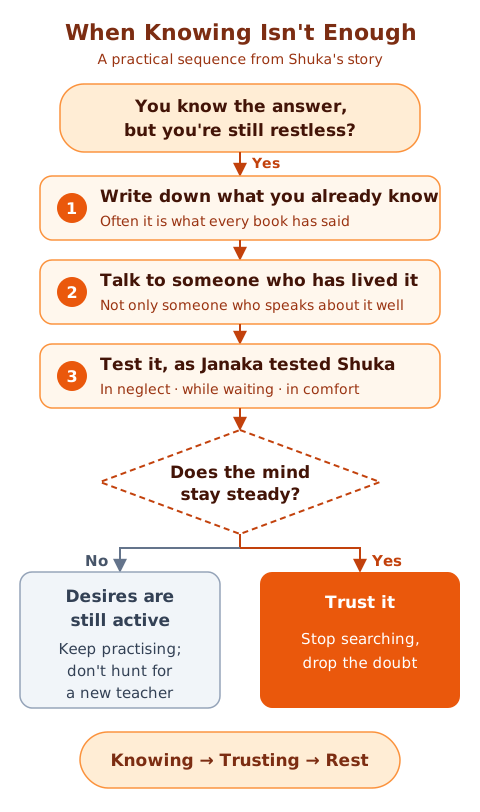
A lot of us live where Shuka was before he met Janaka. We know what is good for us. We know anger costs more than it gains, that the next purchase won't settle anything, that the mind needs discipline. And yet we keep collecting: one more book, one more talk, one more teacher. Shuka's story suggests that this search is often not for information at all. It is for permission to trust what we already know.
So start by writing down what you already know about the question that troubles you. If it turns out to be the same thing your own reflection, your teachers and the books have all been saying, then information is not what is missing.
Then talk it through with someone who has actually lived it, not just someone who can talk about it well. Janaka said nothing new to Shuka. His words carried weight because his life stood behind them.
And test yourself the way Janaka tested Shuka. How does the mind behave when you are ignored? When things you are waiting for don't happen on time? And, hardest of all, when everything is comfortable? If the mind stays steady, trust what you know and stop searching. If it doesn't, the answer is to keep practising, not to go looking for a new teacher.
One honest caution. This is not permission to declare yourself finished, or to wave away every teacher because "I knew that already." Shuka said those very words to his father, and they did not bring him peace. Janaka's "you are free" came only after twenty-one days of watching.
Author's Note
Key Terms
| Term | Meaning |
|---|---|
| Vishranti (विश्रान्ति) | Inner rest; the mind settling completely in what it knows |
| Vishvasa (विश्वास) | Conviction; the firm trust that "this is it" |
| Vasana (वासना) | Deep-rooted desire or latent tendency that pulls the mind towards objects |
| Vasana-kshaya (वासनाक्षय) | The thinning and dissolving of vasanas; called liberation by the wise |
| Sankalpa (संकल्प) | The mind's own willing and imagining, by which the Self is bound |
| Jivanmukta (जीवन्मुक्त) | One who is free while still living in the body |
| Nirvikalpa samadhi (निर्विकल्प समाधि) | Absorption in which no thought or distinction remains |
| Mumukshu (मुमुक्षु) | One who longs for liberation |
Sources
- Yogavasishtha (Maharamayana) — Mumukshu Vyavahara Prakarana, Sarga 1 (the story of Shuka and King Janaka)
- Yogavasishtha (Maharamayana) — Mumukshu Vyavahara Prakarana, Sarga 2 (Vishvamitra applies the story to Rama and asks Vasishtha to teach)