
When a teenager suddenly goes quiet, leaves his plate half full, and answers every question with "nothing's wrong," parents stop sleeping well. That is exactly what happened once in the palace at Ayodhya. The only difference was that the teenager was Rama.
The Yoga Vasishtha does not open with a battle or a miracle. It opens with a young man's sadness. Sage Vasishtha's entire teaching, spread over thousands of verses, is really one long answer to that sadness. So this story series starts there too.
The episode runs from the third to the thirty-third sarga of the Vairagya Prakarana, the book on dispassion. The whole tale is narrated by Valmiki to his disciple Bharadvaja. What follows keeps to the order and incidents of the original; only the telling is mine.
A Prince Comes Home
Rama was not yet sixteen. Vasishtha sent learned brahmins along with him, his mothers held him again and again before letting go, and Rama set out on pilgrimage with his brothers.
The Ganga, the Yamuna, the Sarasvati, Prayag, Naimisharanya, Gaya, Kashi, Kedar, Pushkar, Lake Manasarovar... the text lists so many places that you get winded just reading it. The shores of all four oceans, the forests of the Himalaya and the Vindhyas, the hermitages of the great sages. It feels as if Valmiki wants us to know that Rama really saw the world, and saw it properly.
When he returned, Ayodhya showered him with flowers. The celebrations went on for eight days. Then life settled back into its rhythm: a bath and prayers at dawn, time with his father, a few hours of discussion with Vasishtha, a hunt in the afternoon with his father's permission, and dinner with friends in the evening. You could hardly design a better life for a prince.
But after a while, the rhythm began to break.
"Father, Nothing Is Troubling Me"
The text uses a lovely image here. Just as a clear pond in autumn shrinks a little more every day, Rama grew thinner every day. His lotus-like face turned pale. He would sit cross-legged, cheek resting on his palm, saying nothing to anyone. Only when his attendants pleaded would he manage his bath and evening prayers.
Lakshmana and Shatrughna, who followed Rama in everything, followed him in this as well. Before long, all three brothers were equally withdrawn.
Dasharatha kept asking, "Son, what is worrying you?" And every time Rama gave the same answer: "Father, nothing is troubling me at all." Then he would quietly go and sit in his father's lap.
Of everything in this episode, that scene moves me the most. The son cannot explain what is wrong, yet he does not want to be far from his father either. Perhaps he simply had no words for it. The restlessness inside him did not have a name yet, even for him.
At his wits' end, Dasharatha asked Vasishtha. The guru thought for a while and said only this: "Your Majesty, there is a reason behind it, but do not grieve." He added that the noble are not moved to anger or sorrow by small things. The meaning was plain enough: whatever was happening was not a small thing.
Vishvamitra at the Gate
Around that time, the gatekeepers came hurrying into the court. A sage was standing at the entrance, his matted hair like a column of flame, so radiant that even the elephants and horses near him seemed to have turned gold. Vishvamitra, son of Gadhi, had arrived.
Dasharatha left his throne and went out on foot to meet him. He bowed so low that the jewels of his crown scattered on the ground. His welcome was so full of comparisons that it makes you smile: like sight given to the blind, like rain to a farmer after a long drought. And then he said the sentence a king should only say after careful thought: "Whatever task you have come with, consider it done."
Vishvamitra asked for Rama. Demons kept defiling his sacrifice with flesh and blood. He could have stopped them with a curse, but a curse needs anger, and a sacrifice cannot be performed in anger. So he had come to take Rama with him, just for ten days.
A King Who Was Only a Father That Day
For a moment Dasharatha sat as still as a painting. When he spoke, it was not a king speaking but a father: "Great sage, Rama is not even sixteen. He has never seen a battlefield except the mock fights he played in the palace courtyard. And these days he hardly eats; some grief inside him keeps him silent. How can I send a boy like that to fight demons? Take my whole army. I will come with you myself."
He even said that these four sons had come to him after years of waiting, and that he could not live without Rama.
Vishvamitra flared up. "You gave your word and now you are backing out? A lion who wants to become a deer? Very well. I will go back the way I came." The text says the earth itself trembled at his anger. Then Vasishtha stepped in. He reminded Dasharatha of the honour of the Raghu line and assured him that with Vishvamitra beside him, no one could harm a hair on Rama's head.
Dasharatha gave in and sent a messenger to fetch Rama. But the messenger came back alone. With him was one of Rama's personal attendants, and what he said left the court stunned.
In the Attendant's Words
"Your Majesty, he has been like this ever since he came back from the pilgrimage. If we beg, he eats sometimes; sometimes not even then. Jewellery gives him no pleasure. When he watches the dancers, he asks, what are they all doing? He gives his wealth away to anyone who asks. If someone tells him he is going to be emperor, he laughs as if he were listening to a madman."
"He sits alone by the river or in some deserted place. He neither laughs nor weeps. Ask him anything and the answer is the same: 'Nothing.' And sometimes he softly sings that we have wasted our lives without reaching the highest state."
One thing the attendant says strikes me as remarkably precise. Rama, he says, is neither deluded nor free. Not deluded, because discernment has woken in him and he now sees everything as passing. Not free, because he has not yet found rest within. He is stuck in between. One shore has slipped away, and the other is not yet in sight.
"This Is Not Delusion, It Is Awakening"
Everyone in the court was worried, but Vishvamitra's face showed something else. He said:
eṣa moho raghupater nāpadbhyo na ca rāgataḥ |
Yogavasishtha (Maharamayana) — Vairagya Prakarana, Sarga 11, Verse 2
vivekavairāgyavato bodha eva mahodayaḥ ||
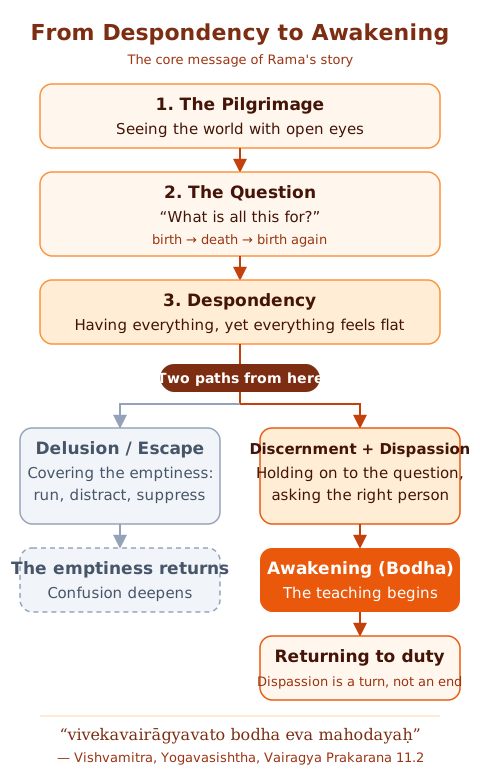
Meaning: This "delusion" of Rama's has not come from misfortune, nor from attachment. In one in whom discernment and dispassion have awakened, this state is an awakening that bears great fruit.
The whole story turns on this one verse. What the court saw as an illness, Vishvamitra called a beginning.
Then Rama arrived. The text describes him with real affection: the first bloom of youth, yet the seriousness of an elder. No agitation in his mind, but no supreme joy yet either. Like a pot that is almost full, with just a few drops still missing. He bowed first to his father, then to Vasishtha and Vishvamitra, then to all the elders.
Dasharatha kissed his son's head and said, "Child, come sit in my lap." Rama did not. He sat on the cloth the attendants had spread on the floor. Only a few days earlier, this same Rama would go and sit in his father's lap without being asked.
Vishvamitra asked him directly: "Prince, what is this pain that is hollowing out your mind the way rats dig through a house? Tell us what you want. You shall have it."
"Where Is the Happiness in This?"
Rama began to speak, and then he spoke for a long time. In the Yoga Vasishtha, his speech runs from the twelfth sarga to the thirty-first.
He started very simply: "I was born in this house, I grew up here, I was educated. Then I went on pilgrimage. And somewhere along the way a thought arose in me that took away my faith in this world."
kiṃ nāmedaṃ bata sukhaṃ yeyaṃ saṃsārasantatiḥ |
Yogavasishtha (Maharamayana) — Vairagya Prakarana, Sarga 12, Verse 7
jāyate mṛtaye loko mriyate jananāya ca ||
Meaning: In this endless chain of the world, where exactly is the happiness? People are born only to die, and die only to be born again.
Then Rama picked up one thing after another and examined it. Wealth, dearest to fools, which gives back nothing but trouble. A lifespan no longer than a drop of dew hanging from a trembling leaf on a tall tree. A body as unsteady as the throat of a frog croaking in a rice field. And above all of these, the mind, which cannot stay still for a moment.
But Rama does not simply complain. At the end he asks a clear question: is there a way to live in this world, doing all one's work, without being touched by sorrow? Who has done it before, and how?
And then came the words that shook the court: "If no such way exists, or if it exists but no one will explain it to me clearly, I will not eat and I will not drink. I will sit silent like a picture painted on a wall, until this body goes out like a lamp with no oil left."
Having said this, Rama fell silent.
When Even the Caged Birds Fell Silent
The description of that silence is one of the most beautiful passages in the Yoga Vasishtha. Sages, ministers, kings and citizens all sat as still as figures in a painting. The birds in their cages did not move a feather. The pet deer froze where they stood. The horses stopped chewing their fodder. Kausalya and the other queens, seated at the palace windows, were so still that not one of their ornaments jingled.
Then, from a cloudless sky, flowers began to fall. For half a ghadi they kept falling. Courtyards, rooftops and terraces filled up, and the people of the city stood with their heads tilted back, staring at the sky. Up above, the unseen siddhas were saying to one another, "We have wandered the worlds since the beginning of creation, and only today have we heard words like these."
Now everyone was waiting for one thing. Who would answer this question?
Before the answer comes, Vishvamitra tells another story: the story of Shukadeva, son of Vyasa, who was wise from birth and yet still restless. That is the next part of this series.
The Core Message
This opening of the Yoga Vasishtha teaches something unusual. The very sadness that frightened the whole palace was exactly what the gurus had been waiting for. In Vishvamitra's words, it was not delusion but awakening.
Dispassion here does not mean hating the world. No one had betrayed Rama; nothing terrible had happened to him. He had everything, and perhaps that is precisely why he could see clearly that "everything" was not enough. That is the door through which knowledge enters. As long as the mind believes that the next thing it gets will finally set everything right, it is not ready to hear any teaching.
One more thing is worth noticing. Rama did not run away to the forest. He came to the court and asked. His question was how to live in the world without suffering. Vishvamitra, too, told the court that once the delusion was gone, Rama would carry out all his duties again, without hindrance. Dispassion here is not an ending. It is a turning point.
In Everyday Life
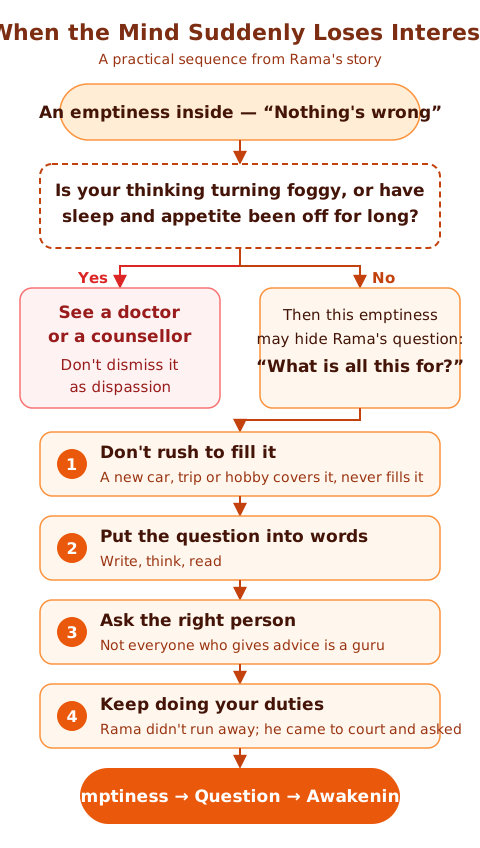
Many of us go through a phase like this at some point. Work is going fine, home is fine, and yet there is an emptiness inside. When someone asks, the answer is the same: "Nothing."
Don't rush to fill that phase with something new. A new car, a new trip, a new hobby will cover the emptiness for a few days; they won't fill it. Rama's story suggests that inside this emptiness there is often a question hiding. Try to put it into words. Write, think, read.
And ask the right person. The attendant tells us that Rama laughed at the scholars who came to lecture him on statecraft. He opened his heart only when Vasishtha and Vishvamitra were in front of him. Not everyone who gives advice is a guru.
One important caution as well. Rama's sadness came with clarity. He was thinking clearly and asking precise questions. If someone's sadness clouds their thinking, or their sleep and appetite stay disturbed for a long time, it is not wise to dismiss it as dispassion. Seeing a doctor or a counsellor matters just as much.
Author's Note
Key Terms
| Term | Meaning |
|---|---|
| Vishada (विषाद) | Deep despondency; a heaviness of the mind |
| Vairagya (वैराग्य) | Dispassion; the mind's natural turning away from what is passing |
| Viveka (विवेक) | Discernment between the lasting and the passing |
| Bodha (बोध) | Awakening; the first glimpse of truth |
| Moha (मोह) | Delusion and attachment born of ignorance |
| Yukti (युक्ति) | A method or means that brings the mind to rest |
| Siddha (सिद्ध) | Perfected celestial beings who move through the sky |
Sources
- Yogavasishtha (Maharamayana) — Vairagya Prakarana, Sarga 3–5 (the pilgrimage, the return and Rama's sadness)
- Yogavasishtha (Maharamayana) — Vairagya Prakarana, Sarga 6–11 (Vishvamitra's arrival, Dasharatha's distress, Rama comes to the court)
- Yogavasishtha (Maharamayana) — Vairagya Prakarana, Sarga 12–31 (Rama's discourse on dispassion)
- Yogavasishtha (Maharamayana) — Vairagya Prakarana, Sarga 32–33 (the court's wonder and the siddhas' rain of flowers)