
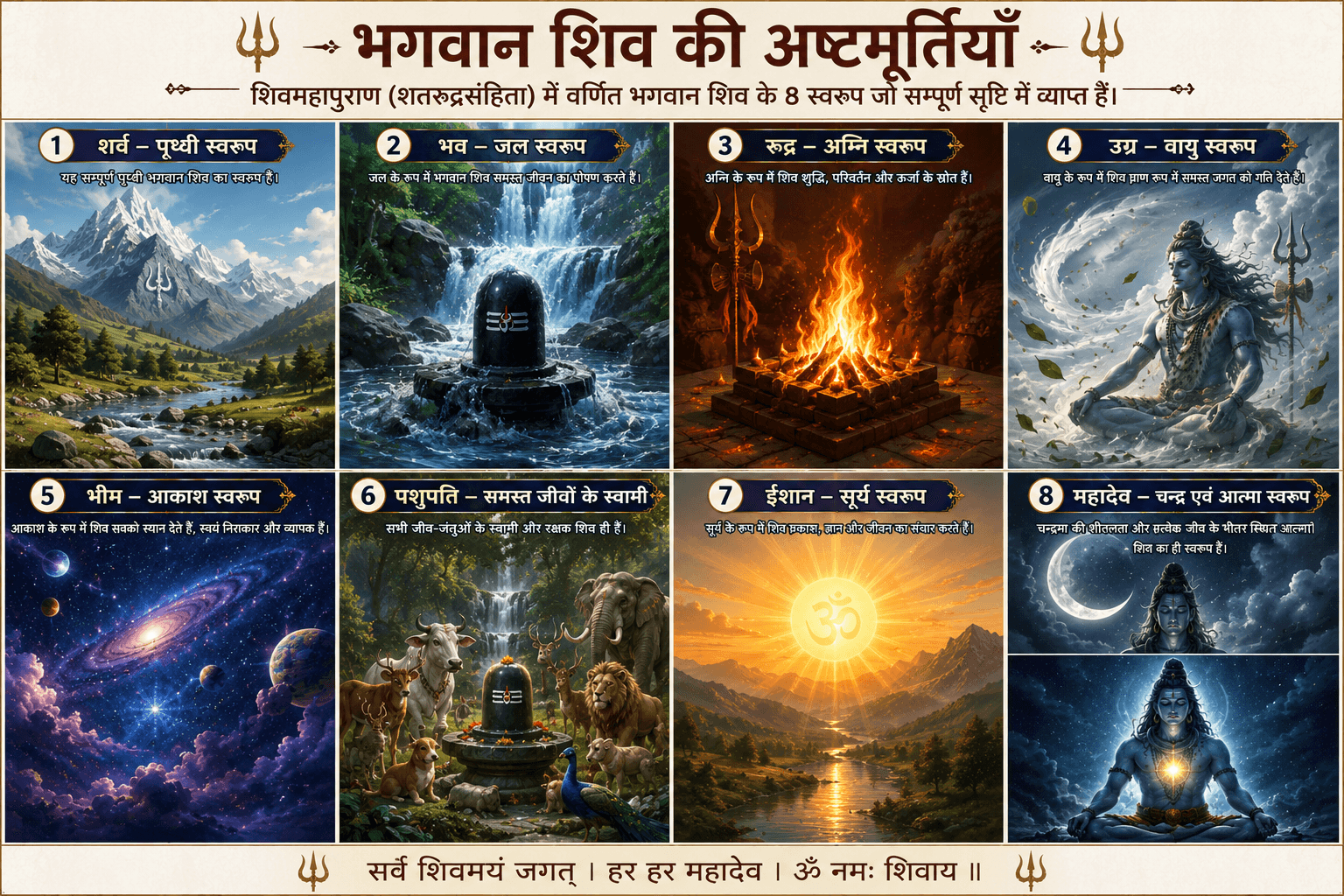
Ask most people to picture Shiva, and one image comes to mind: seated in meditation on Kailash, the Ganga flowing from his matted hair, a crescent moon on his forehead, a trident in hand.
But is Shiva really confined to a mountain? Is he simply one deity among many, or something closer to the fabric of existence itself?
The Shatarudra Samhita of the Shiva Purana answers this with a strikingly expansive idea: Shiva is Ashtamurti — present in eight forms across the entirety of creation. Once you see these eight forms, it's hard to look at nature, other living beings, or your own inner awareness the same way again.
What Is Ashtamurti?
"Ashta" means eight, "murti" means form. According to the Shiva Purana, Shiva pervades all of creation through eight principal forms:
- Sharva — Earth
- Bhava — Water
- Rudra — Fire
- Ugra — Wind
- Bheema — Sky
- Pashupati — All living beings
- Ishana — The Sun
- Mahadeva — The Moon and the Self
Nandishvara tells Sanatkumara that just as countless beads are strung on a single thread, the entire universe rests within these eight forms of Shiva.
The Eight Forms, One by One
1. Sharva — The Earth Itself
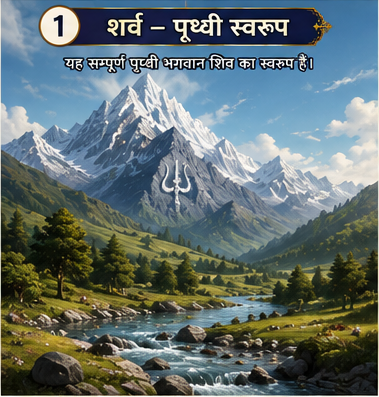
Shiva's first form is Sharva — the earth in its entirety is considered his body. The ground we walk on, the mountains that rise from it, the forests, rivers, and countless creatures it sustains — none of this is mere soil. It is Shiva's own form, made tangible. This is part of why Indian culture has always addressed the earth as mother.
Consider this: the earth never discriminates between the feet that walk on it. King or beggar, saint or sinner — the ground bears everyone's weight equally, without complaint. That patience, that willingness to become an unconditional foundation for everything, is the real essence of the Sharva form. The way a mother nourishes all her children without distinction, the earth — Shiva's Sharva form — offers shelter to every living being without any condition attached.
Once this form is understood, our relationship with the earth has to shift. When we clear-cut forests, hollow out mountains, or poison soil with chemicals, we aren't merely misusing an inert resource — we're inflicting damage on what is, quite literally, the body of Shiva. This is precisely why planting trees, protecting rivers, and treating land with reverence have always carried religious weight in this tradition — all of these acts are, in effect, service to the Sharva form.
To protect the earth, to treat it with respect, to refuse to plunder its resources — this, in a very literal sense, is worship of Shiva's Sharva form.
2. Bhava — The Form of Water
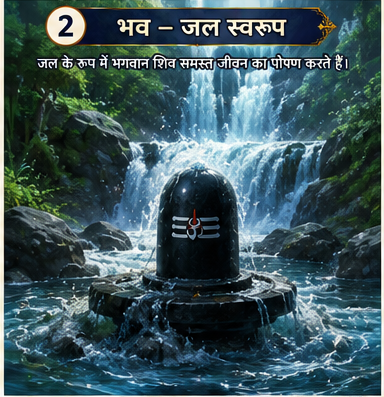
The second form is Bhava. Water is the foundation of all life. Rain, rivers, lakes, oceans, and the current of life flowing inside every living being — all of it is an expression of Shiva's Bhava form. Water isn't merely something that quenches thirst; it sustains life itself.
Notice something about water: it has no fixed shape of its own, yet it takes the shape of whatever holds it — round in a round vessel, square in a square one. That flexibility, that capacity to fit anywhere without resistance, is what the Bhava form is really pointing toward. Just as water naturally flows downward, toward the lowest point, without ego and without resistance, Shiva's compassion, too, flows first and most freely toward those who are humble and dependent. This is exactly why Shiva is called Gangadhara — the one who bears the river in his own hair, as though personally taking on the responsibility of holding this life-giving force in place.
Since ancient times, rivers have been honored as goddesses, wells and ponds have been worshipped — not as superstition, but as a direct acknowledgment that Shiva himself resides within water. When rivers grow polluted today and groundwater tables keep falling, that isn't simply an environmental crisis — it's a reflection of our neglect of the Bhava form.
Honoring water, refusing to waste it, and keeping water sources clean is, in this light, itself an act of worshipping Shiva.
3. Rudra — The Form of Fire
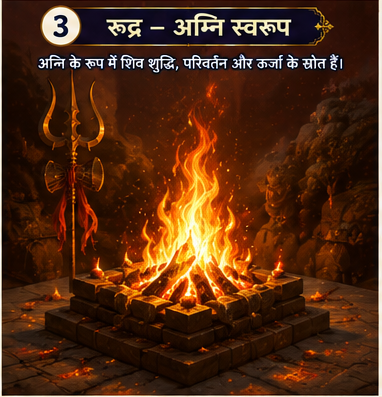
The third form is Rudra — fire itself. Fire doesn't only burn; it also purifies. The fire of a yajna, the fire that cooks a meal, the digestive fire within the body, the heat of the sun — all of these are different expressions of Rudra's power.
Fire has one particular quality: whatever is offered into it, it transforms into its own nature. Wood or ghee, ritual offerings or something impure — fire reduces all of it to ash, and from that ash, a fresh purity emerges. This is the deeper secret of the Rudra form — it doesn't merely destroy, it renews through destruction. The way a forest fire burns away old, dried-out trees to clear space for fresh growth, Shiva's Rudra form burns away our old, worn-out thoughts and habits to open a path for new life.
This is exactly why Shiva is called "Rudra" — one who both makes one weep and puts an end to suffering. The "burning" felt during austerity, during ritual, or simply in life's hardest moments, is in fact the Rudra form at work — purifying us, even when it doesn't feel that way at the time.
Fire is the agent of transformation, which is why Shiva's Rudra form is understood as both change and purification.
4. Ugra — The Form of Wind
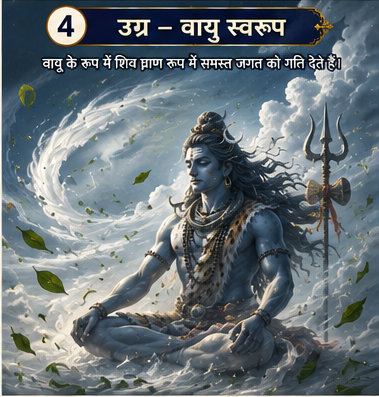
Shiva's fourth form is Ugra — the wind. Wind cannot be seen, yet life is unthinkable without it. In every breath, in the sway of every tree, in the drift of clouds, in the motion of ocean waves — the Ugra form is at work.
Wind has a striking quality: it is invisible, yet it carries some of the most powerful effects in nature. A storm can uproot trees, but that same wind, slowed down, becomes the cool breeze that lulls an infant to sleep. This duality — ferocity and gentleness held in the same force — is exactly what the name "Ugra" points to. Shiva is much the same: fierce when the moment calls for it, as in the Tandava, and profoundly gentle when compassion is what's needed.
Paying attention to the breath — the entire tradition of pranayama and yoga — is, in effect, an attempt to consciously connect with this very Ugra form. When we breathe slowly and deeply, we are directly experiencing this form of Shiva. This is exactly why breath itself has been called Shiva's own touch — every inhale and exhale, whether we notice it or not, is an unbroken conversation with Shiva.
Breath itself is nothing but Shiva's own touch — that is the essence of the Ugra form.
5. Bheema — The Form of Sky
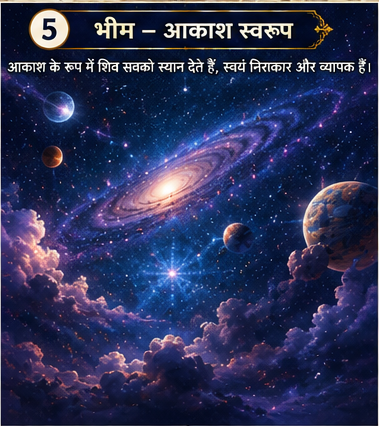
The fifth form is Bheema — the sky. The sky gives everything a place to exist — the sun exists within it, so does the moon, the stars, the planets — yet it is bound to none of them. In the same way, Shiva pervades the whole of creation while remaining unbound by any of it.
The sky has a remarkable quality: clouds pass through it, storms rise within it, birds and planes cross it — yet the sky itself remains untouched by any of it. Clouds never leave it wet; storms never shake it. This witnessing quality — seeing everything happen while remaining unaffected by it — is the deepest message the Bheema form carries. Just as there is no real difference between the sky enclosed within a room and the infinite sky outside — only walls create the illusion of a boundary — there is no real division in Shiva's pervasiveness either; only our limited perception manufactures the sense of separation.
This is exactly why the sky appears again and again as a metaphor in meditation and spiritual practice — the seeker is taught to make their own mind as vast and unobstructed as the sky, so that clouds of thought may come and go while the mind itself stays calm and undisturbed. That, in practice, is what the Bheema form asks of us.
That unbound vastness — everywhere present, yet bound by no limit — is the Bheema form.
6. Pashupati — Lord of All Living Beings
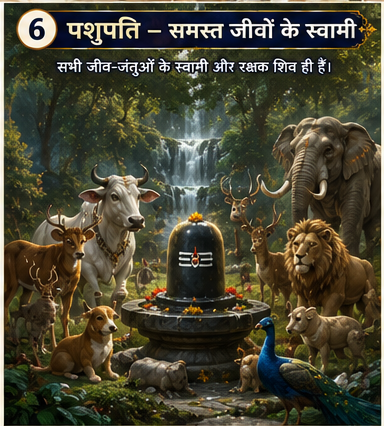
Most people take Pashupati to mean simply "lord of animals." But the Shiva Purana intends something far more expansive. Here, "pashu" refers to every living being — anyone who is born, lives, and eventually dies is a pashu. In this sense, humans are pashu too, as are birds and beasts, and even the smallest microorganisms.
Shiva is the lord of all such beings. Every creature depends on him; he alone sustains and nurtures them. But the deepest layer of meaning here is that the word "pashu" itself is tied to "pasha" — bondage. Whoever is bound is a pashu. And what are these bonds, exactly? Ignorance, ego, attachment, fear — these are the ropes that hold every living being in place. Shiva is the one who cuts through precisely these bonds, which is why he is called Pashupati — not lord of animals, but lord and liberator of every being caught in the noose of bondage.
This understanding shapes behavior in a real way. When we're cruel to an animal, or dismiss some creature as insignificant, we forget that it too carries a portion of Shiva within it — walking its own path toward release from bondage, just as we are. This is exactly why protecting cows, treating all beings with kindness, and practicing nonviolence have carried such weight in this tradition — all of them are, in effect, forms of worshipping the Pashupati form.
He alone frees beings from every fear, and it is he who cuts through the pasha — the binding noose of ignorance, ego, and attachment. This is precisely why this form is called Pashupati.
7. Ishana — The Form of the Sun
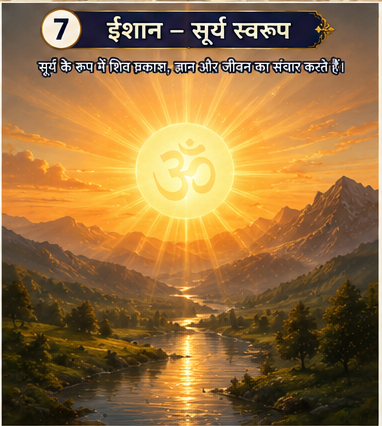
The seventh form is Ishana — the sun. The sun lights up the entire world; grain grows because of it, the seasons turn, life gains its rhythm. In the same way, Shiva's Ishana form spreads the light of knowledge through the world.
The sun has one unusual quality: it asks nothing of anyone, yet it keeps on giving without pause. It takes no day off, plays no favorites — it shines just as brightly over a thief's courtyard as over a saint's. That unconditional, uninterrupted giving is the true signature of the Ishana form. Knowledge works exactly the same way — real knowledge demands nothing in return; it simply presents itself to whoever is ready to have their inner darkness lifted.
Just as sunrise instantly dissolves a night's worth of darkness — no lengthy process required — the arrival of knowledge can erase years of accumulated ignorance in a single moment. This is exactly why a teacher is so often compared to the sun, and why Shiva himself is called the Adi-Guru, the original teacher from whom the entire lineage of knowledge is said to flow.
Just as the sun dispels outer darkness, Shiva dispels the darkness of ignorance through his Ishana form.
8. Mahadeva — The Moon and the Self
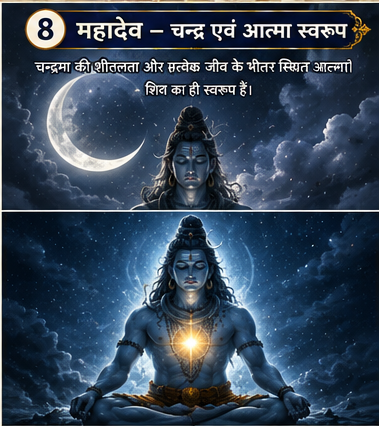
The eighth and final form is Mahadeva. The Shiva Purana names the moon as Mahadeva's form — its coolness, its balance, its nectar-like light, all carrying a message of peace into life.
There's a real difference between the sun and the moon: the sun is self-luminous, while the moon simply reflects the sun's own light, but presents it so gently that the eyes can take it in without straining. That gentleness, that cool, balanced light, is a symbol of the kind of equilibrium life asks for — neither excessive excitation nor excessive passivity. The moon waxes and wanes, yet remains whole throughout — much the way joy and sorrow, rise and fall, come and go in life, while an inner stillness can remain untouched underneath it all.
But the text doesn't stop there. It goes on to say that Shiva's most all-encompassing form is the Atman — the Self. That very Self resides within every living being. It is the witness, the supreme consciousness itself. This final form is what ties the other seven together — earth, water, fire, wind, sky, and every living being are all outward expressions, and the Self is their innermost core. The way a single thread strings together every bead on a necklace, the Self is the thread that gives the remaining seven forms their unity.
Which means: to know the Self within is nothing less than to know Shiva — and this is where the entire journey through Ashtamurti finally arrives.
What the Shiva Purana Is Actually Saying
The description of Ashtamurti was never meant merely as a list of eight names. Its real purpose is to show that nature is never separate from the Divine, that every living being deserves reverence, that protecting the environment is itself a form of devotion, and that all of creation is bound together by a single, shared consciousness.
If the earth is Shiva, why exploit it? If water is Shiva, why pollute it? If every creature carries a portion of Shiva within it, why meet it with violence or contempt? The vision of Ashtamurti offers something well beyond ritual worship — it offers a way of actually living.
Conclusion
Understanding Shiva was never meant to end at the temple door. When we honor the earth, conserve water, protect nature, treat living beings with compassion, and make an honest effort to recognize the Self within — that is when worship of Shiva becomes real.
The Ashtamurti of the Shiva Purana teaches exactly this: Shiva is not confined to any single place — he pervades the whole of creation. Which is why it has always been said — "Sarvam Shivamayam Jagat" — this entire universe is permeated by Shiva.
Related reading: What Is the True Nature of Atman and Brahman? and What Practices Lead to Experiencing the Oneness of Atman and Brahman?
Author's Note
Key Terms
| Term | Meaning |
|---|---|
| Ashtamurti | Shiva's eight forms — Sharva, Bhava, Rudra, Ugra, Bheema, Pashupati, Ishana, Mahadeva |
| Sharva | The form of earth |
| Bhava | The form of water |
| Rudra | The form of fire |
| Ugra | The form of wind |
| Bheema | The form of sky |
| Pashupati | Lord of all living beings |
| Ishana | The form of the sun — the light of knowledge |
| Mahadeva | The form of the moon and the Self — supreme consciousness |
Sources
- Shiva Mahapurana — Shatarudra Samhita, Chapter 2 (description of Shiva's eight forms)
- Gita Press, Gorakhpur edition