
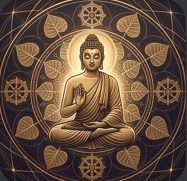
"The formless Brahman can never take a physical form — this is what the Vedas say, and Shankaracharya himself holds this position." This claim has come up repeatedly in recent years — in a video here, a social media post there, sometimes from an acquaintance who'd heard it secondhand. It's the same skepticism that surfaces whenever someone hears the untold story of how Brajbhumi appeared on earth and wonders how literally to take it.
The first time this question landed in front of me, the first thing I did was open the very texts the claim cited and read them myself. What I found there didn't match the claim at all. Below are the actual verses and commentaries — without added interpretation, exactly as they appear in the texts — so you can compare them yourself.
Summary — The Short Answer
The Shruti describes the Supreme Being on two levels. From the standpoint of ultimate truth, it is unborn, unchanging, and formless; but for the sake of worship and the establishment of dharma, that very Supreme Being takes on a divine form through its own power of maya. This isn't a later interpretation — the Yajurveda itself states, "Ajayamano bahudha vijayate" — though unborn, it manifests in many ways (Shukla Yajurveda 31.19). And Adi Shankaracharya himself clarifies this exact point in his commentary on Gita 4.6, using the phrase "dehavan iva jata iva." The original references and remaining evidence follow below.
Avatar in the Shruti — Look at the Actual Verses
Let's start with the most direct evidence, which often gets skipped in these discussions.
"Though Unborn, It Manifests in Many Ways"
Ajayamano bahudha vijayate.
Tasya dhirah parijananti yonim.— Shukla Yajurveda (Vajasaneyi Samhita) 31.19, Uttaranarayana Anuvaka
The meaning is direct — that Supreme Being, though never born, manifests in many forms, and only the wise grasp this mystery. Notice that the verse places "ajayamanah" (unborn) and "vijayate" (manifests) side by side. The Shruti itself is saying that the Supreme Being's unborn nature and its manifestation are simultaneously true. Reading this and still claiming "the Vedas don't accept avatars" didn't make sense to me personally — so I kept looking at the remaining verses.
The Golden Being — Described in the Upanishad Itself
Atha ya esho'ntaraditye hiranmayah purusho drishyate
hiranyashmashrur hiranyakesha apranakhat sarva eva suvarnah.— Chandogya Upanishad 1.6.6
The golden being seen within the orb of the sun — golden beard, golden hair, golden down to the fingernails. If the Vedas' entire purpose were only to establish an attribute-less, formless reality, why would these specific descriptions even be needed? This isn't a denial of form — it's an instruction for worshiping that very form.
The One Who Draws the Bow — a Being With Invoked Form
Aham rudraya dhanura tanomi
brahmadvishe sharave hantava u.— Rigveda 10.125.6 (Devi Sukta)
Divo varahamarusham kapardinam
tveshaṃ rupam namasa ni hvayamahe.— Rigveda 1.114.5
In the first verse, drawing the bow, releasing the arrow, striking down evil — these are all markers of conscious agency. The second verse explicitly names "kapardinam" (matted-haired) and "tveshaṃ rupam" (a radiant form) and then invokes that very form — "ni hvayamahe," we invoke. No one invokes a lifeless symbol.
Bowing to the Arms — the Rudrashtadhyayi
Namaste rudra manyava uto ta ishave namah.
Namaste astu dhanvane bahubhyam uta te namah.— Shukla Yajurveda 16.1 (Rudrashtadhyayi / Shatarudriya)
This is the very Rudrashtadhyayi still recited in every Rudrabhishek ritual today. Further along in this same chapter come "namo hiranyabahave" (to the one with golden arms), "nilagrivaya" (to the blue-throated one), "kapardine" (to the one with matted locks). Bowing to "arms" only makes sense for a being who has arms. Bowing to a void, or to some abstract principle, with reference to its arms carries no coherent meaning.
The Real Question — Does Shankaracharya Actually Deny Avatars?
This is exactly where the most confusion gets spread — in Shankaracharya's own name. So let's open his actual commentaries and check.
The Commentary on Gita 4.6 — the Decisive Evidence
Ajo'pi sann avyayatma bhutanam ishvaro'pi san.
Prakritim svam adhishthaya sambhavamy atmamayaya.— Bhagavad Gita 4.6
Meaning: though unborn and imperishable, and though the lord of all beings, I manifest through my own maya. On this verse, Shankaracharya writes that the Supreme Being, presiding over its own threefold maya, appears for the world's benefit "dehavan iva jata iva" — as if embodied, as if born.
Two words here deserve close attention — "iva" attached to "dehavan," and "iva" attached to "jatah." The commentator didn't write "dehavan" or "jatah" alone — he wrote "dehavan iva" and "jata iva." That single word "iva" (as if) answers the entire dispute. If avatars were genuinely impossible within non-dualism, Shankaracharya would have written, "this is merely a metaphor — nothing actually happens." He didn't write that. And if the Divine truly couldn't manifest in any form at all, there would be no reason to use the word "dehavan" in the first place.
Further in the same chapter, the Divine himself says — "Janma karma cha me divyam" (Gita 4.9) — my birth and action are divine. "Divya" means entirely distinct from ordinary material causes. This is exactly why scripture uses words like manifestation, appearance, and divine play for the Divine, rather than the ordinary word "birth."
Brahma Sutra 2.1.33 — If Creation Is Play, Why Not Avatars?
Lokavat tu lila-kaivalyam.
— Brahma Sutra 2.1.33
In his commentary on this sutra, Shankaracharya states that the Divine's impulse to create isn't to fulfill some lack, but is simply spontaneous play, the way worldly activity is. The logic here is direct — anyone who accepts the Brahma Sutras as authoritative has to accept this sutra too. And if the creation of the entire universe is possible as mere play, why should the play of manifesting an avatar for the sake of dharma be considered impossible?
The Shaligram Example — Directly Cited in the Commentaries
Shankaracharya repeatedly cites the example of the presence of Lord Hari in the Shaligram stone in his own commentaries — in the Brahma Sutra commentary at 1.2.7 and 1.3.14, and in the Taittiriya Upanishad commentary at 1.6.1. He cites this example not to explain someone else's mode of worship, but to reinforce his own argument. A commentator who cites the presence of the Divine in the Shaligram, and the recognition of Vishnu in an image, as valid proof — how could that same person deny the Divine's sacred form, the avatar? The two simply don't fit together — the same acceptance of divine form running through the very names by which Krishna is known and worshiped.
Two Common Objections, and Their Scriptural Answers
"If the Divine Takes Birth, Wouldn't It Fall Into the Bondage of Karma?"
This objection arises from placing a soul's birth and the Divine's manifestation on the same scale. A soul's body is the product of ignorance, craving, and karma — that's exactly why it's bondage. The Divine's manifestation arises from none of these — it happens "through its own maya" (atmamayaya, Gita 4.6). Using the same word "birth" in both cases doesn't make the two things equivalent — the way "rise" in "sunrise" and "the rise of a kingdom" share a word but mean entirely different things. Drawing sameness of meaning from sameness of word is a logical error, not a principle.
"A Body Means the Five Elements; the Five Elements Mean Modification; Modification Means Bondage"
This chain of reasoning collapses at its very first step — because it's never actually established that the body of the Divine's avatar-form is made of the five gross elements. Scripture says the opposite — "Janma karma cha me divyam" (Gita 4.9), meaning that form is divine, self-willed, and beyond material nature. Assuming, without evidence, that it's made of the five elements is the root of this entire confusion. The scriptural meaning of "formless" is: free of a body born of the five elements and of karma, limited in nature — not "incapable of taking any form." Denying that capacity ultimately ends up denying the Divine's omnipotence itself — and that's not acceptable to any scripture.
Five Markers for Recognizing a Divine Avatar
To keep the distinction between a soul's birth and the Divine's avatar clear, this five-point test is useful:
Absence of a body born of ignorance, craving, and karma — the form arises from free will, not from the fruit of karma.
Innate radiance of power — sovereignty present from birth itself, not earned through practice.
Nature remains undiminished — even while manifest, the unborn nature and all-pervasiveness remain intact ("ajayamano bahudha vijayate").
A divine, auspicious form beyond the five elements — "Janma karma cha me divyam" (Gita 4.9).
Omniscience and omnipotence remain unbroken — "bhutanam ishvaro'pi san" (Gita 4.6).
Author's Note
The root of this entire dispute traces back to a single error — an invented definition of the word "formless" gets constructed, one that appears neither in the Shruti nor in the commentaries. Claiming that a Divine Being who creates infinite universes as mere play (Brahma Sutra 2.1.33) "cannot take on a form" seems, to me, to actually limit that Being's omnipotence. And a limited Divine wouldn't be acceptable even to the people raising this objection. Reading the original texts directly makes it clear: there's no contradiction between formlessness and avatar — only a distinction of levels of reality, one that scripture itself openly acknowledges.
Evidence at a Glance
| Evidence | Source | What It Establishes |
|---|---|---|
| Ajayamano bahudha vijayate | Shukla Yajurveda 31.19 | The unborn Divine's manifold manifestation — direct Shruti evidence for avatar |
| The Golden Being | Chandogya Upanishad 1.6.6 | Worship-oriented description of the Divine's radiant human-like form |
| Aham rudraya dhanura tanomi | Rigveda 10.125.6 | The Divine's active agency — bow, arrow, striking down evil |
| Kapardinam tveshaṃ rupam | Rigveda 1.114.5 | Invocation of a matted-haired, radiant form |
| Bahubhyam uta te namah | Shukla Yajurveda 16.1 (Rudrashtadhyayi) | Bowing to the Divine's arms and form |
| Dehavan iva jata iva | Shankara's commentary on Gita 4.6 | Shankaracharya's clear acceptance of avatar |
| Janma karma cha me divyam | Gita 4.9 | The avatar's birth is divine, not material |
| Lokavat tu lila-kaivalyam | Brahma Sutra 2.1.33 | Creation is play — so avatar-as-play is possible too |
| The Shaligram example | Brahma Sutra commentary 1.2.7, 1.3.14; Taittiriya Upanishad commentary 1.6.1 | The commentator's own acceptance of the Divine's presence in an image |
Frequently Asked Questions
Is there evidence for avatars in the Vedas?
Yes. Shukla Yajurveda 31.19's "ajayamano bahudha vijayate" — manifesting in many ways despite being unborn — is direct Shruti evidence for avatar. Beyond this, Chandogya 1.6.6, Rigveda 10.125.6 and 1.114.5, and the Rudrashtadhyayi (Yajurveda chapter 16) also clearly describe the Divine's radiant form.
Did Adi Shankaracharya accept avatars?
Yes. In his commentary on Gita 4.6, he writes that the Supreme Being manifests through its own maya "dehavan iva jata iva." In his Brahma Sutra commentary (1.2.7, 1.3.14), he also cites the example of Hari's presence in the Shaligram.
How can the formless Brahman take on a form — isn't that a contradiction?
No. The scriptural meaning of "formless" is: free of a limited body born of karma and the five elements — not "incapable of taking a form." The Supreme Being is unborn in its ultimate nature, yet manifests with a divine form through its power of maya — that's a distinction of levels of reality, not a contradiction.
What's the difference between a soul's birth and the Divine's avatar?
A soul's birth is the result of ignorance, craving, and karma — it is bondage. The Divine's manifestation happens through its own maya, by free will — and is called "divine" (Gita 4.9). Sharing the word "birth" doesn't make the two equivalent.
Is image worship in keeping with the Vedas?
Adi Shankaracharya himself cites Vishnu's presence in the Shaligram and the recognition of Vishnu in a consecrated image as valid proof (Brahma Sutra commentary 1.2.7, 1.3.14; Taittiriya Upanishad commentary 1.6.1). So the worship of properly consecrated sacred images is a scripturally sanctioned tradition.
About the Author
Nripendra Mishra — a student of scripture and editor of Guru's Adda, with ongoing study of the Upanishads, the Bhagavad Gita, and the Brahma Sutras within the Shankara Vedanta tradition. Every verse and commentary quoted in this article has been verified against the original texts before being presented here.
Sources
Shukla Yajurveda (Vajasaneyi Samhita) — 31.19 (Uttaranarayana Anuvaka), Chapter 16 (Rudrashtadhyayi / Shatarudriya)
Chandogya Upanishad 1.6.6, with Shankara's commentary
Rigveda Samhita — 10.125.6 (Devi Sukta), 1.114.5
Bhagavad Gita 4.6 and 4.9, with Shankara's commentary — Gita Press, Gorakhpur
Brahma Sutra with Shankara's commentary — 1.2.7, 1.3.14, 2.1.33 — Swami Gambhirananda's translation (Advaita Ashrama); George Thibaut's translation, Sacred Books of the East
Taittiriya Upanishad with Shankara's commentary, 1.6.1
Note: every verse and commentary excerpt cited in this article has been re-checked against original editions. If any reference appears inaccurate, please let us know — we will correct it.
Guru's Adda — gurusadda.com | Scriptural Discourse Series