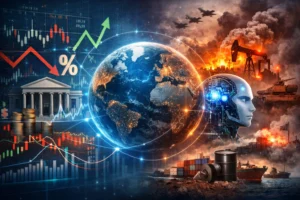
The morning coffee costs more. The heating bill arrives higher than expected. The grocery checkout total keeps climbing. Most people don’t immediately connect these everyday financial pressures to a missile strike in the Black Sea, a semiconductor factory in Taiwan, or a closed shipping lane near Yemen. But they should.
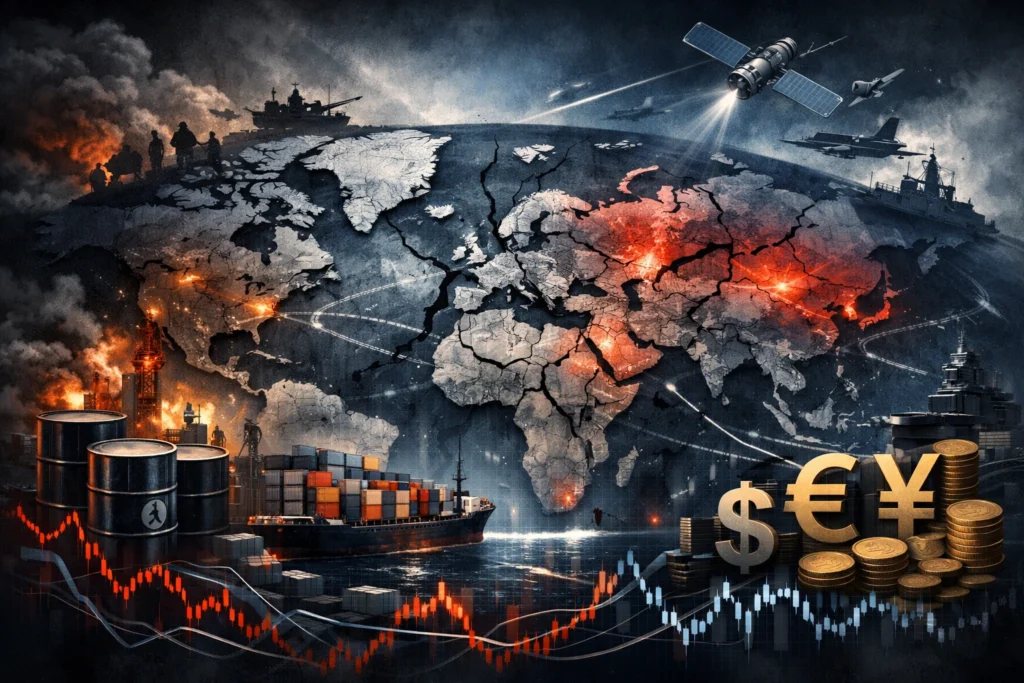
Economics textbooks once treated geopolitics as an external shock—something that occasionally disrupted otherwise predictable models of supply, demand, and growth. Those days are over. Today’s global economy operates in a world where political decisions in Moscow, Beijing, Washington, and Jerusalem don’t just influence markets—they are the market. A drone attack on Saudi oil infrastructure can raise inflation in Berlin. A trade restriction on advanced chips can slow manufacturing in Detroit. A naval blockade in a narrow strait can empty shelves in European supermarkets.
This isn’t crisis exceptionalism. It’s the new normal. The past decade has witnessed a fundamental shift in how economic power works. Globalization hasn’t disappeared, but it has fractured into competing spheres of influence. Free trade has given way to friend-shoring. Energy independence has become a national security priority. And central banks now watch geopolitical risk dashboards as closely as inflation data.
What follows isn’t simply a chronological list of conflicts and crises. These ten geopolitical events represent inflection points—moments when the rules of the global economic game changed. Some triggered immediate shocks that rippled through fuel pumps and stock exchanges. Others set in motion structural transformations that will shape economic reality for decades. Together, they reveal a world where diplomacy, military power, and economic strategy have become inseparable.
Understanding these events isn’t just academic. It’s essential for anyone trying to make sense of why prices behave the way they do, why certain industries are booming while others struggle, and why the economic future feels more uncertain than it has in generations.
1. Russia–Ukraine War and the Global Energy Shock
What Happened
In February 2022, Russia launched a full-scale invasion of Ukraine, triggering the largest land war in Europe since 1945. What began as a military conflict immediately became an economic earthquake. Russia, one of the world’s largest energy exporters, found itself subject to unprecedented Western sanctions. Europe, which had built its industrial model around cheap Russian natural gas, suddenly faced the prospect of freezing factories and darkened homes. Ukraine, a major global supplier of wheat, corn, and sunflower oil, saw its export infrastructure destroyed and Black Sea ports blockaded.
The war didn’t just disrupt two countries—it severed critical arteries of the global economy. European nations scrambled to find alternative energy sources. Global food prices spiked as Ukrainian grain couldn’t reach markets in Africa and the Middle East. The financial architecture that had integrated Russia into Western markets began unraveling.
Immediate Economic Shock
European natural gas prices exploded to ten times their pre-war levels within weeks. Germany, which had sourced over half its gas from Russia, faced the real possibility of industrial shutdowns during winter. Electricity costs across Europe surged, forcing energy-intensive industries like chemicals, steel, and glass to curtail production.
Oil markets convulsed as Brent crude shot past $120 per barrel, with consumers worldwide paying record prices at the pump. Inflation, already elevated from pandemic-era stimulus, accelerated sharply. The European Central Bank and Bank of England faced an impossible choice: raise rates to fight inflation and risk recession, or hold steady and watch prices spiral.
Global food inflation hit hardest in emerging markets dependent on Black Sea grain. Egypt, Lebanon, and numerous African nations faced bread shortages and social unrest. The United Nations warned of potential famine affecting tens of millions.
Financial markets initially plunged, then diverged. European equities suffered while American markets proved more resilient. The dollar strengthened dramatically as investors fled to safety, making dollar-denominated debt more expensive for emerging economies already struggling with higher food and energy costs.
Long-Term Global Economic Impact
Europe embarked on the fastest energy transition in modern history—not primarily for climate reasons, but for energy security. Germany accelerated renewable energy deployment, built liquefied natural gas import terminals in months rather than years, and restarted coal plants it had planned to retire. The continent’s industrial competitiveness faces a lasting reset. Companies that thrived on cheap Russian energy either relocated production, downsized, or absorbed permanently higher costs.
The sanctions regime against Russia created the most significant financial decoupling since the Cold War. Hundreds of Western companies exited the Russian market. Russia’s central bank lost access to roughly $300 billion in frozen foreign reserves, prompting urgent efforts to reduce dollar dependency. Trade increasingly flows through alternative payment systems and currencies, particularly with China and India.
Global food markets underwent structural realignment. Countries recognized the fragility of concentrated agricultural supply chains and began prioritizing domestic food security, even at higher cost. This trend toward food nationalism—export restrictions, stockpiling, subsidies for local production—reversed decades of agricultural trade liberalization.
Defense spending across Europe increased dramatically after years of decline. NATO members committed to spending at least 2% of GDP on defense, channeling hundreds of billions into military capabilities. This represents a permanent shift in fiscal priorities, with implications for public investment in other areas and long-term economic growth.
The war accelerated the fragmentation of the global economy into competing blocs. Countries increasingly make economic decisions based on political alignment rather than pure efficiency. The era of “the world is flat” globalization has given way to what some call “slowbalization”—trade that’s more regional, more politically conditional, and more expensive.
Why This Event Still Matters
The Russia-Ukraine war established a precedent for weaponizing economic interdependence. Countries now understand that deep integration into global markets creates vulnerability as well as prosperity. This insight is driving fundamental changes in how nations approach energy policy, trade relationships, and strategic reserves.
For investors and businesses, the war demonstrated that geopolitical risk isn’t a rare exception—it’s a permanent feature of economic planning. Supply chain resilience now matters as much as efficiency. Diversification away from geopolitically risky suppliers has become corporate strategy, not just crisis management.
The conflict also revealed that sanctions can impose significant costs on the sanctioning countries themselves. Europe’s willingness to absorb higher energy costs to support Ukraine showed that economic and security policy can no longer be separated. Future conflicts will likely see similar economic warfare, with all the disruptive consequences that entails for global markets.
2. US–China Strategic and Trade Rivalry
What Happened
The US-China relationship has evolved from “strategic engagement” to what many now describe as strategic competition or even a new Cold War. This transformation didn’t happen overnight, but the trajectory became unmistakable during the Trump administration’s 2018-2019 trade war, which imposed tariffs on hundreds of billions of dollars of Chinese goods. The Biden administration maintained most of these tariffs and expanded restrictions on technology transfers, particularly in semiconductors and artificial intelligence.
Beyond tariffs, the rivalry encompasses technology leadership, military positioning in the Indo-Pacific, control over critical supply chains, and competition for influence in developing countries. China’s Made in China 2025 initiative and Belt and Road projects represent efforts to achieve technological self-sufficiency and extend economic influence. American responses include export controls on advanced chips, restrictions on Chinese investment in sensitive technologies, and efforts to build alternative supply chains through partnerships with allies.
This isn’t simply two countries disagreeing on trade terms. It’s the world’s largest economy and the world’s second-largest economy decoupling in strategic sectors while remaining deeply intertwined in others—creating what some economists call a “managed separation” that generates constant friction.
Immediate Economic Shock
The initial trade war tariffs raised costs for American importers and consumers. Studies estimated the tariffs cost American households hundreds of dollars annually through higher prices on everything from electronics to furniture. Chinese exports to the US declined, but much of this was rerouted through third countries like Vietnam, Mexico, and Malaysia.
Supply chains that had spent decades optimizing for cost suddenly needed to optimize for political risk. Companies began “China plus one” strategies—maintaining Chinese production but diversifying to other locations. This transition proved expensive and time-consuming, contributing to broader inflation pressures.
Technology sectors faced immediate disruption. Huawei, once poised to dominate global 5G infrastructure, saw its international business collapse under US pressure. Chinese tech companies lost access to advanced American semiconductors and software. American firms like Apple and Intel faced revenue losses and the prospect of being shut out of the massive Chinese market.
Financial markets initially reacted with volatility to each escalation in trade tensions. Eventually, investors priced in a baseline level of US-China friction, but uncertainty remained high. Companies with significant China exposure saw their valuations pressured.
Long-Term Global Economic Impact
The US-China rivalry is reshaping global manufacturing geography. Vietnam, India, Mexico, and Eastern European countries have emerged as beneficiaries of supply chain diversification. However, this reorganization reduces efficiency. Producing in multiple locations rather than concentrating in the lowest-cost area increases expenses and complexity.
Technology development is bifurcating into American and Chinese ecosystems. China has poured resources into developing domestic semiconductor capabilities, artificial intelligence, and other strategic technologies, determined not to remain dependent on Western suppliers. The United States and its allies have formed partnerships like the CHIPS Act and technology alliances to maintain their lead. The result is duplicated research efforts and incompatible standards—economically wasteful but politically necessary.
The rivalry extends to infrastructure and development finance. China’s Belt and Road Initiative has funded ports, railways, and power plants across Asia, Africa, and Latin America, creating economic ties and potential political influence. The US and G7 nations responded with the Build Back Better World initiative (now Partnership for Global Infrastructure and Investment), offering an alternative model. Developing countries now navigate between competing offers, sometimes leveraging both.
Currency and financial systems face pressure. While the dollar remains dominant, China has steadily promoted the yuan for international transactions and developed alternative payment systems to reduce vulnerability to US sanctions. The percentage of global transactions in yuan remains small but is growing, particularly in trade with countries wary of US financial leverage.
Global institutions created in the post-World War II era—the World Trade Organization, International Monetary Fund, and World Bank—face challenges as the US and China compete for influence. China has created alternative institutions like the Asian Infrastructure Investment Bank. The fragmentation of global economic governance makes coordinating responses to crises more difficult.
Why This Event Still Matters
The US-China rivalry is the defining geopolitical dynamic of the coming decades. It affects decisions about where to build factories, which technologies to adopt, where to source materials, and which markets to prioritize. Unlike the US-Soviet Cold War, which involved limited economic interaction, the US and China remain deeply integrated in many sectors even as they decouple in others. This creates constant tension and uncertainty.
For businesses, the rivalry means political considerations increasingly override pure economic logic. A company might choose a more expensive supplier to avoid geopolitical risk. Governments might block investments that would be economically beneficial but strategically concerning. The predictability that characterized globalization’s heyday has given way to constant risk assessment.
The semiconductor restrictions imposed by the US in October 2022, which dramatically limited China’s access to advanced chips and manufacturing equipment, represent a watershed. These controls don’t just slow China’s technological progress—they create two separate technology ecosystems. Products designed for one market may not work in the other. Standards diverge. Innovation becomes duplicated rather than shared. The economic cost of this technological divorce will be substantial and permanent.
3. Israel–Hamas War and Middle East Instability
What Happened
On October 7, 2023, Hamas launched a large-scale attack on Israel from Gaza, killing over 1,200 people and taking hostages. Israel responded with a military campaign in Gaza that has resulted in tens of thousands of Palestinian casualties and massive destruction of infrastructure. The conflict quickly threatened to expand beyond Gaza, with exchanges of fire involving Hezbollah in Lebanon, Houthi forces in Yemen targeting shipping in the Red Sea, and periodic strikes between Israel and Iranian-backed groups in Syria and Iraq.
The war occurred against a backdrop of already heightened regional tensions: Iran’s nuclear program advancement, Saudi-Iran détente brokered by China, stalled Saudi-Israel normalization talks, and ongoing instability in Syria, Iraq, and Yemen. The conflict doesn’t exist in isolation—it connects to broader struggles over regional influence, oil market control, and the future of the Middle East order.
While the immediate violence centered on Israel and Gaza, the economic implications rippled globally through energy markets, shipping routes, defense spending, and geopolitical risk assessments.
Immediate Economic Shock
Oil markets experienced volatility as traders priced in the risk of broader conflict potentially involving Iran or affecting Gulf oil infrastructure. While prices didn’t spike as dramatically as in previous Middle East crises—partly due to substantial US shale production and strategic petroleum reserve releases—the “war premium” in oil futures reflected genuine supply risk concerns.
The shekel weakened and Israel’s equity markets declined as investors worried about economic disruption. Israel mobilized hundreds of thousands of reservists, pulling workers from the economy. Tourism effectively halted. The government announced significant increases in defense spending, straining fiscal accounts.
Regional economies faced disruption. Jordan and Egypt, which had substantial economic ties with both Israel and Palestinian territories, saw trade affected and tourism decline. The Gulf states, despite not being directly involved, faced pressure to demonstrate solidarity while managing relationships with Western partners.
The Houthi attacks on commercial shipping in the Red Sea forced many vessels to reroute around Africa, adding weeks to transit times and substantial costs. Container shipping rates for certain routes increased significantly. This supply chain disruption contributed to fears of renewed inflation pressures in Europe and the United States.
Long-Term Global Economic Impact
The Israel-Hamas war reinforced the Middle East’s status as a persistent source of global economic volatility. For decades, economists and strategists have predicted the region’s declining importance as energy sources diversify. Yet each new crisis demonstrates that Middle Eastern conflicts still send shockwaves through global markets.
Energy security concerns intensified. European nations, already reeling from the loss of Russian gas, confronted the reality that Middle Eastern energy supplies remain vulnerable to conflict. This accelerated investments in renewable energy and nuclear power—not just for climate reasons, but to reduce exposure to geopolitical risk in energy-producing regions.
The conflict highlighted the strategic importance of maritime chokepoints. The Red Sea-Suez Canal route handles roughly 12% of global trade and 8% of liquefied natural gas shipments. The vulnerability of this route to attacks by non-state actors demonstrated how relatively small groups can impose significant costs on global commerce. Insurance premiums for vessels transiting the area increased, adding to transportation costs.
Defense spending in the region continues to escalate. Israel announced major increases in military budgets. Gulf states, despite reduced tensions with Iran, maintain massive defense expenditures. Even countries on the periphery, like Egypt and Jordan, face pressure to increase security spending. These resources devoted to military capabilities represent economic growth not realized in other sectors.
The war complicated efforts at regional economic integration. Plans for transportation corridors linking Gulf states through Jordan and Israel to Europe faced setbacks. The Abraham Accords, which normalized relations between Israel and several Arab nations and promised economic cooperation, encountered new obstacles. Economic initiatives that might have benefited the region remain on hold.
For the global economy, the conflict contributes to a broader sense that geopolitical risk is not declining but intensifying. Businesses planning long-term investments must factor in the possibility of sudden disruptions from conflicts that seem geographically distant but have global economic reach.
Why This Event Still Matters
The Israel-Hamas war is a reminder that unresolved conflicts don’t fade away—they periodically explode with economic consequences. The underlying issues driving Middle East instability remain unaddressed: Palestinian statehood, Iran’s regional ambitions, sectarian divisions, resource scarcity, and competition among regional powers.
Each flare-up of violence doesn’t just create immediate economic disruption. It perpetuates a climate of uncertainty that discourages investment, raises insurance and financing costs, and keeps the “Middle East risk premium” embedded in global energy and financial markets. Companies that might invest in regional infrastructure or manufacturing capacity hesitate, knowing that conflict could erase their investments.
The war also demonstrated the interconnection between regional conflicts and global supply chains. The Houthi attacks on shipping showed how a conflict in one corner of the Middle East can disrupt commerce between Asia and Europe. In an era of just-in-time supply chains and global production networks, these disruptions cascade rapidly.
Looking ahead, the possibility of Israeli-Iranian escalation or a broader regional war remains. Such a conflict could immediately affect 20-30% of global oil production passing through the Strait of Hormuz, potentially triggering an energy crisis that would make previous shocks look minor. This tail risk—low probability but catastrophic consequences—forces policymakers and businesses to maintain costly contingency plans.
4. Red Sea Shipping Crisis and Maritime Security
What Happened
Starting in late 2023, Yemen’s Houthi forces began launching missiles and drones at commercial vessels transiting the Red Sea and Gulf of Aden, claiming solidarity with Palestinians during the Israel-Hamas war. The attacks targeted container ships, tankers, and bulk carriers, regardless of their actual connection to Israel. Several vessels were struck, crew members injured, and ships forced to reroute.
The response was dramatic. Major shipping companies—Maersk, MSC, Hapag-Lloyd, and others—suspended Red Sea transits and rerouted vessels around the Cape of Good Hope at Africa’s southern tip. This added approximately 3,500 nautical miles and 10-14 days to journeys between Asia and Europe. The United States and European nations launched Operation Prosperity Guardian to protect shipping, deploying warships to intercept Houthi missiles and drones.
What makes this crisis particularly significant isn’t just the immediate disruption—it’s what it reveals about vulnerability in global maritime trade. The Suez Canal and Red Sea route handles roughly 12% of global trade, including significant percentages of container traffic, oil, and liquefied natural gas. A relatively small group, using comparatively unsophisticated weapons, managed to disrupt a critical global trade artery.
Immediate Economic Shock
Shipping costs for Europe-Asia routes increased substantially. Container rates from Asia to Northern Europe roughly doubled at peak disruption as vessels rerouted around Africa. The added transit time meant shipping companies needed more vessels to maintain the same service frequency, tightening capacity and raising prices.
European importers faced delays in receiving goods from Asian suppliers. Components for manufacturing arrived late, forcing production adjustments. Retailers worried about inventory shortages, particularly for time-sensitive goods. The uncertainty made supply chain planning extremely difficult.
Energy markets felt the impact as well. Liquefied natural gas shipments from the Middle East to Europe faced higher costs and longer transit times. While not catastrophic—Europe had built substantial gas storage after the Russia-Ukraine war—the disruption reminded markets how vulnerable energy supplies remain to chokepoint disruptions.
Egypt’s economy suffered significantly. The Suez Canal generated over $8 billion annually in revenue, a crucial source of foreign currency. As ships rerouted around Africa, those revenues declined sharply. Egypt, already facing economic stress with high inflation and currency weakness, lost a vital income stream.
Insurance costs increased for vessels transiting the region. War risk premiums added substantial expenses per voyage. Some insurers required additional security measures or refused coverage for Red Sea transits altogether, forcing owners to self-insure at considerable cost.
Long-Term Global Economic Impact
The Red Sea crisis accelerated discussions about supply chain resilience that began during the pandemic and intensified with the Russia-Ukraine war. Companies already considering “nearshoring” or “friend-shoring” found additional motivation. The added cost and unreliability of maritime chokepoints favored production closer to end markets, even if unit costs were higher.
Maritime security emerged as a major geopolitical concern. The Red Sea attacks followed years of incidents in the Strait of Hormuz, piracy off Somalia, and tensions in the South China Sea. Protecting global shipping lanes requires sustained naval presence and international cooperation—both expensive and politically complex. Countries dependent on maritime trade recognized they couldn’t take safe passage for granted.
The crisis revealed asymmetric power dynamics. The Houthis, a non-state actor with relatively limited resources, imposed billions of dollars in costs on the global economy. This demonstrated that disrupting modern supply chains doesn’t require sophisticated military capabilities. Drones and missiles costing thousands of dollars could halt ships worth hundreds of millions carrying cargo worth even more.
Alternative routes gained attention. Discussions about Arctic shipping routes, overland rail corridors through Central Asia, and infrastructure to reduce dependence on traditional maritime chokepoints intensified. While these alternatives face significant obstacles—climate, infrastructure, cost—the Red Sea crisis provided motivation to develop them.
The crisis also complicated development finance and economic growth in East Africa and the Horn of Africa. International shipping companies became more reluctant to service ports in the region. Insurance costs for businesses operating there increased. The conflict in Yemen, previously seen as a largely regional humanitarian disaster, demonstrated global economic reach.
Why This Event Still Matters
The Red Sea shipping crisis illustrates a fundamental tension in globalization: efficiency versus resilience. The Suez route became dominant because it was the fastest, cheapest way to move goods between Asia and Europe. But concentration in a single route created vulnerability. When that route faces disruption—whether from conflict, accidents, or other causes—the entire system suffers.
Maritime chokepoints represent permanent sources of geopolitical risk. The Strait of Hormuz handles roughly 21% of global petroleum, the Strait of Malacca about 25% of traded oil, and the Suez Canal-Red Sea route a major portion of Asia-Europe trade. These narrow passages can be blocked, attacked, or closed for political reasons. As long as global trade depends on maritime shipping—and it will for the foreseeable future—these vulnerabilities persist.
The crisis also demonstrated that conflicts in seemingly peripheral regions can have global consequences. Yemen’s civil war, which has caused immense humanitarian suffering for years, was largely ignored by global economics discussions until Houthi attacks affected international shipping. This pattern repeats throughout history: conflicts are treated as regional problems until they disrupt global commerce, at which point they suddenly demand attention.
Looking ahead, climate change may actually increase reliance on vulnerable maritime routes before alternatives become viable. As Arctic ice melts, new routes may open, but they’ll take decades to develop the infrastructure and reliability of established passages. In the meantime, the world depends on routes that pass through increasingly unstable regions.
5. OPEC+ Energy Politics and Oil Price Volatility
What Happened
OPEC+, the alliance between OPEC nations and partners led by Russia, has evolved into the most powerful actor in global oil markets. This group, which controls roughly 40% of global oil production, uses coordinated production cuts and increases to manage prices. Recent years have seen particularly aggressive use of this power.
In 2020, as pandemic lockdowns crushed oil demand, OPEC+ implemented record production cuts to prevent price collapse. Then, as demand recovered, the group carefully managed supply increases to keep prices elevated. In 2022-2023, despite Western pressure to increase production and ease inflation, Saudi Arabia and Russia led additional cuts, pushing oil toward $90-100 per barrel even as economic growth slowed.
The geopolitics behind OPEC+ have grown increasingly complex. Saudi Arabia and Russia, despite being rivals in Syria and other contexts, have maintained close energy coordination. The Biden administration’s strained relationship with Saudi leadership over human rights and other issues reduced American influence over Saudi production decisions. China’s growing importance as an oil buyer shifted the focus of Persian Gulf producers toward Asian rather than Western markets.
OPEC+ decisions aren’t purely economic—they’re deeply political. Oil revenue funds government budgets across member states. Production levels affect geopolitical leverage. Energy exports provide diplomatic influence. The organization operates as much as a geopolitical alliance as an economic cartel.
Immediate Economic Shock
OPEC+ production decisions directly affect global oil prices, which in turn influence inflation rates worldwide. When the group cuts production, gasoline and diesel prices rise, increasing transportation costs throughout the economy. These higher energy costs feed into the prices of goods and services, contributing to broader inflation.
The 2022-2023 production cuts occurred as central banks fought to reduce inflation. The Federal Reserve, European Central Bank, and Bank of England raised interest rates to cool economies and slow price increases. OPEC+’s decision to keep oil prices elevated by restricting supply worked at cross-purposes, making central banks’ jobs harder and forcing more aggressive rate increases than might otherwise have been necessary.
Energy-importing nations faced deteriorating trade balances. Higher oil prices meant more money flowing to producers and less available for other imports or domestic spending. This particularly affected developing countries with limited foreign currency reserves, contributing to debt distress in nations like Pakistan, Egypt, and numerous African countries.
The US shale industry, while not part of OPEC+, responded to higher prices by increasing production. This partially offset OPEC+ cuts but highlighted the tension between short-term profits for oil companies and broader economic interests. American motorists paid more at the pump while US oil producers earned record profits.
Long-Term Global Economic Impact
OPEC+ has demonstrated that oil remains a potent economic weapon despite decades of predictions about declining fossil fuel importance. The energy transition to renewables is real and accelerating, but oil still powers transportation, manufacturing, and petrochemicals. That gives producers substantial leverage over consuming nations.
The alliance has proven remarkably durable despite internal tensions. Venezuela faces economic collapse, Libya struggles with civil conflict, and members have conflicting interests in regional disputes, yet OPEC+ maintains production discipline. This cohesion gives the group confidence to prioritize higher prices over market share, changing the dynamics of oil markets.
The US-Saudi relationship, historically a cornerstone of global oil market stability, has weakened. This reduces American ability to influence OPEC+ decisions during economic crises. When the US wants lower oil prices to combat inflation or support economic growth, it has fewer diplomatic tools to encourage increased production.
China’s growing importance as an oil importer shifts OPEC+ attention toward Asian rather than Western markets. The preferences and economic cycles of Chinese and Indian consumers increasingly matter more to producers than American or European concerns. This reorientation has geopolitical implications extending far beyond energy markets.
High oil prices, while benefiting producers, accelerate the transition away from fossil fuels. Each spike in gasoline prices improves the economic case for electric vehicles. Each surge in heating oil costs encourages switching to heat pumps. OPEC+ may be maximizing short-term revenue at the cost of accelerating the long-term decline of oil demand—or they may be rationally extracting maximum value from a resource with a limited window of peak profitability.
The strategic petroleum reserves that consuming nations built as emergency buffers have been drawn down significantly, particularly in the United States. Refilling these reserves at higher prices will be expensive, and the protection they offer against supply disruptions has diminished. This leaves consuming nations more vulnerable to future price spikes.
Why This Event Still Matters
OPEC+ production policies directly affect the cost of living for billions of people. When oil prices rise, so do costs for commuting, heating, food (due to transportation and fertilizer), and manufactured goods. These pressures fall hardest on lower-income households that spend a larger share of their budgets on energy and food.
The organization’s decisions complicate monetary policy. Central banks trying to manage inflation face the challenge that energy prices are partly determined by foreign policy decisions of oil-producing states. A central bank might successfully cool domestic demand, but if OPEC+ cuts production, inflation rises anyway. This makes achieving price stability more difficult and potentially requires more severe interest rate increases, increasing the risk of recession.
Energy security remains a permanent concern for importing nations. The transition to renewables will take decades. Until then, economic growth and stability depend partly on stable access to reasonably priced oil. OPEC+’s willingness to use production cuts for political or revenue goals reminds importing nations that energy independence—or at least diversification—carries significant value beyond pure economics.
The relationship between oil producers and consumers is changing. The old model—producers focused on market share, western consumers with dominant influence—has given way to a more multipolar system where producers prioritize revenue, Asian consumers matter most, and western influence has declined. This shift has profound implications for energy markets, geopolitics, and economic power.
6. NATO Expansion and Global Defense Spending
What Happened
NATO expansion, particularly following Russia’s invasion of Ukraine, represents one of the most significant shifts in European security and economic policy in decades. Finland joined NATO in 2023, ending decades of neutrality. Sweden completed accession in 2024, also abandoning long-standing non-alignment. These additions, prompted by the war in Ukraine, brought NATO to 32 members and positioned the alliance directly on Russia’s borders.
Beyond membership expansion, NATO allies committed to substantial increases in defense spending. The alliance’s guideline of 2% of GDP for defense, long honored more in breach than observance, became an imperative. Germany announced a €100 billion special fund for military modernization and committed to sustained higher defense budgets. Poland planned to spend over 4% of GDP on defense, one of the highest levels globally. Even previously reluctant nations like Spain and Italy increased military spending significantly.
This wasn’t just a European phenomenon. Japan, South Korea, Australia, and other Indo-Pacific nations increased defense budgets in response to China’s military expansion. The global trend toward higher defense spending represented a fundamental reallocation of economic resources from civilian to military purposes.
Immediate Economic Shock
Defense companies experienced a boom. Stock prices for major defense contractors surged as governments placed large orders for weapons, ammunition, aircraft, and naval vessels. Companies that had downsized after the Cold War suddenly faced demand they struggled to meet.
Government budgets came under pressure. Increasing defense spending by one or two percentage points of GDP means hundreds of billions of dollars in additional annual expenditure across NATO. These funds had to come from somewhere: higher taxes, increased borrowing, or cuts to other programs. Many European nations already struggled with aging populations, expensive social programs, and post-pandemic debt. Adding defense spending intensified fiscal pressures.
Labor markets tightened in defense sectors. Specialized workers—engineers, technicians, skilled manufacturers—faced high demand. Defense companies competed with civilian industries for talent, potentially bidding up wages and contributing to inflation pressures.
Supply chains for defense production, long optimized for peacetime demand, struggled to scale up. Ammunition production, in particular, couldn’t quickly meet the new demand for supplies to Ukraine plus expanded stockpiles for NATO forces. Bottlenecks emerged in specialized components, raw materials, and manufacturing capacity.
Long-Term Global Economic Impact
Sustained higher defense spending represents a permanent reallocation of economic resources. Economists debate whether defense spending stimulates or burdens economies. Proponents note that it creates jobs, drives technological innovation, and can have spillover benefits. Critics argue that resources devoted to military capabilities could generate more growth if invested in infrastructure, education, or research in civilian sectors.
European industrial policy is shifting. Countries that had largely abandoned domestic defense industries are rebuilding them. This drive for strategic autonomy—the ability to produce critical defense equipment domestically—is expensive and potentially inefficient but considered essential for security. The result is more fragmented defense markets with less specialization and scale efficiency.
The defense buildup affects civilian technology development. Historically, military research has produced innovations that later found civilian applications—the internet, GPS, jet engines. However, in recent decades, the flow has reversed somewhat, with civilian tech companies leading in areas like artificial intelligence, communications, and computing. Increased defense spending may shift research priorities and potentially slow civilian innovation.
Global trade in defense equipment is increasing. Countries expanding their militaries need equipment quickly and often lack domestic production capacity. This creates opportunities for exporters but also raises concerns about arms proliferation and regional security dynamics. The United States, European nations, Russia, and China compete for export markets, with sales sometimes driven more by geopolitics than pure commercial considerations.
The increased defense spending contributes to government debt burdens. Many NATO countries already have debt-to-GDP ratios above 100%. Adding significant military expenditure either worsens these ratios or requires difficult fiscal adjustments elsewhere. This limits government flexibility to respond to future economic shocks.
Brain drain from civilian to defense sectors could affect innovation. When top engineering talent and research budgets shift toward military applications, civilian industries may struggle to attract the people and funding they need for innovation. This could particularly affect Europe, which has already lagged behind the United States and China in key technology sectors.
Why This Event Still Matters
The shift toward higher defense spending represents a fundamental change in national priorities. For over thirty years following the Cold War’s end, developed democracies enjoyed a “peace dividend”—the ability to reduce military spending and invest those resources elsewhere. That era has ended. Security threats are rising, and nations are responding by rearming.
This shift affects economic growth prospects. Resources devoted to defense don’t directly increase living standards or productivity in the way that investments in education, infrastructure, or business capital might. While defense spending creates jobs and can drive some technological advancement, its primary purpose is security, not growth. Economies devoting more resources to defense may grow more slowly than they otherwise would.
The rearmament also affects fiscal sustainability. Many European nations face demographic challenges—aging populations and shrinking workforces—that will strain government budgets in coming decades. Adding substantial defense spending to already expensive healthcare and pension obligations creates serious fiscal pressures. Hard choices about taxes, benefits, or debt will be required.
Global inequality may worsen. While developed nations increase military spending, many developing countries lack resources for both defense and development. The competition for skilled labor, advanced technology, and capital may disadvantage poorer nations. Developed countries’ focus on security could mean less attention and resources for development assistance.
The trend toward higher defense spending is unlikely to reverse quickly. Even if immediate security threats diminish, the equipment being purchased now will need maintenance and eventual replacement. Defense budgets, once increased, prove politically difficult to cut. Countries have effectively committed to permanently higher military expenditure for decades to come.
7. Sanctions on Russia, Iran, and Technology Wars
What Happened
Economic sanctions have evolved from targeted measures against specific individuals or transactions into comprehensive weapons of economic warfare. The sanctions imposed on Russia following its invasion of Ukraine represent the most extensive ever levied against a major economy: asset freezes, trade restrictions, technology export bans, financial system exclusion, and oil price caps.
These sanctions joined existing regimes against Iran, which has faced severe restrictions since 1979 with significant escalation over its nuclear program, and North Korea, subject to UN sanctions for decades. China faces growing restrictions on technology imports, particularly advanced semiconductors and manufacturing equipment. The US Entity List, which restricts exports to certain companies, has expanded dramatically.
The sanctions aren’t just bilateral. The United States increasingly uses secondary sanctions—threatening penalties against third countries that trade with sanctioned nations. This extraterritorial reach leverages the dollar’s dominance in global finance and America’s market size to enforce compliance even from entities with no US presence.
Technology has become a particular focus. Export controls on advanced semiconductors aim to slow China’s military and AI development. Restrictions on Russia targeted its access to components for weapons systems. Iran faces technology sanctions affecting everything from aircraft parts to telecommunications equipment.
Immediate Economic Shock
Russian assets worth hundreds of billions of dollars were frozen in Western financial institutions. The country’s central bank lost access to roughly half its foreign exchange reserves. Major Russian banks were removed from SWIFT, the international payment messaging system, severely hampering trade finance.
Western companies rushed to exit Russia, writing off investments and abandoning operations. McDonald’s, Starbucks, IKEA, and hundreds of other firms closed stores and severed relationships. This capital flight represented one of the largest and fastest corporate retreats from a major economy in modern history.
The ruble initially collapsed before Russia’s central bank, using capital controls and mandatory conversion of export revenues, stabilized it. Russian imports plunged as access to foreign goods became difficult or impossible. Domestic inflation surged as supply shrank.
Iranian oil exports, officially subject to sanctions, continued through evasion and countries willing to defy US pressure, but at discounted prices. The sanctions crippled Iran’s formal economy, contributing to currency collapse and severe inflation. Ordinary Iranians saw living standards decline sharply.
Technology restrictions created immediate bottlenecks. Chinese companies suddenly cut off from advanced chips had to redesign products or halt production. Russian manufacturers couldn’t obtain components for electronics and machinery. Iranian airlines flew aging aircraft they couldn’t properly maintain due to lack of parts.
Long-Term Global Economic Impact
The aggressive use of sanctions is prompting targeted nations to reduce dependence on Western financial systems and technologies. Russia, China, Iran, and others are developing alternative payment systems, increasing use of national currencies in bilateral trade, and building domestic technology capabilities.
De-dollarization has accelerated, though it remains gradual. The dollar still dominates global finance—roughly 88% of currency trading and 60% of central bank reserves. However, the share is slowly declining. Countries worried about potential sanctions are diversifying reserves and exploring alternatives for international transactions. China and Russia increasingly settle trade in yuan and rubles. BRICS nations discuss creating alternative financial infrastructure.
Technology decoupling is creating parallel ecosystems. Chinese companies, unable to access Western advanced chips, are developing domestic alternatives, though with a significant time lag. This duplication is economically inefficient—the world effectively funding two separate research and development tracks for similar technologies—but politically necessary from the perspective of countries seeking technological sovereignty.
Global supply chains are fragmenting along geopolitical lines. Companies must decide whether to serve the Western market or markets aligned with sanctioned countries, as serving both becomes increasingly difficult or impossible. This fragmentation reduces efficiency and increases costs.
Sanctions are proving less effective than hoped at changing behavior while imposing real costs on target populations. Russia adapted to sanctions through trade reorientation toward China, India, and the Global South. Iran survived decades of sanctions, though with significant economic damage. The political results are ambiguous, but the economic pain is clear.
The effectiveness of future sanctions may diminish as countries develop workarounds. Alternative payment systems, currency diversification, and sanction-resistant supply chains reduce leverage. Countries may become less vulnerable to economic pressure as they decouple from the Western-dominated system.
Humanitarian costs are substantial. Sanctions advocates argue they target governments and elites, but ordinary people invariably suffer. Inflation, unemployment, reduced access to goods and medical supplies, and economic hardship affect populations in sanctioned countries. This raises ethical questions about economic warfare’s human costs.
Why This Event Still Matters
Sanctions represent a form of economic power projection. Countries with large markets and control over key financial infrastructure can impose costs on rivals without military force. This seems attractive compared to war, but it’s not cost-free. Sanctions regimes require maintenance, enforcement, and allied cooperation. They can harm the imposing countries through lost trade and investment opportunities.
The weaponization of finance has strategic implications. If countries believe their assets might be frozen or their access to financial systems cut off, they have incentives to preemptively reduce vulnerabilities. This defensive action—reducing dollar holdings, developing alternative systems, building strategic reserves—gradually undermines the effectiveness of the sanctioning power’s leverage.
The technology sanctions on China are particularly consequential. Semiconductors are fundamental to modern economies—they’re in everything from smartphones to automobiles to weapons systems. US restrictions aim to maintain a permanent technology gap, keeping China behind in advanced chips and manufacturing equipment. If successful, this could maintain American strategic advantage. If it fails and China develops indigenous capabilities, it will have succeeded in forcing its most significant competitor toward technological independence.
The sanctions also test international cooperation. For maximum effect, sanctions need broad participation. The United States often struggles to maintain allied unity, particularly when sanctions impose economic costs on partners. European companies lost business in Russia and face risks in China. Maintaining coalition support for sustained economic pressure proves difficult when economic interests conflict with strategic goals.
Looking ahead, the question is whether the global economy fragments into competing blocs with limited economic interaction or whether pragmatism and mutual interests maintain substantial integration despite geopolitical tensions. Current trends suggest movement toward fragmentation, with all the efficiency losses and increased costs that entails.
8. China–Taiwan Tensions and Semiconductor Risk
What Happened
Taiwan sits at the nexus of geopolitics and economics in a way few places do. The island, which China claims as its territory, is home to the Taiwan Semiconductor Manufacturing Company (TSMC), which produces roughly 90% of the world’s advanced chips—the processors that power everything from iPhones to artificial intelligence systems to military hardware.
China has never renounced the use of force to reunify Taiwan with the mainland. In recent years, military tensions have escalated. China conducts regular military exercises around Taiwan, including missile launches and simulated blockades. Chinese aircraft routinely cross the median line in the Taiwan Strait. The rhetoric from Beijing has hardened. Meanwhile, the United States has increased arms sales to Taiwan and strengthened security commitments, though it maintains “strategic ambiguity” about whether it would defend Taiwan militarily.
The Trump administration began restricting Taiwan’s ability to supply advanced chips to Chinese customers. The Biden administration continued and expanded these restrictions. China has responded with pressure on Taiwan and efforts to build domestic semiconductor capabilities, though it significantly lags TSMC’s technology.
The tension creates an extraordinary concentration of economic risk. If conflict disrupted Taiwan’s semiconductor production, the global electronics industry would face catastrophic shortages. There are no quick substitutes for TSMC’s most advanced manufacturing.
Immediate Economic Shock
Military tensions periodically roil financial markets. When China conducted large-scale exercises around Taiwan in 2022 following then-House Speaker Nancy Pelosi’s visit, Taiwanese stocks fell and Asian markets declined. The immediate economic impact remained limited, but the incidents demonstrated how quickly tensions could escalate.
Companies with significant Taiwan exposure face valuation pressures. Investors recognize that concentration of production on an island facing potential military conflict creates unhedgeable risk. This affects not just TSMC but the entire ecosystem of suppliers, customers, and related industries.
Technology companies worldwide have begun considering how to secure chip supplies if Taiwan became unavailable. This scenario planning is difficult because there’s no realistic short-term alternative to TSMC for advanced chips. Companies can’t easily shift production elsewhere because the required manufacturing capability doesn’t exist.
The US and European governments, recognizing the vulnerability, have launched initiatives to build domestic semiconductor manufacturing. The US CHIPS Act allocated over $50 billion to encourage fab construction. Europe announced similar programs. TSMC itself is building facilities in Arizona and Japan. However, these fabs won’t reach full advanced production capacity for years.
Long-Term Global Economic Impact
The push for semiconductor manufacturing diversification represents one of the most expensive industrial policy efforts in decades. Building a modern semiconductor fab costs $20-30 billion and requires years of construction. Operating costs are enormous. The economically efficient solution would be concentration in the lowest-cost location—which is Taiwan. Instead, governments are paying massive subsidies to encourage production in multiple locations to reduce geopolitical risk.
This geographic diversification will permanently increase semiconductor costs. Production that was optimized for efficiency in Taiwan will be distributed across the US, Europe, Japan, and elsewhere, with each location operating below optimal scale. These higher costs will flow through to every electronic product and service.
The semiconductor supply chain is extraordinarily complex, with components, equipment, and materials sourced globally. Efforts to create “secure” supply chains require duplicating not just the final manufacturing but the entire ecosystem. This proves enormously difficult and expensive.
China’s efforts to develop domestic advanced semiconductor capabilities have made progress, though significant gaps remain. If China succeeds in producing competitive advanced chips, the global semiconductor market will effectively split into Western and Chinese ecosystems with limited interaction. This duplication is wasteful but appears increasingly likely.
Taiwan’s economy is increasingly vulnerable to both military and economic pressure. Semiconductor manufacturing accounts for over 60% of Taiwan’s stock market value and roughly 15% of GDP. Any disruption to this industry would devastate Taiwan’s economy. China could potentially achieve significant leverage through economic pressure short of military action.
The global electronics industry faces persistent uncertainty. Every company that depends on semiconductors—which is essentially every major manufacturer and technology company—must plan for potential supply disruptions. This increases costs, requires maintaining larger inventories, and generally reduces efficiency.
The military implications compound the economic ones. Advanced semiconductors are crucial for modern weapons systems. A country that controls semiconductor supply chains has significant strategic leverage. This makes the technology a national security concern beyond its economic importance.
Why This Event Still Matters
Taiwan represents perhaps the most dangerous flashpoint for potential great power conflict. A war over Taiwan would be catastrophic not just for the combatants but for the global economy. Beyond the human toll, semiconductor supply disruption would halt production of countless electronic products. Modern economies would face supply shocks with no historical precedent.
Even without war, the mere possibility affects economic decisions. Companies make investment choices accounting for Taiwan risk. Governments allocate enormous resources to reduce semiconductor dependence. These defensive actions are rational responses to risk, but they’re expensive and reduce efficiency.
The Taiwan situation highlights how economic interdependence, once considered a force for peace, can create vulnerability. For decades, the global economy optimized for efficiency, concentrating production where costs were lowest and quality highest. Taiwan became the overwhelming leader in advanced semiconductors because it was best positioned to do so. Now that concentration is recognized as a strategic liability.
China’s potential use of force against Taiwan is restrained partly by economic considerations—an invasion would be enormously costly and economically disruptive for China itself. However, if China’s leadership concluded that the long-term strategic imperative of reunification outweighed short-term economic costs, or if it believed the economic pain could be managed, that restraint might prove inadequate.
The United States faces difficult choices. Defending Taiwan would risk war with a nuclear-armed power and guarantee massive economic disruption. Not defending Taiwan would undermine alliances, potentially embolden Chinese assertiveness elsewhere, and leave critical semiconductor supply under potential Chinese control. There are no good options, only various degrees of risk.
For businesses and investors, Taiwan represents a risk that can’t be diversified away. It’s not a question of a particular company’s exposure—it’s systemic. If Taiwan’s semiconductor industry faces disruption, the global economy faces a supply crisis with cascading effects across industries. Planning for this scenario is difficult because the magnitude of disruption would be so large that normal business continuity measures would be inadequate.
9. Global Supply Chain Decoupling and Friend-Shoring
What Happened
The pandemic exposed the fragility of global supply chains optimized purely for cost efficiency. When China locked down, when ports congested, when shipping costs exploded, businesses and governments recognized that just-in-time inventory and single-source suppliers created vulnerability. This realization came alongside growing geopolitical tensions, particularly between the US and China, that made concentrated supply chains seem strategically risky.
The result has been a broad shift from “offshoring” (locating production wherever costs are lowest) toward “friend-shoring” (concentrating supply chains in geopolitically aligned countries) and “nearshoring” (bringing production closer to end markets). Companies are diversifying suppliers, increasing inventory buffers, and sometimes accepting higher costs for greater reliability and reduced political risk.
This represents a reversal of several decades of globalization trends. From the 1980s through 2010s, manufacturing increasingly concentrated in China and a few other low-cost locations. Global supply chains became longer and more complex, with components crossing multiple borders before final assembly. This model maximized efficiency but created dependencies that recent shocks exposed as liabilities.
Governments have encouraged this shift through policy. The US CHIPS Act, Inflation Reduction Act, and various European Union initiatives provide subsidies for domestic or allied-nation production. Export controls and sanctions accelerate decoupling by making trade with certain countries difficult or impossible. “Buy American” and similar provisions favor domestic suppliers even at higher cost.
Immediate Economic Shock
Companies undertaking supply chain restructuring face substantial costs. Qualifying new suppliers, building new facilities, and redesigning products for different manufacturing processes requires significant investment and time. These transition costs hit earnings and cash flow.
Manufacturing capacity that took decades to build in China can’t be replicated quickly elsewhere. Vietnam, India, Mexico, and other alternative locations lack the infrastructure, skilled workforce, and supplier ecosystems that made China attractive. Companies moving production face productivity gaps and quality issues while new locations develop capabilities.
Inflation pressures increased as companies absorbed higher costs. Production in higher-wage countries costs more than in low-wage locations—that’s why offshoring happened in the first place. When companies nearshore or friend-shore, unit costs typically rise. These higher costs get passed to consumers through higher prices.
Logistics became more complex. Instead of concentrating production in one location, companies now maintain multiple production sites. This requires more coordination, potentially more inventory, and generally higher logistics costs.
Developing countries that benefited from globalization’s first wave face mixed effects. Some, like Vietnam and India, are gaining as companies diversify from China. Others lose as advanced manufacturing proves difficult to attract and global trade grows more slowly than in previous decades.
Long-Term Global Economic Impact
The efficiency gains from globalization are partially reversing. Economists estimate that peak globalization—roughly 2000-2016—improved living standards significantly by reducing costs and increasing variety. Deglobalization reverses some of these gains. Products cost more to produce when manufacturing is distributed across higher-cost locations with smaller scale economies.
Regional trade blocs are strengthening while global integration slows. The United States-Mexico-Canada Agreement, European Union single market, and Regional Comprehensive Economic Partnership in Asia create zones of deep integration while barriers between blocs rise. This “slowbalization” means trade grows less rapidly than global GDP, reversing earlier trends.
Technology transfer and knowledge sharing are declining. When production concentrates in few locations, knowledge clusters develop and innovations diffuse more quickly. As production disperses and political barriers rise, these knowledge spillovers diminish. This could slow the pace of technological advancement.
Developing countries face reduced opportunities. The classic development path—attracting manufacturing, building skills, moving up the value chain—becomes harder if advanced countries insist on friend-shoring. Countries not part of the preferred geopolitical bloc struggle to integrate into high-value supply chains.
Labor markets are adjusting. Manufacturing employment in some advanced countries is growing after decades of decline. However, the jobs often differ from those that left—more automated, requiring different skills, and sometimes paying less than historical manufacturing wages. The labor market disruption of offshoring is partially reversing, but not identically.
Consumer choice and variety may decline. Globalization brought an explosion of product variety—companies could economically serve niche markets by producing globally and shipping worldwide. As production concentrates regionally and trade barriers rise, some products become unavailable or unaffordable in certain markets.
Innovation patterns are changing. When supply chains were global, companies could source components from wherever they were best produced and cheapest. Now political considerations constrain sourcing decisions. This may slow innovation as companies can’t always access the best components or must spend resources developing alternatives.
Why This Event Still Matters
The supply chain restructuring underway represents a fundamental reordering of the global economy. This isn’t a temporary adjustment—it’s a multi-decade transformation that will determine where things are made, how much they cost, and who benefits from manufacturing employment and industrial development.
The economic cost is substantial. Studies estimate that complete US-China decoupling could reduce global GDP by 5% or more—trillions of dollars permanently lost to reduced efficiency and scale economies. While full decoupling remains unlikely, even partial separation in strategic sectors imposes meaningful costs.
The shift affects geopolitics profoundly. Countries that successfully attract manufacturing gain economic benefits and strategic leverage. Those excluded lose opportunities and influence. Friend-shoring creates strong incentives for countries to align with one bloc or another, reducing space for neutrality or independent foreign policy.
For businesses, the transition creates both challenges and opportunities. Companies heavily invested in China face difficult choices about whether to stay, partially relocate, or fully exit. Those positioned to benefit from friend-shoring—manufacturers in Mexico, Vietnam, or Eastern Europe—face surging demand but need to rapidly build capabilities. Service companies must adapt to supporting more complex, dispersed supply chains.
The environmental implications are significant. Global supply chains’ carbon footprint was already substantial—moving components and finished goods thousands of miles by air and sea generates enormous emissions. However, concentrated production in specialized locations can be more efficient than dispersed production in multiple higher-cost locations. The net environmental effect of supply chain restructuring remains unclear.
The restructuring tests the resilience of global trade institutions. The World Trade Organization was designed to promote open trade and reduce barriers. The shift toward friend-shoring and trade restrictions challenges these principles. If countries increasingly prioritize security over efficiency, the WTO’s relevance diminishes, potentially weakening the rules-based trading system.
10. Rise of Economic Nationalism and Trade Protectionism
What Happened
The post-World War II international order was built on the premise that free trade benefits all participants and that economic integration promotes peace and prosperity. For decades, trade barriers fell, tariffs declined, and international commerce expanded dramatically faster than global GDP. That era is ending.
Across the political spectrum and around the world, economic nationalism has surged. This manifests in various forms: tariffs and trade barriers, “Buy National” provisions, industrial subsidies favoring domestic producers, restrictions on foreign investment in sensitive sectors, export controls on strategic goods, and requirements for local content in manufacturing.
Political leaders increasingly frame economic policy in terms of national sovereignty, strategic autonomy, and protecting domestic industries and workers. President Trump’s “America First” trade policy imposed tariffs and renegotiated trade agreements. President Biden maintained many of these measures and added industrial policy initiatives to strengthen American manufacturing. European leaders speak of “strategic autonomy” and building capacity to produce critical goods domestically. China’s “Made in China 2025” and “dual circulation” strategy emphasizes self-sufficiency in key technologies.
This isn’t simply large economies restructuring. Developing countries are also turning inward, imposing export restrictions on critical minerals and agricultural products, requiring technology transfer as a condition for market access, and subsidizing domestic industries. The number of protectionist measures implemented annually has increased dramatically since the 2008 financial crisis and accelerated further after the pandemic.
Immediate Economic Shock
Tariffs and trade barriers increase costs for businesses and consumers. When a country imposes tariffs on imports, domestic consumers pay higher prices. American consumers, for example, effectively paid the cost of tariffs on Chinese goods through higher retail prices. European consumers face higher costs for products subject to import restrictions.
Retaliation amplifies the damage. When one country imposes trade barriers, others respond in kind. The US-China trade war saw tit-for-tat tariff escalation that raised costs on both sides. European retaliatory tariffs on American goods harmed US exporters. These trade conflicts create lose-lose outcomes where both sides bear costs.
Business uncertainty increased dramatically. Companies making long-term investment decisions need predictable rules. When trade policy becomes a political football, subject to sudden changes, businesses delay investments or demand higher returns to compensate for risk. This uncertainty dampens economic growth.
Global value chains face disruption. Modern manufacturing often involves components crossing multiple borders—cars, electronics, machinery assembled from globally sourced parts. Trade barriers that seem targeted at one country ripple through these chains, affecting production far from the immediate dispute.
Financial markets responded with heightened volatility. Trade policy announcements triggered market swings. Investors struggled to price risk when rules could change unpredictably. Equity valuations in affected sectors declined as future cash flows became more uncertain.
Long-Term Global Economic Impact
The fundamental logic of comparative advantage—that countries benefit from specializing in what they do relatively well and trading for other goods—is being subordinated to political considerations. This makes the global economy less efficient. Countries produce goods they could more cheaply import, and consumers pay higher prices.
The “peace dividend” from economic integration is eroding. One argument for free trade was that economically interdependent countries have incentives not to fight each other. As economies decouple, this restraint weakens. Nations less economically entangled have fewer costs to consider when contemplating hostile actions.
Developing countries face a more difficult path to prosperity. The historical development model—export-led growth, attracting foreign investment, integrating into global supply chains—becomes harder when advanced economies prioritize domestic production and limit imports. This could trap countries in poverty and low development.
Innovation may slow. Historically, innovation has been accelerated by free exchange of ideas, scientists, and products across borders. As economic nationalism rises, countries restrict knowledge flows, limit immigration of skilled workers, and erect barriers to technology transfer. These restrictions reduce the cross-pollination that drives innovation.
Global institutions designed to facilitate trade are weakening. The World Trade Organization struggles to resolve disputes and update rules for modern commerce. Regional and bilateral agreements replace multilateral frameworks. The fragmented result is a more complex, less predictable trading system with higher transaction costs.
Income inequality could worsen within countries. Trade protection typically benefits specific industries and workers at the expense of consumers broadly. Tariffs on steel protect steel workers but raise costs for construction and manufacturing. The protected interests are concentrated and politically powerful, while the costs are diffuse, often resulting in regressive wealth transfers.
Fiscal costs are significant. Industrial subsidies and support for domestic producers require government spending. The US CHIPS Act, European Sovereignty Fund, and similar programs worldwide represent hundreds of billions in public expenditure. These costs must be financed through taxes or debt, with implications for fiscal sustainability.
Why This Event Still Matters
Economic nationalism represents a fundamental shift in how countries conceptualize the relationship between the economy and national power. For decades, the assumption was that prosperity derived from economic efficiency—producing what you’re good at, trading for the rest, and letting comparative advantage allocate resources. Now, security considerations and political pressures override pure efficiency calculations.
This shift has winners and losers. Protected domestic industries and their workers benefit. Consumers pay higher prices. Countries excluded from preferred trading relationships lose opportunities. Multinational corporations face more complex, fragmented markets. The overall effect is almost certainly negative—protectionism creates more costs than benefits—but costs and benefits distribute unevenly.
The rise of economic nationalism makes the global economy more fragile. When countries maintain deep trade relationships, they have strong incentives to resolve disputes peacefully and maintain stable relations. As economies decouple, these incentives weaken. The risk of conflicts escalating increases because the economic costs of conflict decline.
For younger generations, economic prospects may decline. The generations that came of age during peak globalization—roughly 1990-2015—benefited from rapidly growing trade, abundant opportunities for international careers, and declining costs for goods and services. Those entering the workforce now face a less integrated world with slower growth, higher costs, and more barriers to international opportunity.
The shift also affects geopolitical power. Countries that successfully build domestic capabilities in strategic industries gain leverage and security. Those that fail become more dependent and vulnerable. The competition to achieve self-sufficiency in critical sectors—semiconductors, pharmaceuticals, energy, rare earth minerals—is intensifying, with significant resources devoted to reducing dependencies.
Climate change mitigation becomes more difficult. Addressing climate requires global cooperation and efficient deployment of resources to reduce emissions at lowest cost. Economic nationalism works against this. If countries prioritize domestic production over efficiency, emissions reductions become more expensive. If geopolitical rivalries prevent cooperation on clean technology development and transfer, progress slows.
The question is whether this nationalist turn proves temporary—a reaction to recent shocks that will moderate as conditions stabilize—or permanent. If temporary, global trade might eventually recover its previous trajectory. If permanent, we’re witnessing a fundamental transformation in how the global economy operates, with consequences that will shape prosperity, geopolitics, and opportunity for decades.
The Permanent Intersection of Geopolitics and Economics
The ten events outlined above share a common thread: they demonstrate that economics and geopolitics can no longer be analyzed separately. The idea that markets operate according to economic laws while politics and security exist in a separate sphere has proven naïve. Every major economic decision now carries geopolitical implications, and every geopolitical development reshapes economic reality.
This transformation changes how we must think about the future. Economic forecasts that ignore geopolitical risk miss critical variables. Investment strategies based purely on financial metrics without considering political risk face surprises. Business plans that optimize for cost efficiency without weighing supply chain resilience prove inadequate. Government policies that treat economic growth as separable from security concerns fail to address the actual challenges nations face.
Central banks, once focused primarily on inflation and unemployment, now monitor geopolitical developments as carefully as economic data. Energy shocks triggered by conflicts, trade disruptions from sanctions, and defense spending pressures affect inflation, growth, and financial stability as much as traditional monetary variables. The European Central Bank’s response to the Ukraine war, the Federal Reserve’s attention to China tensions, and emerging market central banks managing currency crises triggered by geopolitical events all reflect this new reality.
For ordinary people, this intersection manifests in daily economic life. The price at the gas pump reflects OPEC+ decisions and Middle East tensions more than local supply and demand. Grocery costs incorporate the consequences of Black Sea shipping disruptions and fertilizer supply chains affected by sanctions. The availability and price of electronics depend on semiconductor supply chains vulnerable to Taiwan Strait tensions. Job prospects in manufacturing depend partly on friend-shoring policies and defense spending priorities.
The economic worldview that dominated from the 1980s through 2010s—increasing integration, declining barriers, markets as the primary organizing principle—is giving way to a more complex, contested landscape. This doesn’t mean globalization is ending or that trade will collapse. But the nature of the global economy is changing. Regional blocs matter more than global markets. Political alignment affects trade more than comparative advantage. Security considerations override efficiency calculations.
This transformation creates profound uncertainty. Businesses struggle to plan when political decisions can suddenly make investments obsolete. Investors find that traditional diversification strategies fail when geopolitical shocks affect assets globally. Policymakers face trade-offs between efficiency and resilience, between short-term costs and long-term security, between international cooperation and national sovereignty.
The question facing the global economy isn’t whether geopolitics will continue to matter—it will—but whether the international system can manage these tensions without catastrophic conflict or economic breakdown. The period from 1945-2015 featured increasing integration despite geopolitical tensions, partly because major powers avoided direct conflict and maintained basic economic cooperation. That cooperation is fraying. Trade wars, sanctions, technological decoupling, and military buildups all work against the economic integration that characterized recent decades.
History suggests that periods of geopolitical tension and economic fragmentation often precede major conflicts. The interwar period saw rising nationalism, trade barriers, competitive currency devaluations, and economic blocs—a pattern that culminated in World War II. The contemporary period shows concerning parallels: great power rivalry, economic decoupling, arms races, and alliance formation. Whether current leaders prove more capable than their predecessors at managing tensions and avoiding disaster remains an open question.
What is clear is that the next decade of global economic development will be shaped as much by decisions made in defense ministries and foreign offices as in central banks and finance ministries. The skills needed to navigate this environment differ from those that brought success in the previous era. Understanding geopolitics becomes as essential as understanding economics. Assessing political risk matters as much as financial analysis. Resilience and flexibility matter more than optimal efficiency.
For those trying to make sense of rising prices, employment uncertainty, investment volatility, and economic change, understanding these geopolitical events and their consequences is essential. The global economy doesn’t operate according to simple rules of supply and demand anymore—if it ever did. It operates in a world where political decisions about security, sovereignty, and power fundamentally shape economic outcomes. Ignoring this reality means misunderstanding the economic present and being unprepared for the future.