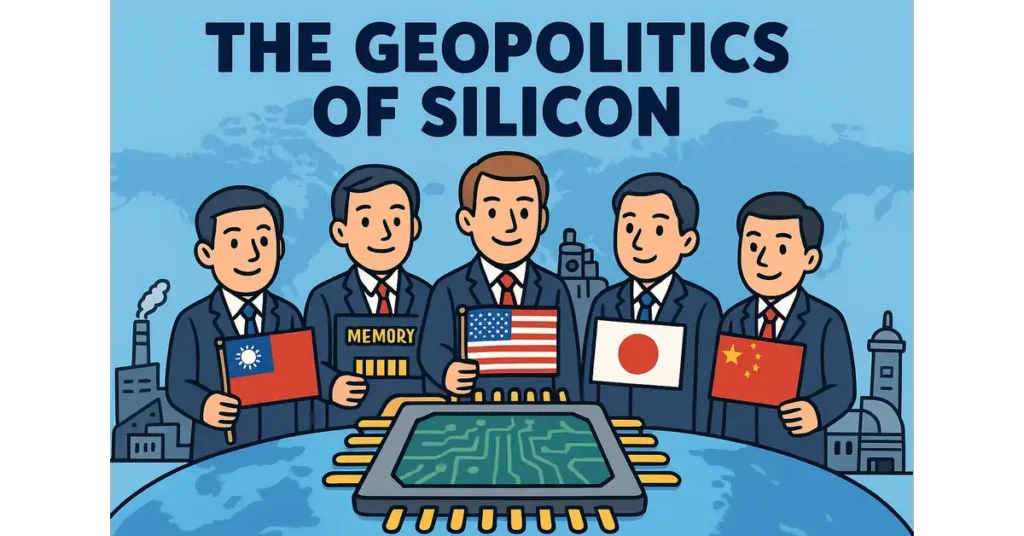
The semiconductor industry has evolved into the backbone of our digital economy, with just five nations controlling the destiny of global technology. These semiconductor industry leaders don’t just manufacture chips—they hold the keys to artificial intelligence, national security, and economic prosperity. The question isn’t who makes the most chips, but who controls the most critical pieces of this $574 billion puzzle.
The New Reality of Semiconductor Dominance
In today’s interconnected world, semiconductors are far more than electronic components. They’re the “central nervous system” of modern civilization, powering everything from smartphones to military defense systems. The COVID-19 pandemic exposed just how fragile our dependence on these tiny chips has become—when supply chains stuttered, entire industries ground to a halt.
What makes the current landscape fascinating is that no single country dominates everything. Instead, we see a sophisticated web of specialization where each semiconductor industry leader controls a specific, irreplaceable piece of the global value chain.
Understanding the Global Semiconductor Value Chain
Before diving into the leaders, it’s crucial to understand how the semiconductor industry actually works. The journey from chip concept to your smartphone involves multiple stages:
The Four Critical Stages
Design & Intellectual Property: Where the chip’s “brain” is created Equipment & Materials: The “picks and shovels” needed for manufacturing Fabrication: Where silicon wafers become functional chips Assembly & Testing: Final packaging and quality control
Each stage requires different expertise, capital investment, and technological capabilities. This natural specialization has created distinct regional powerhouses, each dominating their particular segment.
The Top 5 Semiconductor Industry Leaders: Complete Analysis
Taiwan: The Foundry Empire That Rules Advanced Chips
Taiwan stands as the undisputed champion of advanced chip manufacturing, wielding what experts call a “silicon shield” of immense geopolitical importance. The island nation’s dominance stems from one company that has revolutionized global technology: Taiwan Semiconductor Manufacturing Company (TSMC).
TSMC’s Market Domination by the Numbers
TSMC secured a 64% share of the global pure-play foundry business in Q3 2024, up from 62% earlier in the year, and reached 67% market share by Q4 2024. But these numbers only tell part of the story. When it comes to the world’s most advanced chips—the 3nm and 5nm processors that power flagship smartphones and AI accelerators—Taiwan commands 66% of global foundry capacity in advanced manufacturing processes.
Taiwan’s Semiconductor Ecosystem:
- Primary Companies: TSMC, UMC, MediaTek
- Market Share: 64-67% of global foundry market
- Advanced Process Leadership: 66% of cutting-edge chip production
- Manufacturing Plants: 180+ facilities
- Strategic Advantage: Pure-play foundry model
The “Pure-Play” Revolution
TSMC’s genius wasn’t just in manufacturing—it was in business model innovation. Unlike traditional semiconductor companies that design and manufacture their own chips, TSMC operates as a “pure-play” foundry. This means they manufacture chips designed by other companies, serving as the manufacturing partner for tech giants like Apple, Nvidia, and Qualcomm.
This model has proven incredibly profitable and difficult to replicate. TSMC has maintained continuous profitability since 1991, making it the go-to manufacturing partner for any company needing cutting-edge chip production.
Geopolitical Implications
Taiwan’s semiconductor dominance creates profound geopolitical tensions. The United States, despite its technological leadership, lacks domestic capability to manufacture its most advanced chip designs. This dependency effectively transforms Taiwan from a manufacturing partner into a strategic necessity for American national security.
South Korea: Memory Supremacy and Vertical Integration
South Korea’s semiconductor industry leaders, Samsung Electronics and SK Hynix, have built their empire on a fundamentally different model: vertical integration. These companies control everything from design to manufacturing to sales, giving them comprehensive control over their supply chains.
The Memory Market Battle
The memory chip market has witnessed dramatic shifts in 2025. SK Hynix’s share of the global DRAM market rose to 36.9% in Q1 2025, overtaking Samsung’s 34.4% share for the first time. This historic shift reflects SK Hynix’s strategic focus on High-Bandwidth Memory (HBM), the specialized chips essential for AI accelerators.
South Korean Memory Market Dominance:
| Company | DRAM Market Share (Q1 2025) | HBM Market Position |
|---|---|---|
| SK Hynix | 36.9% | 70% market share |
| Samsung | 34.4% | Struggling in HBM arena |
| Combined Market Control | 71.3% | Dominant position |
The AI Memory Gold Rush
SK Hynix has dominated the HBM market with 70% market share, positioning itself perfectly for the AI boom. HBM chips are essential for training and running large language models, making SK Hynix’s dominance particularly valuable as AI applications explode globally.
The demand is so intense that SK Hynix’s 2025 HBM memory supply has nearly sold out, with the company controlling roughly 46-49% of the overall HBM market according to TrendForce projections.
The K-Semiconductor Strategy
South Korea isn’t resting on its current success. The government has launched the ambitious “K-Semiconductor Strategy,” committing $450 billion alongside a $23.3 billion fiscal stimulus package. The centerpiece is the planned “K-Semiconductor Belt”—16 new fabs with total investment of KRW 622 trillion by 2047.
United States: The Design and Equipment Powerhouse
While America’s domestic chip manufacturing has declined to around 10% of global production, the United States remains the unchallenged leader in the most profitable and strategically important segments: chip design and manufacturing equipment.
The Fabless Advantage
American companies like Nvidia, Qualcomm, Apple, and AMD dominate the “fabless” model—they design the chips but outsource manufacturing to foundries like TSMC. This capital-light approach allows them to capture more than 40% of the global integrated circuit design market while avoiding the massive capital investments required for fab construction.
US Semiconductor Leadership Metrics:
- IC Design Market Share: 40%+
- Manufacturing Equipment: 44% of global wafer fab equipment
- Key Companies: Nvidia, Qualcomm, Intel, AMD, Micron
- Strategic Asset: Electronic Design Automation (EDA) tools
- Manufacturing Plants: 195 facilities
The CHIPS Act: America’s Industrial Policy Response
The 2022 CHIPS and Science Act represents America’s most significant industrial policy intervention in decades. The legislation authorizes $280 billion in new funding, with $52.7 billion specifically for semiconductor manufacturing subsidies and R&D.
However, implementation has faced challenges. Key research agencies have been underfunded by billions compared to the act’s authorization, and high demand for manufacturing funds has led the Commerce Department to cease funding for commercial R&D from key programs.
Export Controls as Strategic Weapons
The US leverages its technological leadership through export controls on advanced chips and manufacturing equipment to China. These restrictions, particularly on extreme ultraviolet (EUV) lithography machines, effectively limit China’s ability to produce cutting-edge semiconductors.
Japan: The Indispensable Materials and Equipment Supplier
Japan represents one of the most fascinating transformations among semiconductor industry leaders. Once commanding nearly 50% of the global market in the 1980s through companies like NEC and Toshiba, Japan has strategically repositioned itself as the indispensable supplier of upstream materials and equipment.
The “Picks and Shovels” Strategy
Japan’s current power lies in controlling the essential inputs that every chipmaker worldwide needs:
Japan’s Upstream Dominance:
- Manufacturing Equipment: 30% of global production
- Critical Materials: 50%+ market share in photoresists and photomasks
- Strategic Position: Essential partner for all major chipmakers
- Key Companies: Tokyo Electron, Kioxia, Renesas
- Manufacturing Facilities: 103 plants
The Rapidus Revival
Japan isn’t content with just upstream dominance. The new Rapidus consortium, in collaboration with IBM and Belgium’s IMEC, aims to produce cutting-edge 2nm chips by 2027. This initiative, combined with strategic partnerships like the TSMC-JASM joint venture, signals Japan’s focused return to advanced fabrication.
China: The Self-Sufficiency Drive and Mature Node Focus
China’s semiconductor strategy is driven by a national security imperative: achieving technological independence. The government’s “Made in China 2025” strategy sets ambitious goals, including 70% semiconductor self-sufficiency by 2025.
Rapid Market Growth Despite Restrictions
Despite facing significant US export controls, China has made remarkable progress. The number of registered chip companies increased from under 1,300 in 2011 to 22,800 by 2020. China exported $104 billion worth of integrated circuits in just the first eight months of 2024, demonstrating its growing manufacturing capabilities.
China’s Semiconductor Progress (2024 Data):
- Advanced Processes: <5% (limited by equipment restrictions to 7nm and above)
- Mid-Range Processes: 20% market share (SMIC mass producing 14nm, advancing to sub-10nm)
- Mature Processes: 40%+ market share (28nm and older nodes)
- Total Foundry Capacity: 28% of global capacity (TrendForce 2024)
- Manufacturing Plants: 181 facilities
- Key Company: SMIC provides IC manufacturing from 350nm to 7nm process technologies
- Strategic Advantage: Massive domestic market and comprehensive process node coverage
China’s Rapid Manufacturing Growth
The numbers tell a remarkable story of rapid expansion. China accounted for over 34% of global semiconductor sales in 2024, while holding 38% of the global market share in assembly, packaging, and testing activities. Even more striking, China’s total chip production surged by 40% in Q1 2024 to reach 98.1 billion units.
These figures reveal that China’s role in the semiconductor ecosystem is far more substantial than often portrayed. While the country may lag in cutting-edge process technologies due to equipment restrictions, it has become the manufacturing backbone for a vast array of semiconductor products.
The Fragmented Value Chain: A Strategic Analysis
The current semiconductor landscape is defined by what experts call a “fragmented value chain.” No single country controls every aspect of chip production, creating both opportunities and vulnerabilities.
Global Semiconductor Market Share by Region (2024)
| Region | Advanced Process Share | Primary Strengths | Key Vulnerabilities |
|---|---|---|---|
| Taiwan | 66% | Advanced foundry manufacturing | Geographic concentration risk |
| South Korea | 11% | Memory chips, vertical integration | China exposure |
| United States | 10% | Design, IP, equipment | Manufacturing dependence |
| Japan | N/A* | Materials, equipment | Limited fabrication |
| China | 9% | Mature nodes, assembly | Technology access restrictions |
*Japan focuses on upstream materials rather than fabrication
The Interdependency Web
This fragmentation creates fascinating interdependencies:
- Taiwan needs US-designed chips and Japanese materials
- South Korea relies on US customers and Japanese equipment
- United States depends on Asian manufacturing for its designs
- Japan serves as the essential supplier to all other regions
- China seeks independence while building alternative supply chains
Current Market Dynamics and Trends
The AI Revolution’s Impact
The artificial intelligence boom has dramatically shifted semiconductor demand patterns. HBM memory, essential for AI training, has become a critical battleground. HBM is projected to account for more than 20% of total DRAM market value starting in 2024, potentially exceeding 30% by 2025.
This shift has benefited companies positioned in the AI supply chain:
- SK Hynix: Dominates HBM production
- TSMC: Manufactures advanced AI accelerators
- Nvidia: Designs leading AI chips
- ASML: Supplies EUV machines for advanced nodes
Geopolitical Tensions Reshape Supply Chains
US-China tensions have fundamentally altered the industry landscape. Companies are being forced to choose sides, with South Korean firms like Samsung and SK Hynix facing particular pressure due to their significant Chinese operations.
The recent revocation of Validated End-User status for South Korean facilities in China creates uncertainty and pressure to relocate production, effectively aligning these companies with US strategic goals.
Future Outlook: The Race for Technological Independence
Supply Chain Diversification Imperative
Every major semiconductor industry leader is now pursuing supply chain diversification strategies:
- TSMC: Building fabs in Arizona and Japan
- Samsung: Expanding in Texas and considering additional US locations
- Intel: Massive domestic expansion under CHIPS Act funding
- SK Hynix: Evaluating US manufacturing options
The Technology Timeline
Looking ahead, several technological milestones will reshape competitive dynamics:
2025-2027 Key Developments:
- 2nm Process: TSMC and Samsung racing for leadership
- Chiplet Technology: New packaging approaches enabling modular designs
- Quantum Computing: Early commercial applications emerging
- Neuromorphic Chips: Brain-inspired computing architectures
Emerging Challengers
While the top five dominate today, emerging players are worth watching:
- India: Ambitious semiconductor manufacturing plans
- Vietnam: Growing assembly and testing capabilities
- Malaysia: Expanding packaging and testing operations
- European Union: Chips Act aiming for strategic autonomy
Strategic Implications for Businesses
Diversification Strategies
Companies dependent on semiconductors must develop sophisticated risk management strategies:
- Multi-source supplier relationships
- Geographic distribution of critical functions
- Inventory buffer strategies for critical components
- Alternative technology pathway development
Investment Considerations
The semiconductor industry’s capital-intensive nature and long development cycles require patient capital and strategic thinking. Key investment themes include:
- Advanced packaging technologies
- Specialty chemicals and materials
- Automation and manufacturing equipment
- Edge computing and AI acceleration
Conclusion: Navigating the New Semiconductor Reality
The global semiconductor landscape is more complex and strategically important than ever before. The five semiconductor industry leaders—Taiwan, South Korea, the United States, Japan, and China—each control critical pieces of a fragmented but interdependent ecosystem.
Success in this environment requires understanding that this isn’t simply a race for manufacturing capacity. It’s a multidimensional competition involving technological capability, geopolitical positioning, supply chain resilience, and market access.
For businesses, governments, and investors, the message is clear: the passive approach is no longer viable. The future belongs to those who understand the nuances of this complex landscape and position themselves accordingly.
The semiconductor industry will continue to be the battleground where technological leadership, economic prosperity, and national security intersect. The leaders who navigate this complexity successfully will shape not just the technology industry, but the global economy for decades to come.
Looking to understand more about semiconductor supply chains and their impact on your business? Stay informed about the latest developments in this rapidly evolving industry that powers our digital world.