Introduction: When Traditional Economics Failed, Keynes Found the Answer
Picture this: It’s 1933, and the United States is drowning in the depths of the Great Depression. Unemployment has skyrocketed to 25%, affecting 15 million Americans, soup kitchens line city streets, and families lose their homes daily. The prevailing economic wisdom says this will sort itself out naturally – just wait for wages to fall and employers will start hiring again.
But there’s a problem: it’s not working.
Enter John Maynard Keynes, a British economist who would fundamentally reshape how we understand unemployment. His revolutionary Keynesian theory of unemployment didn’t just challenge academic thinking – it provided a lifeline during humanity’s darkest economic hours.
The Keynesian theory of unemployment argues that joblessness isn’t always the fault of workers demanding too much money or being lazy. Instead, it suggests that sometimes entire economies get stuck in unemployment traps that only deliberate government action can break.
This isn’t just ancient economic history. From the 2008 financial crisis to the COVID-19 pandemic, governments worldwide still reach for Keynesian solutions when unemployment threatens to spiral out of control. The 2020 pandemic saw unemployment surge from 3.5% to 14.7% in just two months, prompting massive stimulus payments – a textbook Keynesian response.
What Is the Keynesian Theory of Unemployment?
The Classical View That Keynes Challenged
Before we dive into Keynes’s revolutionary ideas, let’s understand what he was fighting against. The Classical School of economics, dominant before the 1930s, painted a simple picture of unemployment:
- Unemployment is voluntary: People choose not to work because they’re holding out for higher wages
- Markets self-correct: If unemployment persists, wages will naturally fall until employers find it profitable to hire again
- Government interference is unnecessary: Free markets will automatically return to full employment
This theory worked well on paper and during normal economic times. But when the Great Depression hit, it became painfully clear that something was missing from this equation.
Keynes’s Revolutionary Insight
The General Theory of Employment, Interest and Money, published in February 1936, turned economic thinking upside down. The Keynesian theory of unemployment introduced a radical new concept: involuntary unemployment.
Keynes argued that unemployment could persist not because workers were asking for too much, but because there simply wasn’t enough demand for goods and services in the economy. When people stop buying, companies stop producing. When companies stop producing, they lay off workers. When workers lose their jobs, they have even less money to buy things. It’s a vicious cycle.
The core principle of the Keynesian theory of unemployment can be summarized as:
“Unemployment arises not because wages are too high, but because aggregate demand is too low. When demand is weak, firms reduce production, leading to layoffs, even if workers are willing to work at lower wages.”
Key Components of the Keynesian Theory of Unemployment
Aggregate Demand: The Heart of the Theory
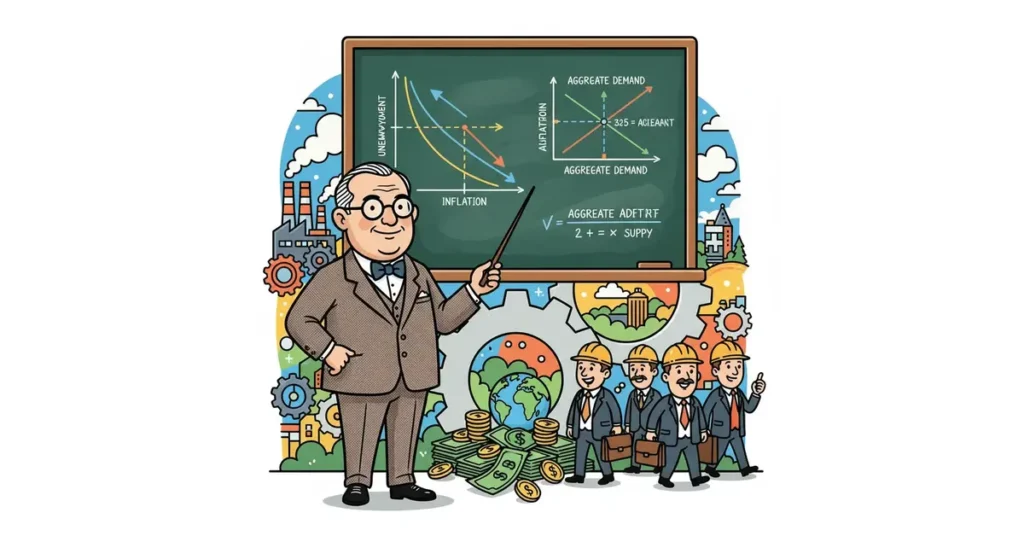
The Keynesian theory of unemployment revolves around the concept of aggregate demand – the total amount of spending in an economy. This includes:
- Consumption (C): What households spend on goods and services
- Investment (I): What businesses spend on equipment, buildings, and inventory
- Government Spending (G): What the government spends on everything from roads to salaries
- Net Exports (X-M): The difference between exports and imports
When aggregate demand falls below the economy’s productive capacity, unemployment rises. It’s like a restaurant that can serve 100 customers but only 60 show up – some servers will be sent home.
The Multiplier Effect
One of the most powerful concepts in the Keynesian theory of unemployment is the multiplier effect. Here’s how it works:
Example: The government spends $1 billion building a new highway.
- First Round: Construction companies hire workers and buy materials
- Second Round: Those workers spend their paychecks at local businesses
- Third Round: Those businesses hire more employees and order more inventory
- Fourth Round: The cycle continues, creating jobs throughout the economy
The final economic impact could be $2-3 billion or more, much larger than the initial $1 billion investment. This multiplier effect is why Keynesian economists argue that government spending during recessions can be highly effective.
Sticky Wages and Prices
The Keynesian theory of unemployment also recognizes that wages and prices don’t adjust as quickly as classical economists assumed. Reasons include:
- Labor contracts: Wages are often fixed for months or years
- Social norms: Cutting wages can damage worker morale and productivity
- Menu costs: It’s expensive for companies to constantly change prices
- Uncertainty: Businesses may prefer to lay off workers rather than cut wages across the board
This “stickiness” means that when demand falls, the adjustment happens through employment cuts rather than wage reductions – creating the involuntary unemployment that Keynes identified.
Real-World Applications: When the Keynesian Theory of Unemployment Proved Its Worth
The Great Depression: Keynes’s Theory in Action
The Great Depression was the Keynesian theory of unemployment‘s first major test, even though Keynes was still developing his ideas during the crisis.
The Problem: By 1933, unemployment in the United States reached 25.6% at its peak, affecting 15 million people. Traditional economic theory suggested this would naturally resolve as wages fell, but instead, the situation kept getting worse.
The Classical Prescription: Do nothing – let markets correct themselves.
The Keynesian Response: Franklin D. Roosevelt’s New Deal programs embodied Keynesian thinking before Keynes had even published his General Theory:
- Works Progress Administration: Employed millions in public works projects
- Civilian Conservation Corps: Put young men to work on environmental projects
- Social Security: Provided income support to maintain consumer spending
The Results: While recovery was slow, these programs helped stabilize the economy and provided a foundation for the massive economic expansion during World War II.
| Year | Unemployment Rate | Key New Deal Programs |
|---|---|---|
| 1933 | 24.9% | Banking reforms, Emergency Relief |
| 1935 | 20.1% | WPA, Social Security Act |
| 1937 | 14.3% | Continued public works |
| 1939 | 17.2% | Recovery stalled when spending cut |
| 1941 | 9.9% | War mobilization begins |
The Golden Age: Post-War Success Story
The period from 1945 to the 1970s is often called the “Golden Age of Capitalism,” and it was largely built on Keynesian theory of unemployment principles.
The Setup: After World War II, Western governments adopted Keynesian policies as standard practice:
- Active fiscal policy to maintain full employment
- Strong social safety nets
- Government investment in infrastructure and education
- International cooperation through institutions like Bretton Woods
The Results Were Spectacular:
- United States: Average unemployment 4.8% from 1948-1973
- Europe: Rapid reconstruction and rising living standards
- Global: Unprecedented period of economic growth and stability
This success seemed to validate the Keynesian theory of unemployment completely. Governments could actively manage their economies to prevent both unemployment and recession.
The 2008 Financial Crisis: Keynesian Theory’s Modern Test
The 2008 global financial crisis provided a crucial test for the Keynesian theory of unemployment in the modern era.
The Crisis: Financial markets collapsed, credit froze, and unemployment began rising rapidly around the world.
The Keynesian Response: Governments and central banks worldwide launched massive stimulus programs:
United States:
- American Recovery and Reinvestment Act: $831 billion
- Bank bailouts and quantitative easing
- Extended unemployment benefits
Europe:
- Coordinated fiscal stimulus
- European Central Bank interventions
- Individual country programs
Results: While the recovery was slower than hoped, most economists agree that Keynesian-inspired policies prevented a repeat of the Great Depression. The Keynesian theory of unemployment once again proved its value in crisis management.
COVID-19: The Ultimate Stress Test
The COVID-19 pandemic created the most severe unemployment crisis since the Great Depression, with unemployment jumping from 3.5% to 14.7% in just two months.
The Keynesian Response Was Swift and Massive:
The U.S. government implemented unprecedented fiscal relief programs totaling over $5 trillion across multiple stimulus packages.
Key Programs:
- CARES Act (2020): $2.2 trillion in relief, including $1,200 direct payments
- American Rescue Plan (2021): $1.9 trillion with $1,400 payments for eligible individuals
- Paycheck Protection Program: Kept workers on payrolls through forgivable loans
- Enhanced unemployment benefits: Extended and increased payments by $300-600 per week
Results: The unemployment rate fell much faster than in previous recessions, dropping from 14.7% in April 2020 to 6.3% by January 2021. While other factors contributed, the rapid Keynesian response was crucial.
Controversies and Criticisms of the Keynesian Theory of Unemployment
The Stagflation Problem of the 1970s
The biggest challenge to the Keynesian theory of unemployment came during the 1970s with the phenomenon of “stagflation” – simultaneous high unemployment and high inflation.
The Problem: Keynesian economics assumed a trade-off between unemployment and inflation (the Phillips Curve). You could have one or the other, but not both.
What Happened: Oil price shocks in 1973 and 1979 created exactly what Keynesian theory said was impossible:
- High unemployment (reaching 10.8% in 1982)
- High inflation (reaching 13.5% in 1980)
- Stagnant economic growth
The Impact: This crisis led to the rise of alternative schools of thought:
- Monetarism: Focus on controlling money supply (Milton Friedman)
- Supply-side economics: Emphasis on tax cuts and deregulation
- New Classical economics: Return to market-oriented solutions
The Crowding Out Debate
Critics argue that government borrowing to finance Keynesian stimulus programs creates a “crowding out” effect.
The Criticism: When governments borrow heavily to fund spending programs:
- Interest rates rise
- Private businesses find it more expensive to borrow
- Private investment falls, offsetting the benefits of public spending
The Keynesian Counter-Argument: During recessions:
- Private investment is already low due to weak demand
- Government spending can actually “crowd in” private investment by reviving confidence and demand
- Low interest rates during recessions minimize the crowding out effect
Modern Evidence: Studies of the 2008-2009 stimulus programs show mixed results, with some crowding out in normal times but less during deep recessions.
Long-term Sustainability Concerns
Another major criticism of the Keynesian theory of unemployment focuses on fiscal sustainability.
The Concern: Continuous reliance on deficit spending to combat unemployment can lead to unsustainable debt levels.
Real-World Examples:
- Greece (2010): Debt crisis forced harsh austerity measures despite high unemployment
- Japan (1990s-2000s): Repeated stimulus packages led to high debt-to-GDP ratios with mixed results
- United States (2020-2021): Massive COVID spending raised debt-to-GDP ratio from 107% to 127%
The Keynesian Response:
- Stimulus should be temporary and targeted to crises
- Economic growth from stimulus can help reduce debt ratios over time
- The cost of inaction (prolonged unemployment) is often higher than the cost of intervention
Modern Relevance of the Keynesian Theory of Unemployment
Why Keynesian Economics Still Matters Today
Despite decades of criticism, the Keynesian theory of unemployment remains highly relevant for several reasons:
Crisis Management: When economic crises hit, even the most conservative governments tend to adopt Keynesian policies:
- Tax cuts and spending increases
- Central bank interventions
- Direct support for affected workers and businesses
Behavioral Economics: Modern research supports Keynesian insights about human behavior:
- People don’t always act rationally as classical theory assumes
- Wages and prices are indeed “sticky” due to contracts, norms, and psychology
- Confidence and expectations play crucial roles in economic outcomes
Global Integration: In today’s interconnected world, demand shocks can spread rapidly across borders, making coordinated Keynesian responses even more important.
Neo-Keynesian Adaptations
Modern economists have updated and refined the Keynesian theory of unemployment to address past criticisms:
New Keynesian Economics incorporates:
- Microeconomic foundations for sticky wages and prices
- Rational expectations (people learn from experience)
- Supply-side factors alongside demand management
- International trade and capital flows
Key Insights:
- Keynesian policies work best during severe recessions
- Supply-side reforms are important for long-term growth
- Inflation targeting and fiscal rules can prevent policy mistakes
- International coordination enhances effectiveness
Lessons for Future Policy
The Keynesian theory of unemployment offers several important lessons for modern policymakers:
Timing Matters: Keynesian stimulus works best when deployed quickly during crisis onset, not after unemployment has already entrenched itself.
Size Matters: Small stimulus packages often fail because they’re insufficient to break the unemployment trap. It’s better to do too much than too little during a crisis.
Design Matters: Modern Keynesian policy focuses on:
- Direct cash transfers to those most likely to spend
- Infrastructure investment with long-term benefits
- Support for state and local governments
- Automatic stabilizers that kick in during downturns
Exit Strategy: Successful Keynesian policy requires clear plans for reducing stimulus as the economy recovers.
Practical Applications of Keynesian Theory Today
Digital Age Adaptations
The Keynesian theory of unemployment has found new applications in our digital economy:
Gig Economy Challenges: Traditional unemployment insurance doesn’t cover gig workers, leading to calls for Keynesian-style universal basic income during economic downturns.
Automation Displacement: As technology replaces jobs, Keynesian job guarantee programs are being reconsidered as ways to maintain full employment.
Platform Economics: Digital platforms can quickly scale up or down employment, making rapid Keynesian responses even more important.
Environmental Economics
Climate change has created new opportunities for Keynesian theory of unemployment applications:
Green New Deal: Proposals for massive government investment in clean energy infrastructure mirror classic Keynesian public works programs.
Just Transition: As fossil fuel industries decline, Keynesian job retraining and placement programs help displaced workers.
Carbon Pricing: Revenue from carbon taxes can fund Keynesian-style employment programs in green industries.
Global Coordination
International applications of the Keynesian theory of unemployment are becoming more sophisticated:
Currency Coordination: Central banks coordinate stimulus to prevent competitive devaluations.
Trade Policy: Understanding that one country’s imports are another’s exports leads to coordinated stimulus rather than protectionism.
Development Economics: International development organizations use Keynesian principles to design aid programs that create sustainable employment.
Conclusion: The Enduring Legacy of Keynesian Unemployment Theory
The Keynesian theory of unemployment represents one of the most important intellectual breakthroughs in economic history. By recognizing that unemployment could persist due to insufficient demand rather than worker stubbornness, Keynes provided both an explanation for economic crises and a roadmap for addressing them.
From the Great Depression to the COVID-19 pandemic, the core insight of the Keynesian theory of unemployment has been repeatedly validated: sometimes markets get stuck, and government action can help unstick them. While critics have rightly pointed out limitations and potential problems with Keynesian policies, the theory’s basic framework remains sound.
The key lessons from nearly a century of experience with the Keynesian theory of unemployment are:
- Demand matters: Unemployment can result from insufficient spending, not just supply-side problems
- Government has a role: Well-designed fiscal policy can reduce unemployment during crises
- Timing is crucial: Quick action works better than delayed response
- Context matters: Keynesian policies work best during severe recessions, not normal times
- Balance is key: Long-term fiscal sustainability must be maintained alongside short-term crisis response
New Challenges with economics
As economies continue to face new challenges – from technological disruption to climate change to demographic shifts – the Keynesian theory of unemployment will likely continue evolving. But its core message remains as relevant as ever: when unemployment threatens to spiral out of control, doing nothing is rarely the answer.
The next time you hear about government stimulus packages, unemployment benefits, or infrastructure spending during a recession, remember that these policies trace their intellectual roots back to a British economist who dared to challenge conventional wisdom during humanity’s darkest economic hour. The Keynesian theory of unemployment didn’t just change how we think about economics – it helped save capitalism itself.
Looking ahead, the Keynesian theory of unemployment will undoubtedly face new tests as artificial intelligence, climate change, and global integration create unprecedented economic challenges. But if history is any guide, the fundamental insight that government action can help break unemployment traps will remain a crucial tool for policymakers worldwide.
The story of the Keynesian theory of unemployment is ultimately a story about hope – the idea that societies don’t have to passively accept mass unemployment as an inevitable fact of economic life. In a world where millions still struggle to find meaningful work, that message of hope remains as powerful today as it was when Keynes first put pen to paper in 1936.