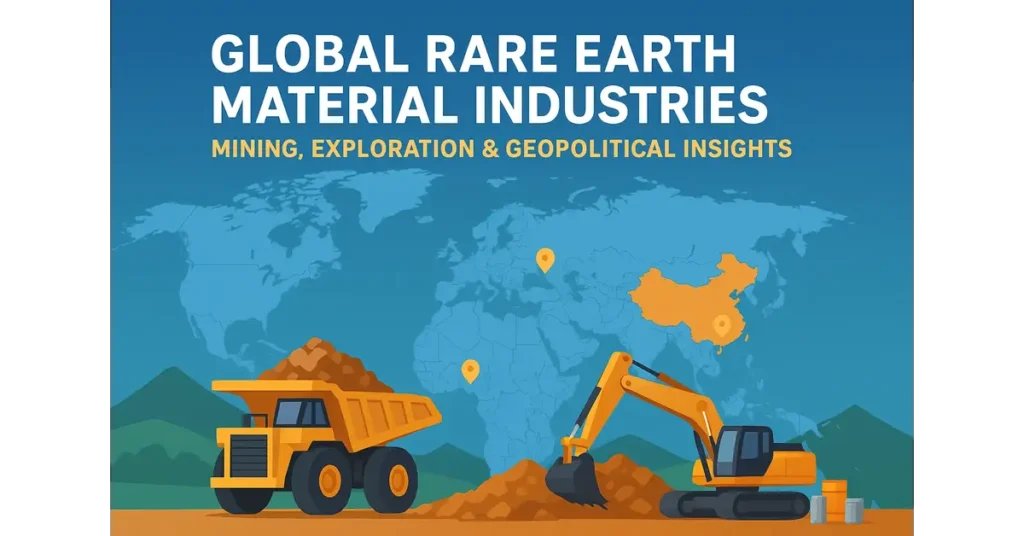
Global Rare Earth Material Industries: Mining, Exploration & Geopolitical Insights
In the sweltering heat of California’s Mojave Desert, workers at the Mountain Pass mine extract tons of earth containing some of the world’s most valuable materials. Meanwhile, halfway across the globe in China’s Inner Mongolia, the massive Bayan Obo facility processes rare earth elements that will eventually power your smartphone, electric car, and wind turbines. This is the reality of rare earth material industries—a sector where geology meets geopolitics, and where 17 obscure chemical elements have become the backbone of our modern technological civilization.
Understanding Rare Earth Material Industries: The Hidden Foundation of Modern Life
Rare earth material industries encompass the entire value chain of rare earth elements (REEs)—from exploration and mining to processing, manufacturing, and recycling. Despite their name, these elements aren’t particularly rare in Earth’s crust. The challenge lies in finding economically viable concentrations and, more importantly, processing them into usable forms without devastating environmental consequences.
The 17 rare earth elements are divided into two categories: light rare earth elements (like neodymium and cerium) and heavy rare earth elements (such as dysprosium and terbium). Each plays a crucial role in different applications, making the rare earth material industries incredibly diverse and complex.
| Light Rare Earth Elements (LREE) | Symbol | Primary Applications |
|---|---|---|
| Lanthanum | La | Battery electrodes, camera lenses |
| Cerium | Ce | Catalytic converters, glass polishing |
| Praseodymium | Pr | Aircraft engines, permanent magnets |
| Neodymium | Nd | Permanent magnets, lasers |
| Promethium | Pm | Nuclear batteries, luminous paint |
| Samarium | Sm | Permanent magnets, nuclear reactors |
| Europium | Eu | Red phosphors in displays |
| Gadolinium | Gd | MRI contrast agents, neutron capture |
| Heavy Rare Earth Elements (HREE) | Symbol | Primary Applications |
|---|---|---|
| Terbium | Tb | Green phosphors, fuel cells |
| Dysprosium | Dy | High-performance magnets, data storage |
| Holmium | Ho | Laser surgery, magnetic field generation |
| Erbium | Er | Fiber optic amplifiers, nuclear control rods |
| Thulium | Tm | Medical X-ray sources, high-temperature superconductors |
| Ytterbium | Yb | Infrared lasers, chemical reducing agents |
| Lutetium | Lu | Medical imaging, research applications |
| Yttrium | Y | LED phosphors, superconductors |
| Scandium | Sc | Aerospace alloys, fuel cells |
The Historical Journey: From Swedish Rocks to Global Strategic Assets
The story of rare earth material industries begins in 1787 when Swedish chemist Carl Axel Arrhenius discovered a black mineral in a quarry near Ytterby, Sweden. This seemingly unremarkable rock would eventually yield four different rare earth elements, launching what would become one of the world’s most strategically important industries.
For over a century, rare earth elements remained laboratory curiosities. The first commercial applications emerged in the early 1900s with gas mantles and specialized glass. However, it wasn’t until the post-World War II boom that rare earth material industries truly began to take shape.
The 1950s and 1960s saw the development of color television, which required europium for red phosphors. This created the first significant market for rare earth materials, transforming them from scientific curiosities into industrial necessities. During this period, the United States dominated production, with companies like Molycorp leading the way at Mountain Pass.
The turning point came in the 1980s and 1990s when China recognized the strategic potential of its vast rare earth deposits. Through aggressive pricing and substantial government support, Chinese companies gradually captured market share. By 2010, China produced more than two thirds of the total global rare earth mine production, fundamentally reshaping the global rare earth material industries landscape.
Current Global Landscape: A World Shaped by Geography and Politics
Today’s rare earth material industries are defined by stark geographical realities. China’s dominance isn’t just about having the most deposits—though it does hold approximately 44 million metric tons in reserves. The real advantage lies in its integrated supply chain, from mining through final product manufacturing.
| Country | Reserves (Metric Tons) | % of Global Reserves | Key Mining Locations |
|---|---|---|---|
| China | 44,000,000 | 35.4% | Bayan Obo, Sichuan, Fujian |
| Brazil | 22,000,000 | 17.7% | Araxá, Catalão |
| Vietnam | 22,000,000 | 17.7% | Dong Pao, Lai Chau |
| Russia | 12,000,000 | 9.7% | Kola Peninsula, Siberia |
| India | 6,900,000 | 5.5% | Odisha, Kerala |
| Australia | 4,200,000 | 3.4% | Mount Weld, Olympic Dam |
| United States | 1,500,000 | 1.2% | Mountain Pass, Alaska |
| Other Countries | 11,400,000 | 9.4% | Various locations |
Source: U.S. Geological Survey, Mineral Commodity Summaries 2025
Major Mining Hubs and Processing Centers
China: The Undisputed Leader China’s rare earth material industries center around several key regions:
- Bayan Obo, Inner Mongolia: The world’s largest rare earth deposit, co-located with iron and niobium
- Sichuan Province: Rich in heavy rare earth elements, particularly valuable for high-tech applications
- Fujian and Guangdong: Major processing centers where raw ores become refined products
| Chinese Mining Region | Primary REEs | Annual Production (MT) | Key Companies |
|---|---|---|---|
| Bayan Obo, Inner Mongolia | La, Ce, Pr, Nd | 65,000 | China Northern Rare Earth |
| Sichuan Province | Dy, Tb, Er, Tm | 18,000 | Shenghe Resources |
| Jiangxi Province | Y, Dy, Tb | 12,000 | China Minmetals |
| Fujian Province | Y, Dy, Tb, Gd | 8,500 | Xiamen Tungsten |
| Guangdong Province | Y, Dy, Tb | 6,200 | Guangdong Rising |
The United States: Fighting Back The U.S. rare earth material industries are experiencing a renaissance:
- Mountain Pass, California: Now operated by MP Materials, this facility has become America’s primary rare earth source
- Texas and Wyoming: Emerging as processing hubs, with new facilities planned to reduce dependence on Chinese processing
| U.S. Facility | Location | Capacity (MT/year) | Status | Investment ($M) |
|---|---|---|---|---|
| Mountain Pass Mine | California | 38,000 | Operating | 1,700 |
| Fort Worth Processing | Texas | 20,000 | Under Construction | 700 |
| Magnequench Facility | Indiana | 5,000 | Planned | 200 |
| Round Top Project | Texas | 15,000 | Development | 500 |
Australia: The Rising Star Australia’s rare earth material industries are rapidly expanding:
- Mount Weld, Western Australia: Operated by Lynas Rare Earths, this mine produces some of the world’s highest-grade rare earth concentrates
- Malaysia: Hosts Lynas’s processing facility, creating an integrated Australia-Malaysia supply chain
| Australian Operation | Company | Location | Capacity (MT/year) | Market Cap ($M) |
|---|---|---|---|---|
| Mount Weld Mine | Lynas | Western Australia | 22,000 | 6,200 |
| LAMP Processing | Lynas | Malaysia | 22,000 | – |
| Nolans Project | Arafura | Northern Territory | 4,400 | 890 |
| Browns Range | Northern Minerals | Western Australia | 3,000 | 145 |
Emerging Players Several countries are developing their rare earth material industries:
- Brazil: Serra Verde project promises to become a major supplier
- Vietnam: Developing processing capabilities to complement its substantial reserves
- India: Building both mining and processing infrastructure
The Numbers That Matter: Demand, Supply, and Market Realities
The economics of rare earth material industries tell a compelling story of surging demand and constrained supply. The total global demand for rare earth oxides (REOs) is expected to increase from 208,250 metric tons in 2019 to a forecasted 304,678 metric tons by 2025.
This growth is driven primarily by the clean energy transition. In 2019, global REO demand for the production of magnets amounted to 43,733 metric tons, and is forecast to increase nearly double, to 82,469 metric tons by 2025.
| Application Segment | 2019 Demand (MT) | 2025 Forecast (MT) | Growth Rate | Key Elements Used |
|---|---|---|---|---|
| Permanent Magnets | 43,733 | 82,469 | +88.6% | Nd, Pr, Dy, Tb |
| Catalysts | 38,157 | 49,824 | +30.6% | La, Ce |
| Glass/Ceramics | 31,246 | 41,871 | +34.0% | Ce, La, Nd |
| Metallurgical | 28,935 | 36,742 | +27.0% | La, Ce, Pr |
| Polishing | 19,467 | 24,333 | +25.0% | Ce |
| Phosphors | 15,973 | 18,765 | +17.5% | Eu, Y, Tb |
| Batteries | 12,783 | 21,456 | +67.8% | La, Ce, Nd |
| Electronics | 8,956 | 14,218 | +58.8% | Y, Eu, Gd |
| Other Applications | 8,995 | 15,000 | +66.7% | Various |
| Total Global Demand | 208,245 | 304,678 | +46.3% | All REEs |
Source: Statista Global Rare Earth Oxides Demand Analysis 2025
Applications Driving Growth
Permanent Magnets: The largest and fastest-growing segment
- Electric vehicle motors
- Wind turbine generators
- Industrial automation equipment
- Consumer electronics
Catalysts: Essential for oil refining and automotive applications
- Fluid cracking catalysts in petroleum refining
- Automotive exhaust treatment systems
- Chemical processing applications
Batteries and Energy Storage
- Electric vehicle batteries (particularly nickel-metal hydride)
- Grid-scale energy storage systems
- Portable electronic devices
Defense and Aerospace
- Precision-guided munitions
- Radar and communication systems
- Jet engines and aircraft components
The 2025 Geopolitical Earthquake: China’s Export Controls
The rare earth material industries faced their biggest disruption in years when China’s Ministry of Commerce (MOFCOM) and General Administration of Customs on April 4, 2025, issued Announcement 18, which imposes export controls on specific medium and heavy rare earth materials.
These controls came as part of China’s response to US tariffs, with Beijing imposing restrictions on the exports of seven rare earth minerals. The timing wasn’t coincidental—it followed President Trump’s executive order called “Immediate Measures to Increase American Mineral Production” announced an increase in rare earth production.
| Controlled Rare Earth Materials | HS Code | Export License Required | Strategic Importance |
|---|---|---|---|
| Dysprosium compounds | 28053090 | Yes | High-performance magnets, EVs |
| Terbium compounds | 28053090 | Yes | Green phosphors, fuel cells |
| Yttrium compounds | 28053090 | Yes | LED displays, superconductors |
| Holmium compounds | 28053090 | Yes | Laser applications, magnets |
| Erbium compounds | 28053090 | Yes | Fiber optics, telecom |
| Thulium compounds | 28053090 | Yes | Medical devices, X-ray sources |
| Lutetium compounds | 28053090 | Yes | Medical imaging, research |
Source: China Ministry of Commerce Announcement 18, April 2025
The impact was immediate. MP Material, which was previously sending US RRE material to China for processing, as of April 2025 has halted all exports of its rare earths to China. This move highlighted the vulnerability of global rare earth material industries to geopolitical tensions.
Industrial Ecosystems: Where Mining Meets Manufacturing
One of the most fascinating aspects of rare earth material industries is how they create unique industrial ecosystems. These aren’t just about extracting materials from the ground—they’re about building entire value chains that can compete globally.
The California Cluster
Mountain Pass sits at the heart of a growing California rare earth ecosystem. The mine benefits from its proximity to:
- Silicon Valley’s technology companies
- California’s massive renewable energy sector
- Defense contractors throughout the Southwest
- Los Angeles’s logistics infrastructure for global shipping
The Australian Model
Lynas has created a different model, splitting operations between Australia and Malaysia:
- Mining in Western Australia takes advantage of high-grade ores and mining expertise
- Processing in Malaysia leverages lower costs and strategic location for Asian markets
- This hybrid approach demonstrates how rare earth material industries can optimize across borders
China’s Integrated Approach
Chinese rare earth material industries benefit from complete vertical integration:
- Mining operations directly connected to processing facilities
- Processing facilities co-located with manufacturing industries
- Manufacturing centers embedded in global supply chains
Technology and Innovation: The Future of Rare Earth Material Industries
The rare earth material industries are experiencing a technology revolution driven by both supply constraints and environmental concerns. Several innovations are reshaping the sector:
| Technology | Description | Environmental Benefit | Cost Reduction | Current Status |
|---|---|---|---|---|
| Bioleaching | Bacteria extract REEs from low-grade ores | 80% less acid waste | 30-40% cost savings | Pilot projects |
| Selective Ion Exchange | Target specific REE separation | 60% less chemical waste | 25% efficiency gain | Commercial scale |
| Grain Boundary Diffusion | More efficient magnet production | 50% less REE consumption | 20% material savings | Widely adopted |
| Urban Mining | REE recovery from e-waste | 90% waste reduction | 40% supply cost | Expanding |
| Advanced Flotation | Improved ore concentration | 35% less tailings | 15% yield improvement | Commercial |
| Membrane Separation | Clean REE purification | 70% water reduction | 20% energy savings | Development |
Advanced Processing Technologies
Bioleaching: Using bacteria to extract rare earth elements from low-grade ores, potentially opening up new deposits that were previously uneconomical.
Selective Separation: New chemical processes that can separate specific rare earth elements more efficiently, reducing waste and environmental impact.
Grain Boundary Diffusion: Technology that allows manufacturers to use rare earth elements more efficiently in permanent magnets, reducing overall demand.
Urban Mining and Recycling
The concept of “urban mining”—extracting rare earth elements from electronic waste—is gaining traction. Japan has become a leader in this field, with companies developing processes to recover rare earth elements from discarded electronics, air conditioners, and fluorescent lights.
Alternative Materials Research
Research into alternatives to rare earth elements continues, though progress has been limited. The unique properties of rare earth elements—particularly their magnetic and optical characteristics—make them difficult to replace in many applications.
Environmental and Social Challenges: The Hidden Costs
One area where the original document fell short was addressing the environmental and social challenges facing rare earth material industries. These issues are becoming increasingly important as companies face pressure from investors, regulators, and consumers.
Environmental Concerns
Rare earth mining and processing create significant environmental challenges:
- Radioactive waste: Many rare earth deposits contain thorium and uranium, creating radioactive tailings
- Acid mine drainage: Processing rare earth ores often requires strong acids, which can contaminate groundwater
- Air pollution: Dust from mining operations and emissions from processing facilities affect local air quality
| Environmental Impact | Traditional Mining | Modern Techniques | Improvement |
|---|---|---|---|
| Water Usage (L/kg REO) | 2,500-4,000 | 800-1,200 | 65-70% reduction |
| CO2 Emissions (kg/kg REO) | 45-75 | 15-25 | 67-75% reduction |
| Acid Waste Generation | High | Low-Medium | 60-80% reduction |
| Land Disturbance (ha/Mt) | 150-200 | 50-80 | 60-73% reduction |
| Radioactive Tailings | Uncontrolled | Contained storage | 90%+ safer |
| Processing Recovery Rate | 75-85% | 92-98% | 15-20% improvement |
Social Impact
Mining communities often bear the brunt of environmental problems:
- Health impacts from air and water pollution
- Displacement of traditional communities
- Economic dependence on volatile commodity markets
Companies like MP Materials and Lynas are investing heavily in cleaner technologies and community engagement programs, but challenges remain significant.
Investment and Financial Dynamics: Following the Money
The rare earth material industries have attracted unprecedented investment attention in recent years. This isn’t just about mining companies—it’s about entire ecosystems of investors, from venture capital firms funding recycling startups to sovereign wealth funds backing strategic projects.
Government Investment
Governments worldwide are treating rare earth material industries as matters of national security:
- The U.S. Department of Defense has invested hundreds of millions in domestic rare earth projects
- The European Union’s Raw Materials Alliance is funding research and development
- Japan and South Korea are forming strategic partnerships with mining companies
| Government Initiative | Country/Region | Investment ($M) | Focus Area | Timeline |
|---|---|---|---|---|
| Defense Production Act | United States | 750 | Supply chain security | 2022-2027 |
| Critical Raw Materials Act | European Union | 1,200 | Strategic autonomy | 2023-2030 |
| Resource Security Strategy | Japan | 450 | Diversification | 2021-2026 |
| K-Materials Strategy | South Korea | 380 | Technology development | 2022-2027 |
| Critical Minerals Strategy | Australia | 200 | Processing capabilities | 2023-2028 |
| Operation Sovereign Metals | Canada | 150 | Domestic mining | 2024-2029 |
Private Capital
Private investors are also taking notice:
- Rare earth ETFs allow retail investors to gain exposure to the sector
- Private equity firms are acquiring mining and processing assets
- Technology companies are making strategic investments in their supply chains
| Investment Vehicle | Ticker/Name | AUM ($M) | Top Holdings | 5-Year Return |
|---|---|---|---|---|
| VanEck Rare Earth ETF | REMX | 850 | MP Materials, Lynas | +145% |
| Global X Lithium & Battery ETF | LIT | 1,200 | Various REE miners | +89% |
| Sprott Uranium Miners ETF | URNM | 620 | Uranium/REE companies | +67% |
| iShares MSCI Global Metals | PICK | 890 | Mining companies | +34% |
| First Trust Materials AlphaDEX | FXZ | 430 | Materials sector | +28% |
Major Private Equity Deals (2022-2025):
- KKR invested $500M in Australian rare earth processing
- Blackstone acquired $300M stake in Brazilian mining operations
- Apollo Global Management funded $250M in U.S. recycling facilities
Looking Ahead: The Future of Rare Earth Material Industries
Several trends will shape the future of rare earth material industries:
Supply Chain Diversification
China’s export controls are encouraging ex-China rare earth and magnet production in the long run. This will lead to more geographically distributed supply chains, though the transition will take years to complete.
Technology Integration
Rare earth material industries will become increasingly integrated with technology sectors. We’re already seeing mining companies partnering directly with electric vehicle manufacturers and renewable energy companies.
Sustainability Focus
Environmental concerns will drive innovation in processing technologies and mining practices. Companies that can demonstrate clean operations will have competitive advantages in attracting investment and customers.
Geopolitical Evolution
The current U.S.-China tensions are just one chapter in a longer story. As other countries develop their rare earth capabilities, we’ll see new alliances and partnerships emerge.
The Bigger Picture: Why Rare Earth Material Industries Matter
Rare earth material industries might seem like a niche sector, but they’re fundamental to some of the biggest trends shaping our world:
Climate Change: The transition to renewable energy and electric vehicles depends entirely on rare earth elements for efficient motors, generators, and batteries.
Technological Innovation: From smartphones to artificial intelligence hardware, rare earth elements enable the technologies that define modern life.
National Security: Military technologies increasingly depend on rare earth elements, making secure supply chains a matter of national importance.
Economic Development: Countries with rare earth resources and processing capabilities will have significant advantages in the global economy.
Conclusion: Navigating an Uncertain Future
The rare earth material industries stand at a crossroads. The sector faces unprecedented demand growth driven by the clean energy transition and technological innovation. At the same time, geopolitical tensions and environmental concerns are forcing fundamental changes in how these materials are produced, processed, and used.
The surge in global demand projections for rare earth elements poses complex supply chain challenges, with over 60% of REEs currently produced, processed, and exported by China, raising strategic risks for other countries and regions.
Success in this environment will require companies and countries to balance multiple objectives: ensuring secure supply chains, minimizing environmental impact, maintaining cost competitiveness, and navigating complex geopolitical relationships.
For investors, policymakers, and business leaders, understanding rare earth material industries isn’t just about understanding a commodity market—it’s about understanding one of the key forces shaping our technological and economic future. The decisions made in this sector today will influence everything from the pace of climate action to the balance of global power for decades to come.
The story of rare earth material industries is ultimately a human story—of communities adapting to new economic realities, of engineers solving complex technical challenges, and of nations competing for strategic advantage. As we move deeper into the 21st century, these 17 elements discovered in a Swedish quarry more than two centuries ago will continue to shape our world in ways we’re only beginning to understand.