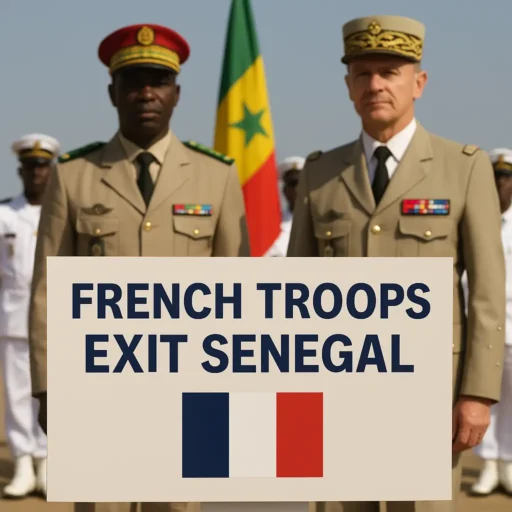
The French troops withdrawal from Senegal was completed on July 17, 2025, marking the definitive end of a 65-year military presence in the West African nation. France formally handed over its last military bases in Senegal on Thursday, ending a 65-year presence in the country, with about 350 French soldiers leaving Senegal. This historic withdrawal represents a fundamental shift in France-Senegal relations and signals broader changes in West Africa military presence dynamics across the region.
Timeline of Key Events
Colonial Era and Independence (1857-1960)
- 1857: Formation of the Tirailleurs Sénégalais military corps under Governor Faidherbe
- December 1, 1944: Thiaroye Massacre – French troops kill hundreds of African riflemen who had served in WWII
- 1960: Senegal achieves independence; first French-Senegalese defense agreement signed
Post-Independence Military Cooperation (1960-2024)
- 1960: French military bases established under bilateral defense agreements
- 1974: Defense agreements updated to maintain French military presence
- 2010s-2019: Technical and military cooperation agreements renewed
The Withdrawal Process (2024-2025)
- March 24, 2024: Bassirou Diomaye Faye wins presidential election with over 54% of the vote in the first round, becoming at age 44 the youngest president in the country’s history
- April 2, 2024: Faye sworn in as president at age 44
- February 12, 2025: Senegal formally requests French military withdrawal
- March 7, 2025: France transfers two military bases in the Marechal and Saint-Exubery districts of Dakar to Senegalese control as the first step of complete withdrawal
- July 1, 2025: France hands over the Rufisque joint station to Senegal, a communications facility active since 1960
- July 17, 2025: Final handover ceremony of Camp Geille, the largest French military installation in Senegal, attended by Mbaye Cisse, chief of General Staff of the Senegalese Armed Forces, and Pascal Ianni, commander of French forces in Africa
The Final Chapter: Completing French Troops Withdrawal from Senegal
The withdrawal process culminated with the formal handover of France’s two remaining military installations: Camp Geille in Ouakam, Dakar, and the associated airfield facilities at Léopold Sédar Senghor International Airport. The ceremony was attended by senior military officials from both nations, including Senegalese Armed Forces Chief of Staff General Mbaye Cisse and French Africa Command General Pascal Ianni.
Camp Geille, spanning 5 hectares in Ouakam, had served as France’s primary military installation in Senegal since independence. The facility housed the majority of the approximately 350 French personnel stationed in the country, who had been tasked with joint operations with Senegalese forces and regional security coordination.
The departure process began in March 2025 and concluded in July, marking the end of a departure process that spanned several months. The methodical approach to the withdrawal demonstrated both countries’ commitment to ensuring a smooth transition while maintaining diplomatic relations.
Presidential Leadership and the Sovereignty Agenda
President Bassirou Diomaye Diakhar Faye, born March 25, 1980, in Ndiaganiao, is a former tax official who served as general secretary of the PASTEF party. His electoral victory represented a decisive mandate for change, as he campaigned on promises to reassert Senegalese sovereignty and review international relationships established during the colonial era.
Faye is closely associated with Ousmane Sonko, a popular opposition figure, whom he later appointed as Prime Minister. The new administration’s approach to France-Senegal relations reflects broader generational changes in African politics. The younger leaders are increasingly questioning post-colonial arrangements that may no longer serve national interests.
Senegal’s new government has taken a hard-line stance against the presence of French troops as part of a larger regional backlash against what many see as the legacy of an oppressive colonial empire. This position resonated strongly with Senegalese voters, particularly younger demographics who constitute a majority of the population.
Historical Context: French Colonial History in Senegal
The foundations of French military presence in Senegal trace back to the mid-19th century colonial expansion. The establishment of the Tirailleurs Sénégalais in 1857 under Governor Louis Faidherbe marked the beginning of systematic military recruitment of Senegalese soldiers for French colonial objectives. These forces played crucial roles in French military operations across West Africa and participated in both World Wars.
The Thiaroye Massacre of December 1, 1944, represents one of the darkest chapters in Franco-Senegalese military relations. French forces killed hundreds of African soldiers who had served France during World War II and were demanding fair treatment and compensation. This tragedy remains deeply embedded in Senegalese collective memory and continues to influence contemporary perspectives on French military presence.
Upon independence in 1960, Senegal entered into defense agreements that permitted continued French military presence. These arrangements were typical of France’s post-colonial strategy in Africa, designed to maintain influence and protect French interests while providing security guarantees to newly independent nations.
Regional Implications: Shifting Sahel Region Geopolitics
The French withdrawal from Senegal occurs within a broader context of changing Sahel region geopolitics. France’s decision to give up the last of its military bases in Senegal is seen as a significant turning point in relations with the former colonial power. Unlike neighboring countries where military coups preceded French withdrawals, Senegal’s democratic approach provides a different model for reassessing colonial-era relationships.
France now has no permanent army camps in either west or central Africa following the Senegal withdrawal. This represents a dramatic shift from France’s traditional “Françafrique” policy, which maintained extensive military networks across former African colonies for decades after independence.
The withdrawal has implications for regional security cooperation, particularly in counterterrorism efforts and maritime security along the West African coast. French forces in Senegal had participated in intelligence sharing and joint operations that extended beyond national borders, requiring new arrangements to address regional security challenges.
Security Transition and Future Arrangements
The completion of the French troops withdrawal from Senegal necessitates careful planning for future security arrangements. The Senegalese Armed Forces must now assume complete responsibility for national defense and regional security cooperation. This transition requires enhanced capabilities in areas previously supported by French military assets.
The handover of military infrastructure presents opportunities for Senegal to repurpose these strategic assets according to national priorities. Camp Geille and other former French installations can now serve exclusively Senegalese military operations designed for national rather than external objectives.
Alternative security partnerships may emerge to address regional challenges. The African Union, Economic Community of West African States (ECOWAS), and other regional organizations could play expanded roles in security cooperation. Senegal may also develop new bilateral partnerships with countries beyond its former colonial power.
Economic and Diplomatic Implications
The military withdrawal represents one component of broader changes in France-Senegal relations across multiple sectors. President Faye has promised to review mining contracts and ties with key nations, suggesting that military withdrawal may be part of a comprehensive reevaluation of foreign relationships.
These changes could affect economic cooperation, development assistance, and trade relationships that have historically linked France and Senegal. However, both governments have indicated interest in maintaining positive relationships while establishing new foundations based on sovereign equality rather than historical dependencies.
The diplomatic implications extend beyond bilateral relations to influence broader African approaches to post-colonial partnerships. Senegal’s democratic transition away from French military dependence may serve as a model for other African nations seeking to redefine similar relationships.
Looking Forward: Post-Colonial Africa’s New Direction
The completion of the French troops withdrawal from Senegal marks more than a military repositioning; it symbolizes fundamental changes in how African nations engage with former colonial powers. Senegal’s peaceful, democratically-managed transition demonstrates that significant changes in international relationships can occur through electoral processes rather than military interventions.
This development reflects broader trends in post-colonial Africa, where younger generations are increasingly questioning arrangements established during the independence era. The success of Senegal’s approach may influence other African nations considering similar reassessments of their international partnerships.
The French withdrawal also represents an opportunity for Senegal to develop more diversified international relationships based on mutual benefit rather than historical obligations. As West Africa continues evolving its geopolitical relationships, Senegal’s experience provides valuable lessons for democratic transitions away from colonial-era arrangements.
Key Takeaways
• Historic Completion: The French troops withdrawal from Senegal was completed on July 17, 2025, ending a 65-year military presence that began with post-independence defense agreements in 1960.
• Democratic Leadership: President Bassirou Diomaye Faye, elected with over 54% of the vote at age 44, led this transition through democratic processes rather than military intervention, unlike other regional examples.
• Systematic Process: The withdrawal occurred over several months, from initial base transfers in March 2025 to the final handover ceremony at Camp Geille on July 17, 2025.
• Regional Significance: France now maintains no permanent army camps in west or central Africa, representing a fundamental shift in French-African military relations.
• Future Model: Senegal’s approach demonstrates how post-colonial Africa can redefine international relationships through democratic processes, potentially influencing other African nations’ approaches to similar transitions.
Further Reading:
Writing Economic History with the Archives Nationales du Sénégal – African Economic History Network