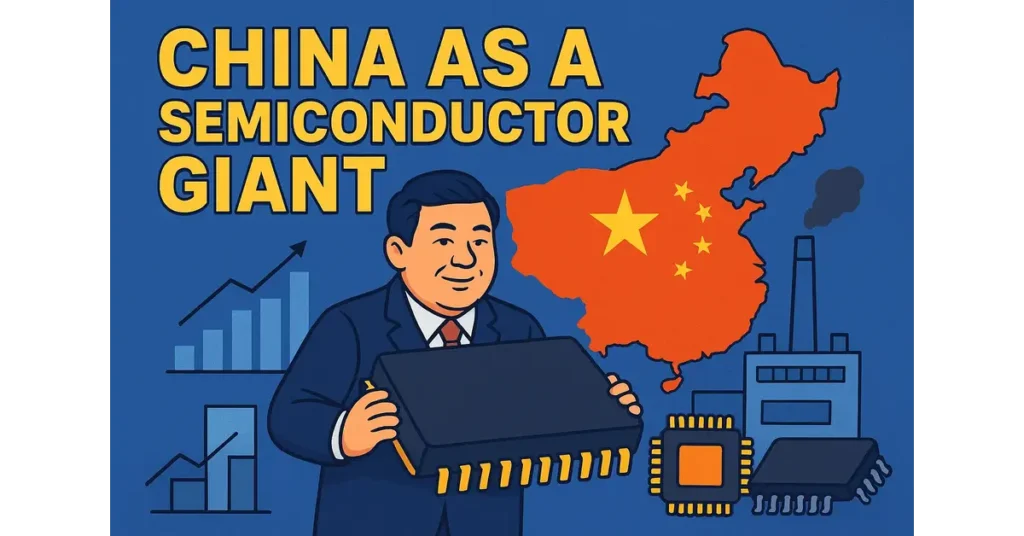
Introduction: The Semiconductor Battleground of the 21st Century
In the modern digital economy, semiconductors have evolved far beyond simple computer components. These tiny chips, smaller than a fingernail, now power everything from smartphones and electric vehicles to artificial intelligence systems and military defense networks. The question of whether China as a semiconductor giant is becoming reality has profound implications for global technology, economics, and geopolitics.
The race to dominate semiconductor manufacturing has been compared to the Cold War nuclear arms race, making chips a critical national security asset. For any nation to claim “giant” status in this arena, it must demonstrate massive production volumes, technological leadership, significant global market share, and the geopolitical leverage that comes with a robust, self-sufficient supply chain.
China’s ambitious “Made in China 2025” strategy has set clear goals to transform the nation from merely being the “world’s factory” into a technology-intensive powerhouse. But does China’s ambition match its actual capabilities? This comprehensive analysis examines the data, progress, and persistent challenges to determine whether China as a semiconductor giant represents genuine market leadership or geopolitical theater.
China’s Strategic Foundation: State-Backed Ambition Meets Reality
The “Made in China 2025” Blueprint
China’s semiconductor ambitions are anchored in the national strategic plan “Made in China 2025,” signed by Premier Li Keqiang in May 2015. This comprehensive initiative aims to upgrade Chinese industries and move them higher up the value chain, with specific targets for the semiconductor sector:
- 2020 Target: 40% domestic content of core materials and chips
- 2025 Target: 70% domestic content
- 2030 Vision: $305 billion in output, meeting 80% of domestic demand
However, China’s semiconductor self-sufficiency is expected to reach 50% by 2025, indicating the complexity of achieving complete technological autonomy. The actual self-sufficiency figure reached only 30% by 2025, but this hasn’t deterred China’s strategic commitment.
The “Big Fund”: Unprecedented State Investment
The financial muscle behind China’s semiconductor ambitions comes from the China Integrated Circuit Industry Investment Fund, commonly known as the “Big Fund.” This state-owned enterprise has deployed capital across three phases:
| Phase | Investment Period | Total Investment | Key Focus Areas |
|---|---|---|---|
| Phase I | 2014-2019 | $21.8 billion | Initial ecosystem building |
| Phase II | 2019-2024 | $29.08 billion | 75% focused on wafer fabrication, equipment, materials |
| Phase III | 2024-2030 | $47.5 billion (CNY 344 billion) | Supply chain resilience, advanced equipment |
The third phase of China’s Big Fund officially commenced on December 31, 2024, with substantial CNY160 billion (US$21.9 billion) in initial funding, representing China’s largest-ever semiconductor investment commitment.
Research demonstrates the effectiveness of this state-led approach. A quasi-natural experiment found that the Big Fund can significantly improve enterprise innovation quality, causing a 20.37% increase in innovation metrics by alleviating financing constraints for young, technology-focused companies.
Key Players in China’s Semiconductor Ecosystem
China’s semiconductor landscape features several homegrown champions across different value chain segments:
| Company | Specialization | Key Capabilities | Market Position |
|---|---|---|---|
| SMIC | Pure-Play Foundry | 7nm, 14nm, 28nm+ processes | 5th largest globally with 5.3% market share |
| Hua Hong Semiconductor | Pure-Play Foundry | 28nm, 65nm+ mature nodes | 6th largest globally (2.6% share) |
| YMTC | Memory (NAND) | 128-layer NAND Flash | 5% global market share |
| CXMT | Memory (DRAM) | 19nm DRAM production | Key domestic DRAM player |
| HiSilicon | Fabless Design | Kirin series, AI processors | Wholly-owned by Huawei |
The Manufacturing Revolution: China’s Production Surge
Manufacturing Infrastructure: China’s Massive Expansion
SEMI World Fab Forecast – Official Industry Data
According to the authoritative SEMI World Fab Forecast report, China is leading the global semiconductor industry expansion in 2024. The report, which covers over 1,500 front-end semiconductor facilities globally, confirms China’s dominant position in new manufacturing capacity additions.
2024 Manufacturing Expansion Data:
- 18 new fab projects started operations in China in 2024 (most globally)
- Global capacity growth: 6.4% increase to reach record 30 million wafers per month
- Equipment spending: $41 billion on wafer fabrication equipment (40% of global total)
- Foundry capacity: Foundry suppliers increased capacity to record 10.2 million WSPM in 2024
Manufacturing Capacity Sites and Facilities
Major Manufacturing Hubs:
- Shanghai Region: SMIC’s primary manufacturing base with multiple 12-inch fabs
- Beijing: Focus on advanced R&D and pilot production facilities
- Shenzhen: Consumer electronics and automotive semiconductor production
- Wuhan: YMTC’s 3D NAND flash memory manufacturing center
- Hefei: CXMT’s DRAM production and ChangXin facilities
- Chengdu: Expanding automotive and industrial semiconductor capacity
Facility Types and Specifications:
- 300mm (12-inch) fabs: Primary focus for high-volume production
- 200mm (8-inch) fabs: Mature-node and analog device production
- Specialty fabs: Power semiconductors, RF devices, sensors
- Memory fabs: DRAM and NAND flash dedicated facilities
Primary Verification Sources
Official Industry Reports:
- SEMI World Fab Forecast (January 2024) – Global semiconductor capacity tracking
- SEMI Fab Equipment Spending Report – Equipment investment data
- TrendForce Foundry Market Analysis – Capacity utilization metrics
Government and Industry Sources:
- China Semiconductor Industry Association – Domestic production data
- Ministry of Industry and Information Technology – Policy and capacity planning
- National Development and Reform Commission – Strategic investment tracking
Market Research Firms:
- Maximize Market Research – China market size: $180B in 2024
- Expert Market Research – Market projections: $366.57B by 2034
- IMARC Group – Alternative projection: $429.9B by 2033
Key Production Metrics (2024)
| Metric | Value | Growth Rate | Source Context |
|---|---|---|---|
| Q1 2024 Chip Production | 98.1 billion units | +40% YoY | Domestic production surge |
| New Fabs (2024) | 18 facilities | Leading globally | Capacity expansion |
| Wafer Capacity | 8.6 million units annually | Up from 7.6M in 2023 | Infrastructure growth |
| Global Consumption Share | 53.7% | Market dominance | Largest consumer globally |
The Mature-Node Strategy: Turning Restrictions into Opportunities
China’s focus on mature-node production represents a strategic pivot driven by U.S. export controls. While American restrictions primarily target advanced chips, China currently commands 27 percent of global production capacity for chips in the 20–45 nm range, and 30 percent of global production capacity in mature nodes.
China’s share of global mature-node production is expected to grow from 31 percent in 2023 to 39 percent in 2027, positioning the country for dominance in a market segment projected to account for 40% of the total semiconductor market by 2030.
This creates a fascinating strategic reversal: U.S. policy intended to constrain China’s technological advancement has paradoxically strengthened China’s position in mature nodes critical for automotive, industrial IoT, and consumer electronics applications.
Domestic Demand Drivers: EVs, AI, and 5G
China’s semiconductor surge is fueled by massive domestic demand across key growth sectors:
Electric Vehicles: In 2024, EV sales in China exceeded 11 million units, significantly increasing demand for power semiconductors, AI processors, and connectivity solutions. China’s exports of automotive semiconductors reached $419.15 billion in 2024, demonstrating the sector’s rapid expansion.
5G Infrastructure: China leads globally with over one million 5G base stations and a projected 430 million users by 2025, creating robust domestic demand for RF semiconductors and high-performance chips.
Artificial Intelligence: The surge in AI applications and large language models generates immense demand for specialized processors, with Chinese companies like Cambricon emerging as domestic alternatives to international suppliers.
The Technological Reality Check: Breakthroughs vs. Bottlenecks
The 7nm Achievement: Engineering Triumph or Economic Mirage?
One of the most significant developments in China’s semiconductor story was the discovery of a domestically produced 7nm chip in Huawei’s Mate60 smartphone. Device teardowns confirmed that SMIC, China’s leading foundry, manufactured the Kirin 9000s processor—a remarkable engineering achievement accomplished despite stringent U.S. export controls.
However, the technical details reveal important limitations:
| Aspect | China (SMIC) | Industry Standard (TSMC/Samsung) |
|---|---|---|
| Lithography | DUV Multi-Patterning | EUV Single Exposure |
| Yield Rate | ~15% estimated | 70-90% typical |
| Manufacturing Cost | ~10x more expensive | Baseline cost |
| Production Viability | Limited/uneconomical | Mass production ready |
The key constraint is SMIC’s lack of access to Extreme Ultraviolet (EUV) lithography machines, produced exclusively by Dutch company ASML. Instead, SMIC uses “multi-patterning” techniques with Deep Ultraviolet (DUV) machines, requiring three to four patterning rounds to achieve the same transistor density as a single EUV exposure.
This technical workaround creates a fundamental economic problem. The low yield rates (estimated at 15%) and complex manufacturing process make these chips up to 10 times more expensive than TSMC’s equivalent products, rendering them commercially unviable for mass production.
Critical Dependencies: The Foreign “Chokepoints”
Despite impressive progress, China faces persistent technological dependencies that constrain its path to complete self-sufficiency:
Lithography Equipment: The most significant bottleneck remains the lack of access to EUV lithography machines essential for high-yield production of sub-7nm chips. While Chinese companies like Shanghai Micro Electronics Equipment (SMEE) are developing domestic alternatives, they remain years behind industry leaders.
Electronic Design Automation (EDA) Software: The entire chip design process relies on sophisticated EDA software dominated by U.S. companies like Synopsys, Siemens EDA, and Cadence. Without access to cutting-edge design tools, Chinese firms face limitations in developing more powerful chips.
A recent U.S.-China agreement that lifted some EDA software restrictions in exchange for China moderating rare earth export controls demonstrates the transactional nature of the “chip war”—both sides leverage their respective advantages in ongoing negotiations.
Geopolitical Dynamics: The “Chip War” Reshapes Global Supply Chains
U.S. Export Controls: “Small Yard, High Fence” Strategy
The United States has implemented comprehensive export controls designed as a “small yard, high fence” approach—narrowly targeting the most critical technologies while maintaining high barriers. These measures include:
- Blacklisting dozens of Chinese semiconductor entities
- Requiring licenses for foreign companies using U.S. intellectual property
- Revoking “validated end user” status for Samsung and SK Hynix Chinese operations
- Restricting access to advanced chip-making equipment
China spent $41 billion on wafer fabrication equipment in 2024, accounting for about 40% of all purchases worldwide, highlighting both China’s massive investment and the global impact of restrictions.
China’s Counter-Leverage: Critical Materials and Market Access
China hasn’t remained passive in the face of restrictions. The country controls significant portions of critical material supply chains and has begun implementing its own export controls on:
- Gallium and Germanium: Essential for semiconductor production
- Antimony: Critical for batteries and defense applications
- Rare Earth Elements: Vital for advanced electronics
This creates a complex interdependency where both sides must balance competitive restrictions with economic necessities.
Global Supply Chain Fragmentation
The semiconductor geopolitical tension is driving fundamental changes in global supply chains:
Regional Blocs Emerging:
- Western Bloc: U.S./Europe/Japan focusing on reshoring and “friend-shoring”
- East Asian Bloc: Taiwan/South Korea maintaining technological leadership
- Chinese Bloc: Building comprehensive domestic capabilities
Taiwan’s “Silicon Shield:” Taiwan Semiconductor Manufacturing Company (TSMC) produces 90% of the world’s most advanced chips, creating the “silicon shield” concept—Taiwan’s indispensability to the global economy theoretically deters Chinese military action.
This fragmentation will likely increase costs and reduce efficiency in the short term while potentially creating greater resilience and strategic autonomy for each bloc long-term.
Future Projections: China’s Path to 2030
Market Size and Revenue Forecasts
China’s semiconductor industry could generate $116 billion in annual revenue by 2024, capturing upwards of 17.4% of global market share. Looking ahead, China’s semiconductor revenue is projected to reach approximately $295.06 billion by 2030 within a global market approaching $1 trillion.
Technological Trajectory: The Two-Track Future
Mature-Node Dominance: China is on track to become the dominant global producer of mature-node semiconductors by 2030. Its aggressive fab buildout, state subsidies, and massive domestic market position it to capture the majority of this critical market segment.
Advanced-Node Challenges: The path to leadership in cutting-edge nodes (5nm and below) remains highly uncertain without access to EUV technology. The technological gap may narrow from five years to three or four, but fundamental dependencies on foreign equipment and software will likely persist.
Sector-Specific Projections
| Sector | China’s Position by 2030 | Key Drivers |
|---|---|---|
| Automotive Semiconductors | Likely global leader | Massive EV market, domestic demand |
| Mature-Node Production | Dominant player (40%+ share) | Fab capacity, cost advantages |
| Memory Chips | Strong regional player | YMTC, CXMT expansion |
| Advanced Processors | Technologically constrained | EUV access limitations |
| AI Chips | 82% domestic self-sufficiency by 2027 | Domestic demand, targeted investment |
Investment and Business Implications
For Investors: Differentiated Opportunities
The analysis reveals distinct investment thesis depending on market segment:
High-Growth Opportunities:
- Mature-node production and equipment
- Automotive semiconductor ecosystem
- Memory chip manufacturing
- Chinese EDA and design tool companies
Higher-Risk Segments:
- Advanced-node production capabilities
- Companies dependent on restricted U.S. technologies
- Pure-play advanced chip designers
For Business Leaders: Supply Chain Strategies
Companies should adopt differentiated strategies based on China’s semiconductor development:
Diversification Imperative: Proactively develop alternative supply sources in emerging hubs like India and Vietnam while maintaining China relationships where feasible.
Segment-Specific Approach:
- For mature-node requirements: China offers competitive sourcing opportunities
- For advanced chips: Maintain non-China supply chains to avoid technology restrictions
- For automotive: China’s growing capabilities present significant opportunities and competition
Conclusion: Giant, Chimera, or Both?
The question “Is China as a semiconductor giant reality or myth?” requires a nuanced answer: China is simultaneously both a giant and a chimera, depending on the market segment.
Where China is Already a Giant:
- Market consumption: 53.7% of global demand
- Mature-node production: Rapidly approaching global dominance
- Manufacturing capacity: Leading new fab construction worldwide
- Automotive semiconductors: $419.15 billion market with strong growth trajectory
- State investment: Unprecedented $47.5 billion Big Fund III commitment
Where China Remains a Chimera:
- Advanced-node economics: 7nm production exists but lacks commercial viability
- Critical dependencies: Reliant on foreign EDA software and lithography equipment
- Yield rates and costs: Significantly behind industry leaders in efficiency
- Technology access: Export controls limit access to cutting-edge manufacturing tools
The Strategic Reality
China as a semiconductor giant represents a fundamental shift in global technology dynamics, but it’s occurring along different timelines and segments. By 2030, China will likely dominate mature-node production and serve as the primary supplier for automotive, industrial, and consumer electronics semiconductors—a position that grants enormous economic and geopolitical leverage.
However, in the most advanced chip segments that power AI, high-performance computing, and cutting-edge mobile devices, China will likely remain technologically constrained and economically uncompetitive without access to the most sophisticated manufacturing equipment.
This creates a bifurcated global semiconductor landscape where China as a semiconductor giant is undeniably real in mature technologies while remaining aspirational in the most advanced segments. For businesses, investors, and policymakers, success requires understanding and navigating this dual reality rather than viewing China’s semiconductor development as simply successful or unsuccessful.
The long-term trajectory points not toward a single semiconductor giant but toward a multi-polar, balkanized industry where each major power bloc develops its own version of self-sufficiency. In this emerging world, China as a semiconductor giant will be both a market reality and a continuing geopolitical challenge—requiring sophisticated strategies that account for both China’s genuine capabilities and persistent limitations.
Key Takeaways for Stakeholders:
- Mature-node dominance is real and accelerating
- Advanced-node leadership remains economically and technologically constrained
- Supply chain diversification is essential for risk management
- China’s domestic market creates sustainable demand for its semiconductor industry
- Geopolitical fragmentation is reshaping global semiconductor supply chains permanently
The semiconductor industry’s future will be defined not by a single dominant player, but by the complex interplay between China’s genuine capabilities, persistent technological dependencies, and the broader geopolitical forces reshaping global technology supply chains.